Boston Bruins
“There’s not even 32 of them in the league.”
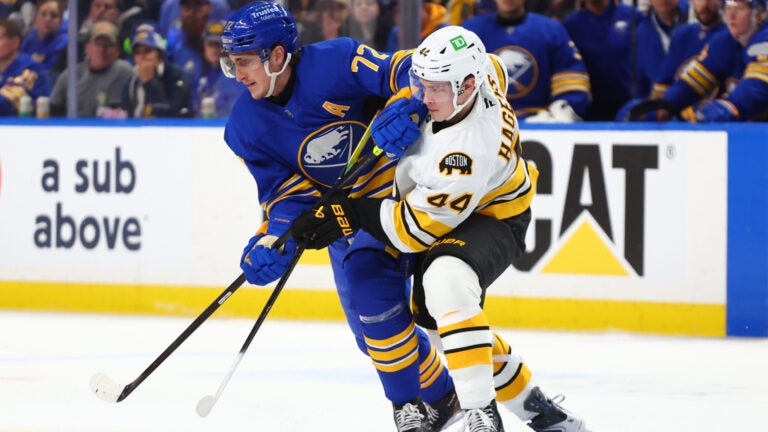
James Hagens has plenty of room to grow entering his first full NHL season in 2026-27. AP Photo/Jeffrey T. Barnes
Don Sweeney and the Bruins’ top brass have plenty of work to do this summer if this roster wants to take another step forward next season amid an increasingly cutthroat Atlantic Division field.
Don Sweeney and the Bruins’ top brass have plenty of work to do this summer if this roster wants to take another step forward next season amid an increasingly cutthroat Atlantic Division field.
As Sweeney and Cam Neely stressed last Wednesday, speed and skill appear to be the top priority for a Boston team that couldn’t keep up with a deeper and faster Sabres club in the playoffs.
Another minutes-eating presence on the blue line is also needed to alleviate the incessant barrage of pucks and Grade-A looks that Jeremy Swayman turned aside throughout the 2025-26 campaign.
But, as Neely candidly admitted at TD Garden, Boston’s efforts toward shifting its label from a retooling team into a burgeoning contender are likely stuck in neutral so long as there’s a glaring vacancy in the middle of Boston’s forward corps.
“We all, in this room, recognize we don’t have a true No. 1 C,” Neely said. “That’s something we want to try to rectify, whether it’s this offseason or those guys growing into it. But it’s something we know that’s needed.”
Finding a franchise center — one capable of driving play atop a top forward line and making his presence felt on special teams — is easier said than done.
It’s an organizational north star that the Bruins have been in pursuit of for years since both Patrice Bergeron and David Krejci hung up their skates in 2023. Boston’s retooling status is largely rooted in the club’s inability to cultivate a sustainable succession plan well before Bergeron and Krejci were on their last legs.
Despite Boston’s hopes of Elias Lindholm being able to replicate at least some of Bergeron’s two-way prowess and scoring punch, the 31-year-old forward has labored in his two years in Boston, with a lingering back injury sapping some of his skating ability.
Lindholm, who ended the year on Boston’s third line, still has five more years left on his deal at $7.75 million per season.
Pavel Zacha, fresh off a career year with 30 goals and 65 points, could function as a versatile and effective second-line center. But it’s likely asking too much for him to drive play on a top-line role, while his struggles in the postseason (two goals in 31 playoff games) do raise some eyebrows.
Boston could try to pool picks, prospects, and other assets into a hefty trade package this summer to try to pluck an established center like Robert Thomas out of St. Louis. But, given the low supply of true elite pivots in the league, the asking price will be exorbitant.
“Even at the trade deadline as you’re exploring, whether it’s this time or the summertime, you realize that when you do make a call about a player of that nature you’ve just described, the guy on the other side says there’s not even 32 of them in the league,” Sweeney said last week when asking about pursuing No. 1 centers via trade.
Trades for distressed assets or players marked with red flags like Elias Pettersson or Mason McTavish could be a potential pivot for Sweeney and his staff if they’re banking on upside and willing to invite even more risk into their roster building.
Still, there’s no guarantee that such a move will result in Boston having a long-term fixture at 1C — and could quickly turn into a disaster if the Bruins are saddled with another burdensome contract, or watch some of their trade chips blossom elsewhere.
Another avenue might require more patience. But, if the Bruins are willing to play the long game, could Boston already have a pair of potential top-line centers already on their roster in Fraser Minten and James Hagens?
Even with the expected growing pains that presented themselves this season for the 21-year-old Minten and 19-year-old Hagens, Neely believes that the upside is there for both young forwards to anchor Boston’s pivot pipeline for the foreseeable future.
“I think they both have that skill set,” Neely said. “They’re both a little different players. One’s more like Bergy as far as a 200-foot player and maybe [doesn’t] see the ice as well as Hagens does.
“Hagens’ head is up all the time, he’s constantly looking to distribute. … Whether they either become number one centers is up to them and how that goes for them and what the path is for them. We want to give these guys every opportunity to take a job that’s staring at them.”
Minten, who played a full 82 games with Boston this season at center, has all the makings of a future middle-six stalwart in a black-and-gold sweater.
Initially projected as more of a two-way, third-line center at the NHL level, Minten spent a hefty portion of this season on a top line next to David Pastrnak and Marat Khusnutdinov.
Ramping up Minten’s reps next season after averaging 15:33 of ice time per game in 2025-26 stands as the next order of business, which likely becomes tenable if Boston carves out a top-six spot for the young forward moving forward.
Minten’s floor as a dependable, 200-foot centerman is already established. If he can grow his offensive game after tallying 17 goals and 35 points in his first full NHL campaign, Boston could have a franchise fixture in place.
“People originally described Fraser as one player,” Sweeney said. “Why put a ceiling there? We’ll see what he’s going to do. I think you described that Bergy necessarily wasn’t described as the Hall of Fame player that he became when he first started out of the gate. But that being said, we’re hoping that every one of those guys hits their high side.”
Hagens offers higher upside in terms of a true, top-line center — capable of carving up defenses and elevating his linemates on every shift.
But, given his age and lack of experience at the NHL’s highest level, it’s unrealistic to expect the seventh pick in the 2025 NHL Draft to immediately thrive as a 70-point stalwart in 2026-27.
As tantalizing as Hagens’ skating, edge work, and playmaking prowess might be, the Bruins are expecting plenty of bumps in the road next season as the Boston College product tries to find his footing in the pros. A start on the wing appears to be still the expected path for Hagens entering a new season before shifting him down the middle.
“James will get a chance in the middle of the ice,” Sweeney said. “The entry point’s a little easier on the wing, as we’ve always talked about.”
The Bruins would welcome any scenario where either Hagens or Minten thrives and eventually seizes a top-line role in Boston, with the other settling into a vital second-line spot.
But, as is the case with every young player, there’s often a wide amount of variance between projected production and profiles — and what actually presents itself over the course of an 82-game season.
And, even if Hagens and Minten both hit their ceiling, it’s certainly not expected to happen as soon as the 2026-27 campaign.
There’s a lot to like about both Hagens and Minten and how they could grow into key players in Boston’s lineup.
But, it remains to be seen if this Bruins’ front office — looking to capitalize on any momentum seized by a brief playoff experience — has the patience needed to let both youngsters grow into those critical roles.
“It sometimes has to be by committee,” Sweeney said of identifying top-line centers. “Hopefully, you grow and you strike oil.”
Conor Ryan is a staff writer covering the Bruins, Celtics, Patriots, and Red Sox for Boston.com, a role he has held since 2023.
Sign up for the Today newsletter
Get everything you need to know to start your day, delivered right to your inbox every morning.