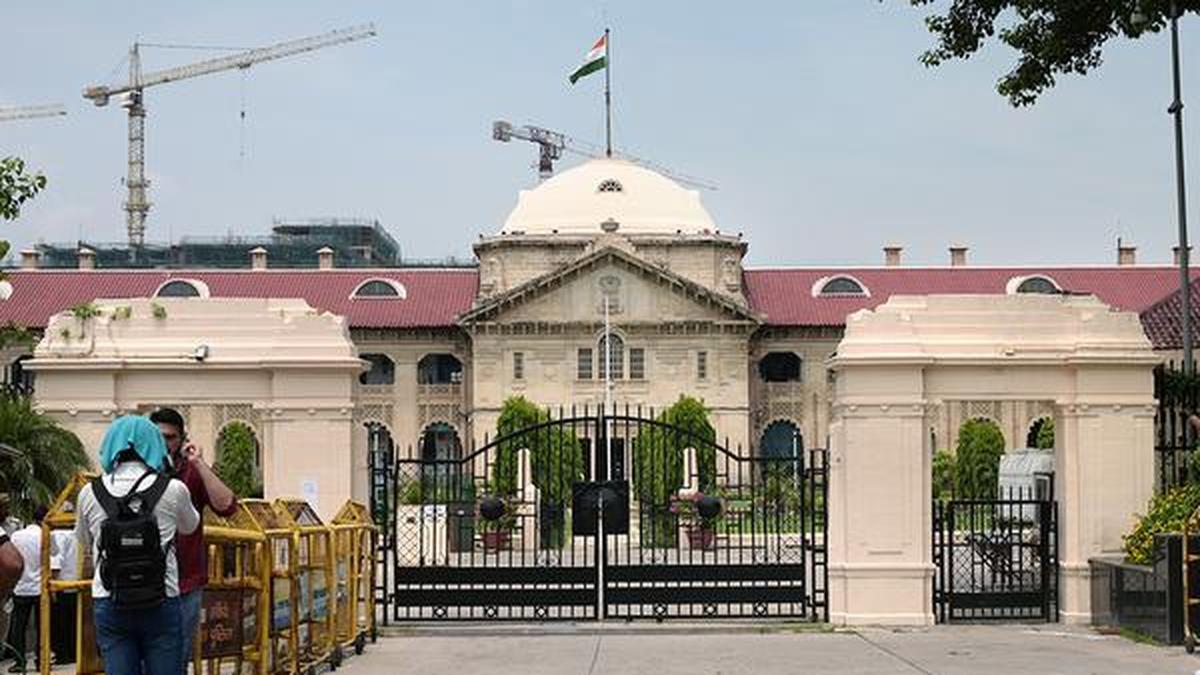
The Allahabad High Court observed that while delayed justice had shaped public perception of courts, the huge pendency of criminal cases was primarily due to failures of the State government and police.
| Photo Credit: The Hindu
Referring to the famous Bollywood film dialogue “Tarikh pe Tarikh” (date after date), the Allahabad High Court recently observed that while delayed justice had shaped public perception of courts, the huge pendency of criminal cases was primarily due to failures of the State government and police, not judicial officers alone.
A Bench of Justice Arun Kumar Deshwal, in its May 7 order, noted that many young and committed judicial officers were unable to function effectively because of severe staff shortage, lack of police cooperation in executing summons and warrants, and delays in forensic reports.
The observations came while hearing a bail plea in a murder case in which investigators failed to seek DNA matching of blood found on a recovered screwdriver. Taking serious note of the lapse, the court had summoned the Director General of Police (DGP), the Principal Secretary (Home), and the Director of the Forensic Science Laboratory (FSL).
During the hearing, the FSL Director informed the court that only eight of Uttar Pradesh’s 12 forensic laboratories had DNA profiling facilities and that the laboratories suffer from shortages of staff and modern equipment. The court was also told that the FSL functioned under the police department, limiting its administrative and financial autonomy.
“….main reason for pendency of cases in district courts is not the capability of the judicial officers but because of shortage of staff, non-execution of court’s process by the police and delay as well as incomplete FSL reports. Therefore, it is the State government as well as police who are mainly responsible for pendency of criminal cases in district courts even then district judiciary is blamed by the social media and other common persons for non disposal of their cases,” court said.
‘Became MPs, MLAs’
Quoting a report by the Association for Democratic Reforms, the court said it was because of taking advantage of the pendency of criminal cases, many criminals kept on repeating the offences again and again without any fear, and even many of them also became MLAs, MPs, and even Ministers.
The Bench also expressed concern over the safety of judicial officers, stating that judges often faced intimidation from criminals and, unlike in Punjab and Haryana, district judges in Uttar Pradesh were not routinely provided personal security officers.
To address systemic shortcomings, the court issued several directions, including filling vacancies in forensic laboratories within a year, upgrading forensic infrastructure, training police personnel in evidence collection, strengthening district court staffing, and considering autonomous status for the FSL under the Home Department.
The DGP, Rajeev Krishna, who was present in the hearing through video conference, was also directed to ensure stricter compliance in executing court processes, mandate DNA matching queries in relevant investigations, and promote digital systems such as e-summons, e-warrants, and AI-based speech-to-text recording of witness statements.
The court ultimately rejected the accused’s bail plea, citing call records, recovery of the blood-stained weapon, and the victim’s e-rickshaw linking him to the crime.
Published – May 11, 2026 08:39 pm IST