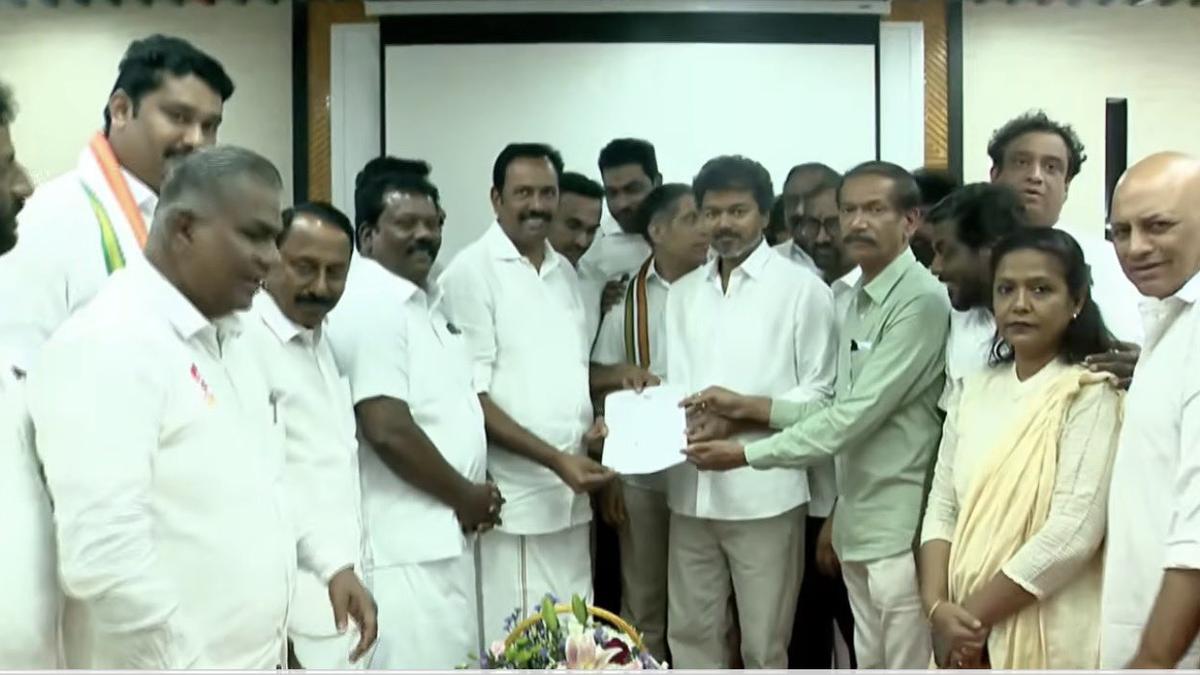
The story so far:
For days after the Tamilaga Vettri Kazhagam (TVK) emerged as the single largest party in the 2026 Assembly elections in Tamil Nadu, Governor Rajendra Arlekar refused to swear in party president C. Joseph Vijay as the new Chief Minister. The Lok Bhavan insisted that Mr. Vijay prove majority by handing over physical letters of support from at least 118 MLAs in the 234-seat Tamil Nadu Legislative Assembly.
What is the role of the Governor in the formation of a new government if there is a hung Assembly following an election?
The Governor appoints the Chief Minister under Article 164 of the Constitution. The Constitution does not provide a settled procedure for a Governor to choose a Chief Minister in a hung Assembly, though constitutional conventions dictate that the Governor’s actions must be guided by sobriety.
The primary objective of the Governor, as a constitutional head of the State, is to ensure the formation of a stable government. To this end, the Sarkaria Commission, the five-member Committee of Governors appointed by the President pursuant to the decision taken at the Conference of Governors held in New Delhi in November 1970, and conventions evolved through successive Supreme Court rulings provide that the personal bona fide or any ipse dixit of Governors is irrelevant.
The Lok Bhavan must proceed legally and explore all possibilities with political parties, groups, and independent MLAs within a reasonable time to maintain the constitutional machinery in the State. Only if all alternatives fail and to avoid any violence to correct constitutional practice should a Governor, as a last resort, initiate the process for the declaration of President’s rule in the State under Article 356 of the Constitution.
The Constitution has not defined the ‘reasonable time’ a Governor could take to explore possibilities for forming a responsible and stable government. But the Governor cannot wait indefinitely and, in the process, lay the field open for horse-trading. In fact, the Supreme Court has interpreted in the B.R. Kapur (2001) and Rameshwar Prasad (2006) judgments that the Governor could dissolve a Legislative Assembly under Article 174(2)(b) even before the first meeting of the State Legislature to avoid a breakdown of the constitutional machinery due to parties’ inability to stake claim to form a meaningful government for want of requisite strength. The Governor cannot be in limbo, being unable to appoint a government or exercise the power of dissolution.
What is the hierarchy or order of preference to extend an invitation to form a government?
The Sarkaria Commission Report of 1988, endorsed by the Supreme Court, has recommended that a Governor should first invite the pre-poll alliance which has won a majority. However, in Tamil Nadu, no such alliance has a clear majority. The next option is to invite the single largest party that could demonstrate majority support.
A nine-judge Bench in the S.R. Bommai judgment (1994) reasoned that the Constitution does not create an obligation that the political party forming the government should necessarily have a majority in the Assembly. “Minority governments are not unknown. What is necessary is that that government should enjoy the confidence of the House,” the Supreme Court said.
The third in the order of preference is a post-poll alliance of parties that can demonstrate a majority in the Assembly. The use of this third option has become more frequent in recent times, with coalition governments becoming the norm. The Court had found nothing wrong in ideologically similar parties engaging in mutually convenient post-poll alliances to cross the Rubicon of the ‘golden majority’ in the House.
If none of these options work, the Governor can recommend President’s rule, although this is an extreme measure. The Court has advised that a “constitutional machinery in the State should, as far as possible, be maintained”. This advice has assumed new relevance in recent years, with Governors seen as using their discretionary powers to recommend President’s rule to “promote the political interests of the party in power at the Centre.”
Has the floor test been a constant, objective means to prove a majority?
Critics have said Governor Arlekar’s insistence on physical letters of support is the sole reason for the deadlock in Tamil Nadu. A writ petition has been filed in the Supreme Court, arguing that the Governor is “duty-bound” to invite Mr. Vijay to form the new government, swear him in, and immediately subject his claim to a trust vote on the floor of the Assembly.
The Committee of Governors had also concluded that the test of confidence in the government should normally be left to a vote in the Assembly.
Though the S.R. Bommai judgment includes a paragraph indicating that a floor test should be confined to testing the strength of an incumbent Chief Minister who is alleged to have lost majority support, and not used in the formation of a new government after elections, successive Supreme Court precedents have nevertheless relied on the floor test as the most objective and transparent way to ascertain majority. These judgments also highlighted that the fate of the electorate’s mandate must not be left to the personal discretion of the Governor.
What are some instances where floor tests rescued the constitutional machinery in States?
Repeated occasions of the Court ordering floor tests to assess a claim to govern, whether by an existing or incoming government, have made it the touchstone for ensuring a stable government. In 2017, the Court declined to stay the swearing-in of the Bharatiya Janata Party’s Manohar Parrikar as Goa Chief Minister at the head of a post-poll alliance, but reduced the 15-day window allowed to him to prove a majority over the Congress, which was the single largest party, and ordered a floor test in 48 hours. Mr. Parrikar won the floor test. The Court intervened in Karnataka the next year after the Governor invited B.S. Yediyurappa to form the government while giving him 15 days to prove a majority. On a challenge by the Congress-Janata Dal (Secular) combine, the Court allowed the swearing-in but cut short the time for the floor test to 24 hours and said it must be conducted on live camera and not by secret ballot. Mr. Yediyurappa resigned before the trust vote.
The Supreme Court has time and again held that the House, and not Raj Bhavan, “is the place where democracy is in action”. That is, the decision on who should govern must not be left to the subjective satisfaction of the Governor but must be objectively determined on the floor of the House.
Published – May 10, 2026 04:16 am IST