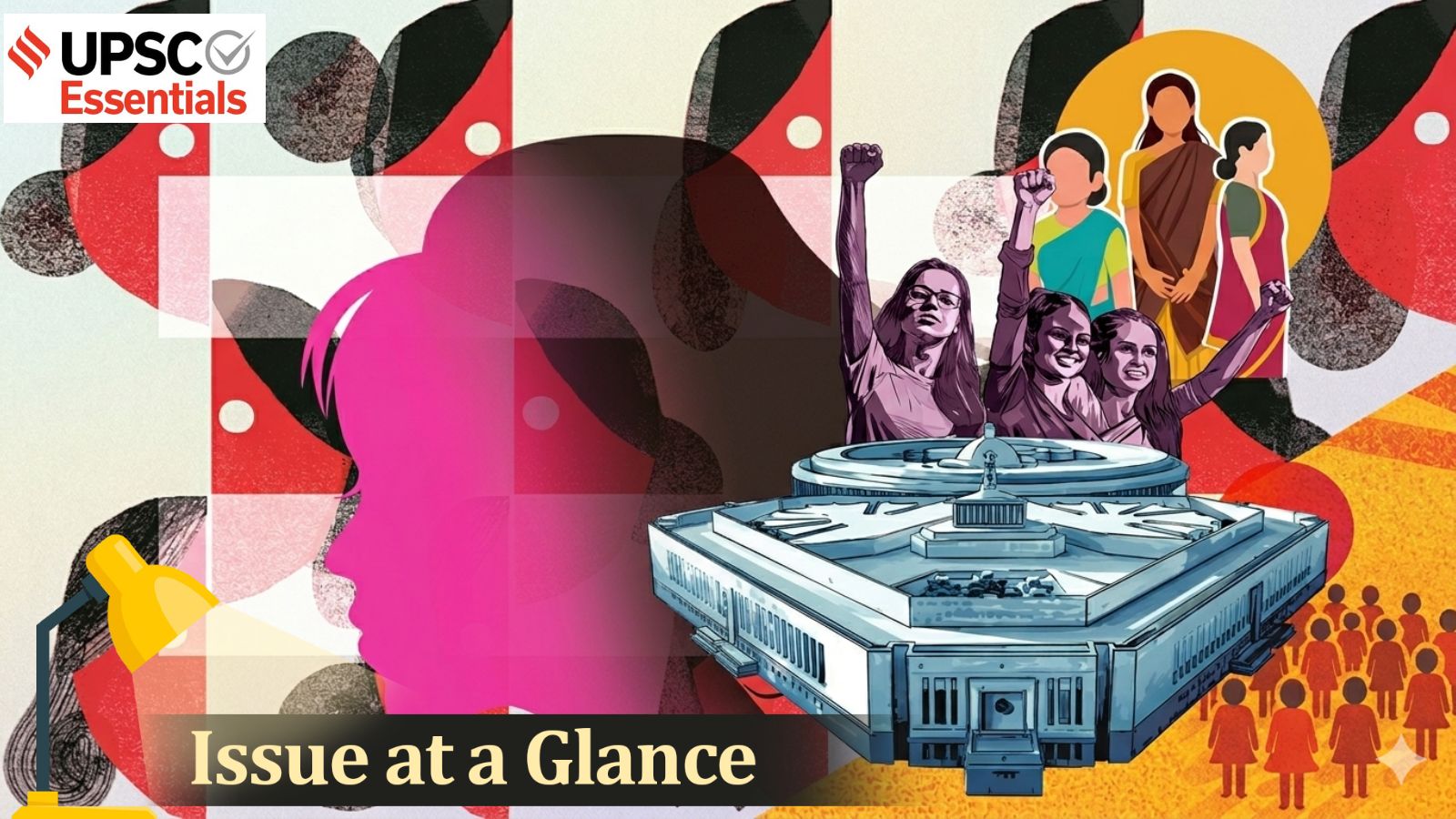
UPSC Issue at a Glance is an initiative by UPSC Essentials aimed at streamlining your UPSC Current Affairs preparation for the prelims and mains examinations by focusing on issues making headlines. In this edition, we cover the issue of Women’s representation and reservation in the legislature from a broader perspective. Let’s get started.
The month of April witnessed significant legislative activity in Parliament. During the recent session, the Lok Sabha took up three key bills for consideration and passage, namely the Constitution (131st Amendment) Bill, 2026, the Delimitation Bill, 2026, and the Union Territories Laws (Amendment) Bill, 2026. However, the Constitution (131st Amendment) Bill, 2026, failed to get 2/3rd majority in the Lok Sabha. Following the defeat, Union Minister for Parliamentary Affairs Kiren Rijiju requested the Speaker not to take up the other two Bills, as they were closely linked to the Amendment Bill.
The Constitutional (131st Amendment) Bill, 2026, sought to increase the strength of the Lok Sabha from 543 to 850 seats, with 815 seats allocated to the states and 35 to the union territories.
The objective of the bill was said to implement one-third reservation for women in the Lok Sabha as well as in the assemblies of states and union territories. The Bill aimed to amend the Nari Shakti Vandan Adhiniyam, 2023, to expedite women’s reservation; a Delimitation Bill to set up a Delimitation Commission based on the latest available population figures; and a Bill to extend women’s reservation to Union Territories with Legislative Assemblies.
Against this backdrop, the developments in Parliament have once again brought the issue of women’s reservation into the spotlight. It is thus essential to understand women’s representation and reservation in India from a broader perspective—cutting through the noise and focusing on clarity.
Question 1: What do the trends show about women’s representation in Parliament?
The demand for increasing women’s representation in Parliament has been part of political and academic discourse for a long time, but the trends show mixed signals. In terms of women’s representation in lower houses of Parliament, India was ranked at 147 out of some 190 countries according to April 2026 data by Parline, a tracker on national parliaments maintained by the Inter-Parliamentary Union (IPU).
Story continues below this ad
An analysis of past numbers shows that in terms of representation, the share of women has rarely breached the 15% mark across legislatures. In Lok Sabha, the Lower House of India’s Parliament, the figure has never exceeded even that. From the first Lok Sabha (1951-52), when there were 24 women MPs out of a total 489 (4.9%), the figure for the incumbent House — the 18th Lok Sabha (2024-29) — stands at 75 out of a total 543 (13.6%).
The highest figure in this regard was in the previous Lok Sabha (2019-24), when women comprised 14.36% — 78 out of 543 — of the House’s membership. On the other hand, India’s lowest figure of 3.5% came during the 6th Lok Sabha (1977-79): the 1977 general election was held right after the Emergency (1975-77) imposed by then Prime Minister Indira Gandhi. Gandhi, India’s first woman PM (and the only one to date), lost that election after 11 years at the helm.
The share of women in Lok Sabha has seen a gradual upward trend over time.
As Chart 1 indicates, the percentage share of women in Lok Sabha has seen a gradual upward trend over time. But it took India 15 general elections to reach a double-digit percentage figure (10.9% in 2009), which underlines the fact that women still have some way to go to reach the 33% mark if reservation is not implemented.
Rajya Sabha, or the Upper House, though not directly elected by the people, presently has 39 women MPs out of a total of 245—about 16%.
Story continues below this ad
Question 2: What was the Constituent Assembly debate on women’s reservation?
The history of legislation regarding women’s reservation in India is complex. Although the idea of women’s reservation is today viewed as a contemporary breakthrough, its inception can be traced back to the debates held in the Constituent Assembly between 1946 and 1950. In these debates, two out of the 15 women who were part of the Assembly argued unrelentingly against the implementation of reservation for women. Surprisingly, the only one in favour was a man: R K Chaudhari.
The women who opposed the idea in Constituent Assembly
During the Constituent Assembly debates, Hansa Mehta and Renuka Ray emerged as prominent voices against the reservation of seats for women. Both were activists for India’s independence, having participated in the non-cooperation and swadeshi movements, besides serving in the All India Women’s Conference — a non-governmental organisation dedicated to promote women’s welfare.
During the debate on December 19, 1946, Mehta expressed her gratitude to Mahatma Gandhi for extending the freedom struggle towards women. Mehta, herself a general category candidate in the 1937 Bombay Legislative Council, insisted that women had never asked for privileges.
Mehta’s reluctance towards the demand for reserved seats, separate electorates, or quotas arguably stemmed from a unitarian spirit that bound the women of the Constituent Assembly.
Story continues below this ad
In 1947, Ranuka Ray echoed Mehta’s argument strongly. She recalled her opposition to the 1935 Government of India Act, which ensured reservation for women in the legislature.
According to her, women should advance by merit — or as she termed “ability” alone — and added that reservation would “impediment to our growth and an insult to our very intelligence and capacity.”
The counter argument
R K Chaudhari offered a distinct perspective. “When a woman asks for something, as we know, it is easy to get it and give it to her,” he said, in the debate held on November 9, 1948. “But when she does not ask for anything in particular it becomes very difficult to find out what she wants.”
He claimed to be speaking from his experience as a “parliamentarian and a man of the world”, his argument based on what he perceived as the everyday callousness in men that enabled a systemic discrimination against women.
Story continues below this ad
He criticised the composition of the Drafting Committee, which, according to him “consisted of people who have no domestic relations with women” and thus showed nervousness regarding the subject. Later, he lamented the death of male chivalry outside of the House, and in the streets of India: “Women generally have lost faith in the chivalry of men. The young men of to-day do not show respect to them even in the trams and buses.”
Ray immediately rebutted Chaudhari’s argument — even as she ironically referred to him as a “champion and defender of women” — and reiterated her stance.
Interestingly, Chaudhari’s argument seemed to arise from the legislature’s inability to transcend the gap between theoretical and practical equality. Chaudhari recognised this gap as a form of “systemic exclusion”, which reservations could help bridge.
In 1949, the Assembly’s women members placed their faith in the idea of merit and formal equality that could be realised through initiatives such as universal adult franchise. Numbers, however, show how a different reality unfolded over time.
Story continues below this ad
Question 3: What has been the legislative journey of women’s reservation in India?
In independent India, the principle of gender equality was enshrined in the Constitution through the Preamble, Fundamental Rights, Fundamental Duties, and Directive Principles of State Policy. The Constitution not only guarantees equality to women but also empowers the state to adopt measures of positive discrimination to address the cumulative social, economic, educational, and political disadvantages they face.
From Preamble to Panchayat
The Foundation 1/3 Reserved Full Arc Global Pledge
CONSTITUTIONAL BACKBONE
The Articles that Protect Women
The Constitution grants women equality before law while empowering the State to create special provisions to counter historical disadvantages in social, economic, and political spheres.
⚖
Article 14 — Equality Before Law
Guarantees equal protection of law for all women without discrimination.
★
Article 15(3) — Positive Discrimination
Empowers the State to make special provisions in favour of women and children.
◆
Article 16 — Equal Opportunity
Ensures equality of opportunity in matters of employment and public office.
●
Article 39(d) — Equal Pay
Directs the State to secure equal pay for equal work for men and women.
→
Article 42 — Maternity Relief
Mandates humane working conditions and maternity relief as a state duty.
LOCAL GOVERNANCE
One-Third of Seats Belong to Women
Articles 243D and 243T guarantee women a minimum one-third share of directly elected seats and Chairperson offices across all Panchayats and Municipalities in India.
1/3
Seats in every Panchayat (Art. 243D)
1/3
Chairperson offices at each Panchayat level
1/3
Seats in every Municipality (Art. 243T)
★
Rotation Across Constituencies
Reserved seats are rotated across different constituencies to ensure wider representation.
◆
SC/ST Women Included
The one-third quota includes seats reserved for women from Scheduled Castes and Scheduled Tribes.
THE FULL ARC
Preamble to Panchayat — A Continuous Promise
India’s constitutional commitment to women flows from its founding ideals in the Preamble — justice, equality, fraternity — through Fundamental Rights, Directive Principles, and Fundamental Duties, all the way down to elected seats in village councils.
FUNDAMENTAL DUTY
Article 51A(e) — Dignity as a Duty
Every citizen is constitutionally bound to renounce practices derogatory to the dignity of women — making gender respect not just a right but a civic obligation.
INTERNATIONAL COMMITMENT
CEDAW — India’s Global Pledge for Women
India ratified the Convention on Elimination of All Forms of Discrimination Against Women (CEDAW) in 1993, binding itself to international standards on women’s equal rights — complementing its domestic constitutional framework.
1993
Year India ratified CEDAW
30+
Years of international gender equality commitment
⚖
What CEDAW Does
Commits India to eliminate all forms of discrimination against women in political, economic, social, and cultural life.
★
Domestic + Global Framework
CEDAW works alongside India’s constitutional provisions to create a dual-layer legal protection for women’s rights.
Sources: Constitution of India · Ministry of Women & Child Development · United Nations CEDAW
However, it did not originally provide for the reservation of seats for women in Parliament and state legislatures. Consequently, several attempts were made to amend the Constitution, with bills introduced in 1996, 1998, 1999, and 2008 to provide such reservation.
The first three bills lapsed with the dissolution of the respective Lok Sabhas. The 2008 bill was introduced in the Rajya Sabha and passed by the Upper House. However, it also lapsed with the dissolution of the 15th Lok Sabha.
In 2021, a public interest litigation was filed before the Supreme Court by the National Federation of Indian Women, seeking the reintroduction of the Women’s Reservation Bill to reserve 33 per cent of seats for women in the Lok Sabha and legislative assemblies.
Story continues below this ad
In 2023, Parliament unanimously passed the Nari Shakti Vandan Adhiniyam (Women’s Reservation Bill, 2023), which later became the Constitution (One Hundred and Sixth Amendment) Act upon receiving presidential assent.
Question 4: What are the key features of the Nari Shakti Vandan Act, 2023?
The Nari Shakti Vandan Adhiniyam is seen as an effort that can enable equitable participation of women. It reflects India’s commitment to Article 15(3) of the Constitution, which allows the state to provide women and children with special legislation and welfare provisions. Key features of the Nari Shakti Vandan Adhiniyam (Constitution (One Hundred and Sixth Amendment) Act are:
1. Reservation for women: The Bill reserves, as nearly as may be, one-third of all seats for women in Lok Sabha, state legislative assemblies, and the Legislative Assembly of the National Capital Territory of Delhi. This will also apply to the seats reserved for SCs and STs in Lok Sabha and states legislatures.
Women’s Reservation — 106th Constitutional Amendment
33% For Women New Articles SC/ST Sub-Quota Delhi Included 15-Year Clause Seat Rotation
THE MANDATE
One-third of all seats reserved for women
The 106th Amendment reserves at least one-third of seats filled by direct election in the Lok Sabha and every State Legislative Assembly for women.
1/3
Of Lok Sabha seats for women
1/3
Of every State Assembly for women
CONSTITUTIONAL CHANGE
Three new articles inserted into the Constitution
The amendment adds Articles 330A, 332A, and 334A to the Constitution, creating an entirely new legal framework for women’s political representation at every level of elected government.
★
Article 330A — Lok Sabha
Reserves one-third of House of the People seats for women, including one-third of SC/ST reserved seats for women from those communities.
⚖
Article 332A — State Assemblies
Mirrors 330A for every State Legislative Assembly — one-third of direct-election seats reserved for women across all states.
◆
Article 334A — Commencement & Duration
Sets out when reservation takes effect (post-census + delimitation), fixes a 15-year duration, and governs seat rotation after each delimitation exercise.
EQUITY WITHIN EQUITY
SC/ST women get a share within existing reserved seats
The amendment ensures women from Scheduled Castes and Scheduled Tribes are not excluded from the new quota. One-third of all SC/ST reserved seats in both Lok Sabha and State Assemblies must go to women from those communities.
◉
One-third of SC seats for SC women
Within the total SC reserved seats in Lok Sabha and State Assemblies, at least one-third must be allocated to women from the Scheduled Castes.
◉
One-third of ST seats for ST women
The same one-third sub-quota applies to Scheduled Tribe reserved seats — ensuring tribal women gain guaranteed political representation.
✓
Counted within overall 1/3 women’s quota
SC/ST women’s reserved seats are included in — not additional to — the overall one-third women’s reservation figure.
TERRITORIAL SCOPE
NCT of Delhi Assembly brought under the mandate
While Delhi is not a full state, its Legislative Assembly is explicitly covered by this amendment via changes to Article 239AA. Delhi women legislators — including SC women — are included under identical one-third reservation rules.
STATES
Covered under new Article 332A — one-third of direct-election seats for women
DELHI (NCT)
Covered under amended Article 239AA — same one-third rule, including SC sub-quota
SUNSET PROVISION
Reservation expires after 15 years — unless extended
Article 334A sets a 15-year limit on the reservation from the date it comes into force. After this period, the provisions lapse unless Parliament legislates to extend them. The exact start date depends on when the post-2023 census is published and delimitation is completed.
⏱
Clock starts after census + delimitation
The 15-year period does not begin on the date of Presidential assent (Sep 28, 2023) — it begins only after the post-2023 census figures are published and a delimitation exercise is completed.
→
Parliament can extend by law
Article 334A(2) empowers Parliament to determine — by legislation — how long seats reserved for women shall continue beyond the initial period.
ROTATION MECHANIC
Reserved seats will rotate after each delimitation
To prevent permanent locking of constituencies, Article 334A(3) mandates that reserved seats for women will rotate across different constituencies after every subsequent delimitation exercise. Parliament will determine the rotation method by law.
↻
Rotation after every delimitation
No constituency stays permanently reserved — seats cycle through different areas of a state or the country after each delimitation round.
⚖
Method decided by Parliament
The specific rotation formula — which seats rotate, in what order, by what criteria — will be determined through future legislation by Parliament.
◆
No mid-term disruption
Existing Houses and Assemblies are not dissolved early. The amendment and rotation rules apply only from the next election after delimitation.
Sources: The Constitution (106th Amendment) Act, 2023 · Gazette of India, Sep 28, 2023 · Ministry of Law and Justice
2. Commencement of reservation: The reservation will be effective after the census conducted after the commencement of this act has been published. Based on the census, delimitation will be undertaken to reserve seats for women. The reservation will be provided for a period of 15 years. However, it shall continue till such date as determined by a law made by Parliament.
Story continues below this ad
3. Rotation of seats: Seats reserved for women will be rotated after each delimitation, as determined by a law made by Parliament.
Although the Women’s Reservation Bill (Nari Shakti Vandan Adhiniyam) was passed in September 2023, it is yet to be implemented. Beyond the question of implementation, a deeper debate persists on the nature and effectiveness of representation itself.
Rituparna Patgiri writes, “While mere representation is not enough, there’s also a need to move beyond distinctions of women’s issues (usually non-political) versus other issues (political ones). This can be made possible by not just increasing the numerical representation of women, but also giving voice to them on diverse issues. This will help make women’s presence in politics an ordinary rather than an extraordinary phenomenon.
Moreover, institutional support in the form of training, mentoring, and leadership development, particularly for first-generation women politicians from socially marginalised backgrounds, remains insufficient. The lack of financial resources, high election campaign costs, and limited access to funding networks further make it harder for women to contest elections equitably.
Politics continues to be considered a male bastion. Deep-rooted gender biases affect intra-party dynamics as well as voter perception. Therefore, if the Women’s Reservation Bill has to bring about meaningful constitutional transformation, then it has to go beyond the mere politics of women’s presence. It requires party-level restructuring and collaboration between political parties.”
Post Read Questions
(1) During the debates of the Constituent Assembly, some members opposed the idea of reservation of seats for women. With reference to this, consider the following:
1. Hansa Mehta
2. Renuka Ray
3. R. K. Chaudhary
Who among the above emerged as prominent voices against the reservation of seats for women?
(a) 1 and 2 only
(b) 2 and 3 only
(c) 3 only
(d) 1, 2 and 3
(2) Which of the following articles of the Constitution of India provides for the reservation of seats for women in the Legislative Assemblies of the States?
(a) Article 331
(b) Article 332
(c) Article 332-A
(d) Article 333
(3) Consider the following:
1. Ammu Swaminathan
2. Begum Qudsia Aizaz Rasul
3. Annie Mascarene
4. Dakshayani Velayudhan
5. Durgabai Deshmukh
6. Matangini Hazra
7. Kanaklata Barua
Which of the above were members of the Constituent Assembly of India?
(a) 1, 2, 3, 4 and 5 only
(b) 1, 2, 4 and 5 only
(c) 3, 4, 6 and 7 only
(d) 1, 2, 3, 5, 6 and 7 only
Prelims Answer Key
1. (a) 2. (c) 3. (a)
(Sources: Women’s representation in Parliament and state assemblies, explained in 4 charts, As Bill on women’s reservation in Houses is defeated, remembering the women who opposed it in Constituent Assembly, Women’s Reservation Bill: Beyond the politics of presence, egazette.gov.in)
Gear up for UPSC Prelims 2026—Practice smarter, revise faster, and succeed with our Special Quiz Magazine. Click Here
🚨 Click Here to read the UPSC Essentials magazine for April 2026. Share your views and suggestions in the comment box or at manas.srivastava@indianexpress.com🚨
Subscribe to our UPSC newsletter. Stay updated with the latest UPSC articles by joining our Telegram channel – Indian Express UPSC Hub, and follow us on Instagram and X.