The controversy over the internal grooming policy of eyewear brand Lenskart has escalated quickly. However, in today’s “reel age”, it shouldn’t be a surprise. Controversies are no longer small. What started as a debate quickly turned to outrage. Boycott Lenskart calls followed. But the incident in Mumbai this week, where a Muslim woman BJP leader barged into a store in Mumbai and started applying a tilak on the staff, is a stark example of how quickly public anger in India can escalate.
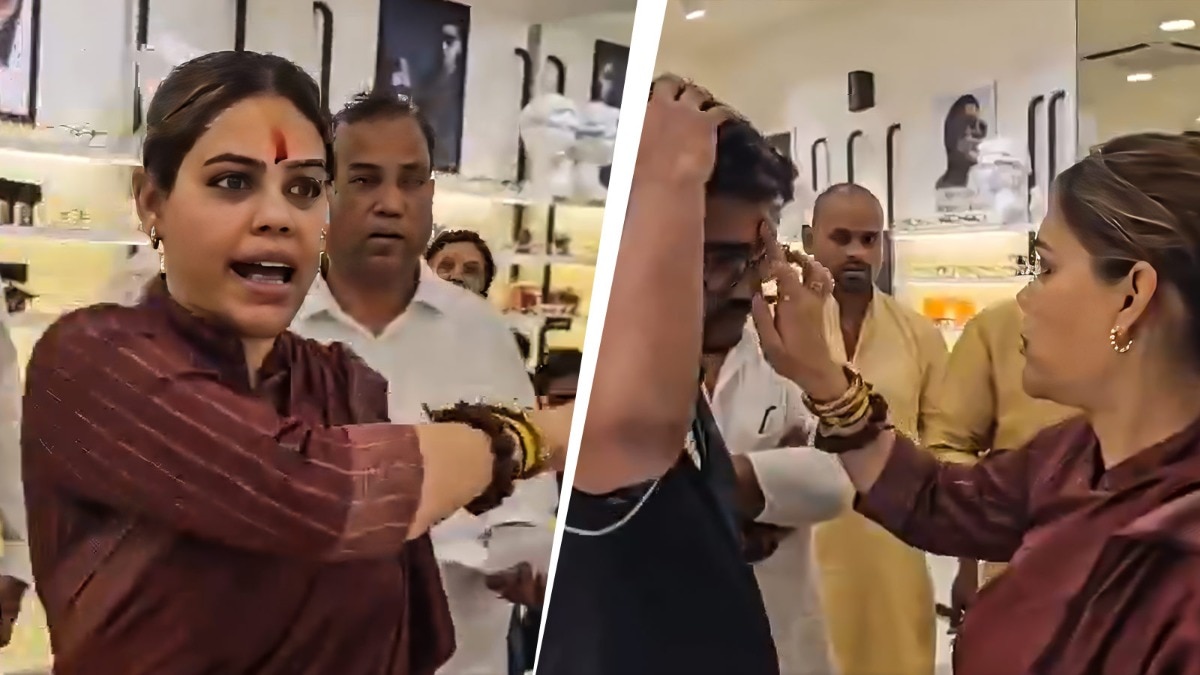
On Monday, the protest became intimidation. Nazia Elahi Khan, who calls herself a BJP minority morcha leader, stormed into a Lenskart store in Mumbai with a camera crew and boldly confronted the store manager, who turned out to be a Muslim, over alleged curbs on bindi, tilak and kalawa (sacred thread worn by Hindus).
“Mohsin Khan ho, isliye band karvaya tilak? (You are Mohsin Khan. Is that why you stopped everyone from wearing tilak?)” Nazia is heard asking in a confrontational tone.
Now, let us not deny the fact that the controversy around Lenskart’s alleged internal “style guide” has struck a nerve. Issues around religious expression – whether it be a tilak or a hijab – are deeply personal in India. Instances of religious insensitivities have often been blown out of proportion.
Remember Fab India’s ‘Jashn-e-Riwaaz’ controversy. Or Tanishq’s 2020 ad that showed a Muslim family organising a baby shower for their Hindu daughter-in-law. In both cases, the companies had to withdraw their ads amid widespread outrage.
But what happened at the Lenskart store in Mumbai reflects a shift from outrage to coercion. It became a performance. And such performances are exactly what gives fuel to the fire. After all, it’s the land of Bollywood.
What was concerning was that employees who had no control over Lenskart’s internal policies were put on the spot. In this case, the store manager, being a Muslim, became a lightning rod.
The intimidation of Mohsin Khan, who was drawn into a confrontation he did not choose, continued. The BJP leader also accused him of forcing the practices of his religion.
“Tum Mohsin Khan toh sabko Mohsin Khan banaoge? Musalmano nai toh Pakistan leliya… Bharat desh me sharia lagu karwana hai kya (If you are Mohsin Khan, you will turn everyone into a Mohsin Khan? Muslims have already snatched Pakistan. You want to implement Sharia law in India?)” Nazia further says.
Matters did not end there. The BJP leader then goes on to call each Hindu staff member one by one and applies a tilak on them.
“Why go after low-level workers instead of finding out who made the grooming document and how it got approved and punishing them? This particular person might be just following orders. Find the big fish,” one user tweeted.
This is the anatomy of modern outrage. Once people latch on to a narrative, it spreads like wildfire, and more often than not, it becomes bigger than it should be. All it takes is a simple recording of a clip on your mobile.
In fact, such a situation was building up. Over the past few days, videos of activists smashing Lenskart eyewear near stores have swamped X and Instagram. Another video showed a person entering a store and dumping his glasses into the dustbin.
The incidents perfectly encapsulate India’s anger issues. We have all seen the road rage incidents that garner headlines frequently now.
So how did the Lenskart row even start?
HOW THE LENSKART CONTROVERSY STARTED?
It began after an undated Lenskart document emerged on social media. Hawk-eyed social media users were quick to point out that it purportedly restricted employees from wearing bindis and a tilak. However, no such guidelines on hijab were found.
It didn’t sit well. Questions started being asked. The controversy deepened when current and former Lenskart employees started sharing their experiences.
A former store manager in Pune said his outlet lost points during the audit because some staff were found wearing kalawa. Another claimed he was sacked after he complained about the grooming policy.
By then, social media did what it does best. People had already taken sides. It didn’t even wait for a clarification from Lenskart or its Shart Tank-fame CEO, Peyush Bansal. When Bansal addressed the issue, calling it an old document rather than an HR policy, it was too late.
Even an apology from Lenskart and a revised guide welcoming symbols of faith, including bindi, tilak, kalawa, kada, hijab, and turban, did little to soothe tempers.
A country on a short fuse refused to be convinced. The Mumbai store incident on Monday showed how little it takes for an issue to spiral and become a confrontation.
Yes, companies must be held accountable in cases of discrimination. People do have the right to question and call out perceived bias. But today’s India is touchier and far less patient. That dilutes the fine line between protest and provocation.
– Ends
Published By:
Abhishek De
Published On:
Apr 21, 2026 12:39 IST
Tune In