Overview:
Recent increase in fuel prices in Haiti has quickly triggered a ripple effect across the capital and beyond, driving up the cost of transportation and essential goods — including drinking water, rice and pasta — for already struggling households.
PORT-AU-PRINCE — Jefferson Bertrand, a senior high school student living on Rue Citron in Delmas 33, was returning from church last Sunday when his mother sent him to buy water. When he arrived at the shop, the vendor informed him that a five-gallon container had increased from 100 to 125 gourdes, roughly 70 cents to 90 cents.
Bertrand had to turn back and return to his mother, who was stunned by the new price.
“One day, they will ask for 250 gourdes just to fill this gallon,” said his mother, sitting in front of a plastic basin as she did her laundry.
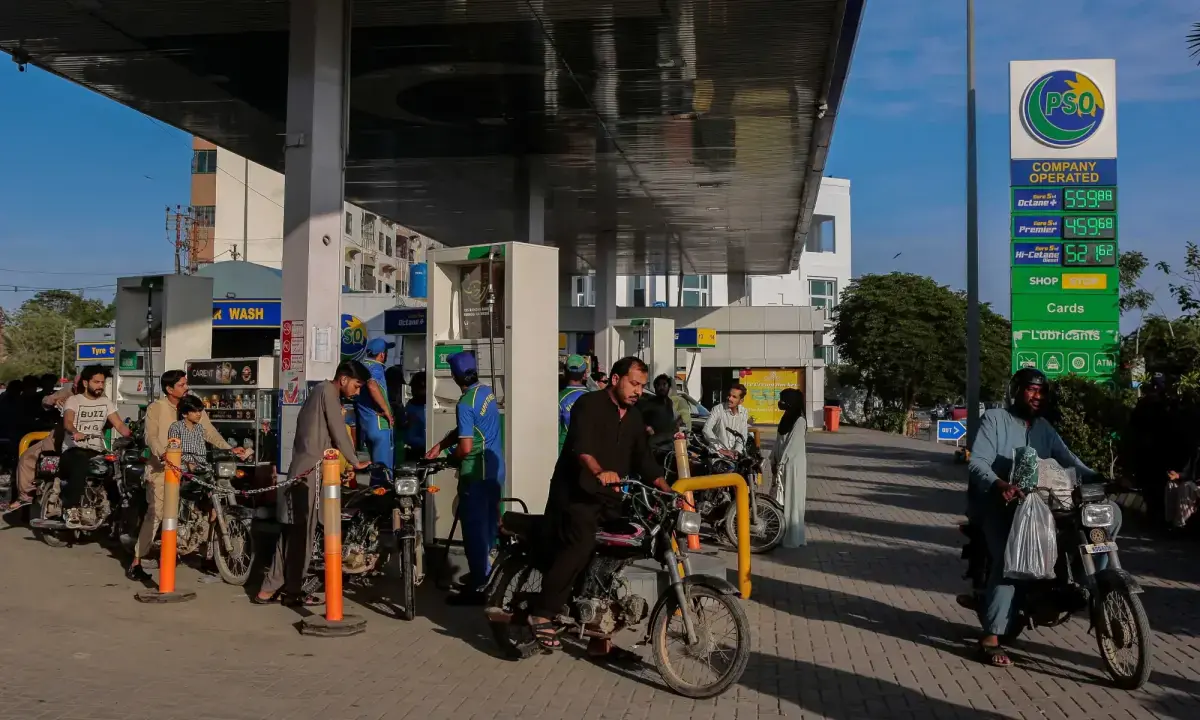
Across the capital and beyond, Haitian households are feeling the impact of the government’s fuel price increase — from public transportation fares to basic necessities in some areas of the country. At the pump, The Haitian Times and locals have seen gasoline is selling at about $5.58 per gallon, diesel has increased to $6.54, while kerosene has risen to $6.50. All in, the new prices are about 30% and 40% higher than when the month began.
Residents said the price hike is worsening the already high cost of living, but they have few options. The new prices on the Haitian market are reportedly the result of rising oil prices due to the war on Iran. With the blockade of the Strait of Hormuz, Haiti is feeling the increase in oil barrel prices on the international market.
For Haiti’s urban households, the higher cost of living is coming even as gang violence continues to disrupt the economy and in the seventh consecutive year of recession – and more than enough reason to protest.
Unanticipated price increases
The new reality is hitting residents of Port-au-Prince, who had expected prices to rise somewhat.
Chantal Vilsaint, a mother of two living in Petite-Place Cazeau, was among those surprised when she went to buy water for bathing and learned prices had gone up.
‘Where is the water you went to buy,’ a neighbor within earshot asked, seeing Vilsaint return home without her five-gallon container.
‘I’m going back to get 10 gourdes more, because a water bucket no longer sells for 25 gourdes but for 35 gourdes,’ Vilsaint replied.
Two passengers in the Delmas 48 area discuss the fare with a motorcycle taxi driver to take them to Pétion-Ville, due to road blockages affecting transportation, on Monday, April 6, 2026. Photo by Juhakenson Blaise / The Haitian Times
A potable water reseller confirmed to The Haitian Times that one of the bulk water supply companies in Haiti’s capital, Pino Eau Nationale, announced that as of April 10, its 1,500-gallon tanker trucks are being sold for about $107. However, this price applies only to sales and deliveries in specific areas, including lower Delmas 60, Caradeux and the Cul-de-Sac plain.
For deliveries from Delmas 60 through Canapé-Vert up to the Kinam Hotel in Pétion-Ville and upper Turgeau, the company has set the price at $111. From Pétion-Ville to Laboule 12, the truck sells for $114, while deliveries to Kenscoff are priced at about $130.
“The reason for this increase is the rise in fuel prices,” Pino Eau Nationale said in a statement announcing the hike. “This has led to higher costs for all essential inputs, forcing the company to raise the price of its 1,500-gallon water trucks.”
With no government guidance, vendors set own prices
Prices vary from one neighborhood to another. While the government sets the fuel price, it has no control over essential goods prices such as food, and merchants have set those based on their own economic constraints.
Rodler Barthélemy, a hairdresser specializing in African braids and locs, explains that rising prices are causing disputes between vendors and consumers in his area of Route de Frère, near Pétion-Ville. Products such as soft drinks, spaghetti and rice have all increased.
“Vendors are complaining; some are even hurling insults, especially as they have to pay for transportation while gangs are also forcing them to pay again for their goods,” said Barthélemy. “We don’t have the words. Even shoeshiners have raised the price of cleaning shoes from 25 gourdes to 50 gourdes in my area.”
A small bag of rice has increased from $15 to $17 and the large bag from $25 to $27, according to Barthélemy. A small pack of spaghetti previously sold for 90 cents now costs more than $1 in some shops. The small box of powdered milk that had dropped to 38 cents gourdes has risen again to 50 cents in some neighborhoods.
Wage demands fueled too
Protests are quickly emerging over the recent days. A Taxi driver demonstration was followed the next day by bus operators. Three-wheel motorcycle riders in the capital and factory workers have also stepped forward to demand an increase in the minimum wage, which is around $5 in the manufacturing sector.
Monday, workers launched a three-day strike. Refusing to work, several dozen workers marched along the airport road in Port-au-Prince to demand a $20 minimum wage and better working conditions.
“Alix Didier Fils-Aimé has increased the price of gas, but our salaries have not been adjusted,” said unionist Télémaque Pierre during the protest.
“A worker who lives in Croix-des-Bouquets and comes to work at Trois Mains factories, near the airport road, spends on average 500 gourdes on transportation alone. What could he possibly eat with 185 gourdes?”
Dozens of workers from SONAPI textile factories demonstrated on the airport road, near Toussaint Louverture International Airport, demanding an increase in the minimum wage in response to rising fuel prices in Port-au-Prince on April 15, 2026. Photo by Juhakenson Blaise / The Haitian Times.
Meanwhile, in Haiti’s Sud department, the situation remains particularly difficult for residents, as confirmed to The Haitian Times by a representative of the Ministry of Sports in the region. Local authorities were in discussions with fuel station owners in the region, and have set prices even higher than those set by the central government, led by Prime Minister Alix Didier Fils-Aimé.
Gasoline is being sold at about $6, diesel at $7 and kerosene at around $6.50. Fuel stations justify these increases by citing additional costs linked to insecurity, including payments demanded by gangs for the passage of fuel trucks, as well as shipping fees required to transport fuel to the southern region.
Berlus Samson, a resident of the city of Les Cayes, questions the usefulness of the Port of Saint-Louis-du-Sud if it cannot bring fuel into the region. Fuel must pay a fee to travel along roads controlled by gangs, then pay for transport by boat to reach Miragoâne before finally arriving in the South Department.
James Lamarre said overall the fuel resellers, who use it as a pretext to set product prices as they wish, seem to benefit.
“From what I’ve learned, it’s only cement that’s being unloaded there,” said Lamarre. “And that hasn’t stopped a sack of cement from being sold at 1,500 gourdes in the city of Les Cayes.”
Like this:
Loading…