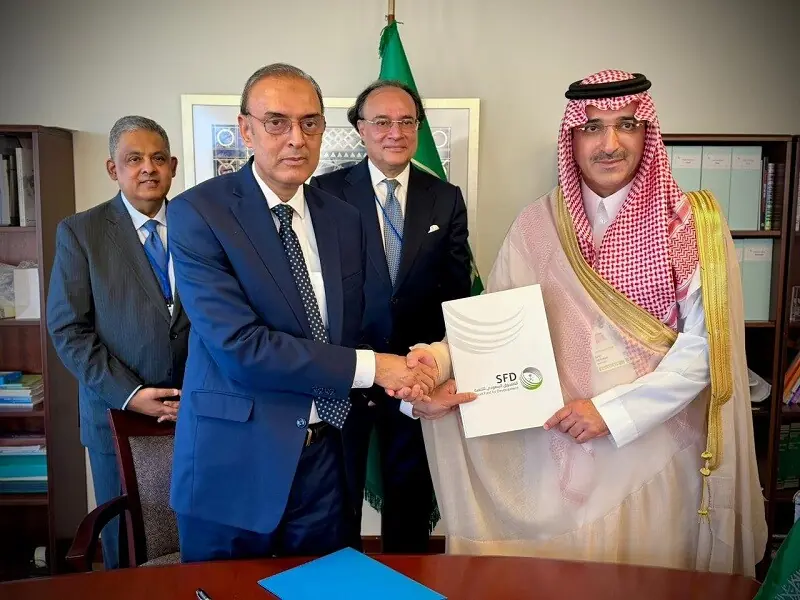
Pakistan and Saudi Arabia on Friday signed an agreement to extend a $3 billion deposit from the Saudi Fund for Development (SFD).
Saudi Arabia, earlier this week, pledged an additional $3 billion in deposits for Pakistan and extended its existing $5bn facility for a further three years.
“The agreement, signed between the Saudi Fund for Development (SFD) and the State Bank of Pakistan (SBP), provides for the extension in the maturity of a USD 3 billion deposit placed by SFD with the State Bank of Pakistan,” said a post on X by the Ministry of Finance.
The ministry said that the agreement was signed between SBP Governor Jameel Ahmed and Chief Executive Officer of the SFD Sultan bin Abdulrahman Al-Marshad.
Minister for Finance and Muhammad Aurangzeb witnessed the signing of an important financial agreement in Washington, D.C., in the presence of Pakistan’s ambassador to the United States.
The development took place on the sidelines of the World Bank-IMF Spring Meetings 2026.
The ministry added that the extension of the deposit reflects “strong and longstanding economic partnership between Pakistan and the Kingdom of Saudi Arabia” and will support the country’s external sector stability.
On Thursday, the Saudi Press Agency also reported that Saudi Arabia had extended the $5bn deposit with the central bank and announced an “additional $3bn deposit”.
“This assistance aims at supporting Pakistan’s economy and strengthening its resilience amidst evolving global economic challenges, and comes in accordance with the leadership’s directives to strengthen the bonds of brotherhood between the two countries, affirming the kingdom’s commitment to fostering the economic growth of Pakistan, which is expected to reflect positively on the living conditions of Pakistani citizens,” it said.
Pakistan will reportedly return a $3.5bn loan to the UAE this month, putting pressure on its reserves and risking breaches of its International Monetary Fund (IMF) programme targets.
The development comes at a sensitive time for the country’s external account position, which is already under strain from rising global oil prices and economic spillovers linked to tensions in the Middle East.
According to official figures, Pakistan’s foreign exchange reserves stood at $16.4bn as of March 27, sufficient to cover close to three months of imports. However, the repayment requirement from the UAE has added fresh pressure on the country’s external buffers.
In March, Islamabad failed to secure an agreement with the UAE to roll over the $3.5bn facility, marking the first such failure in seven years and raising concerns about near-term financing gaps.
Pakistan’s foreign exchange position, though under pressure, remains part of a broader stabilisation effort under IMF-supported reforms.
Analysts say external financing risks remain a key vulnerability, particularly amid volatile energy prices and constrained global capital markets.