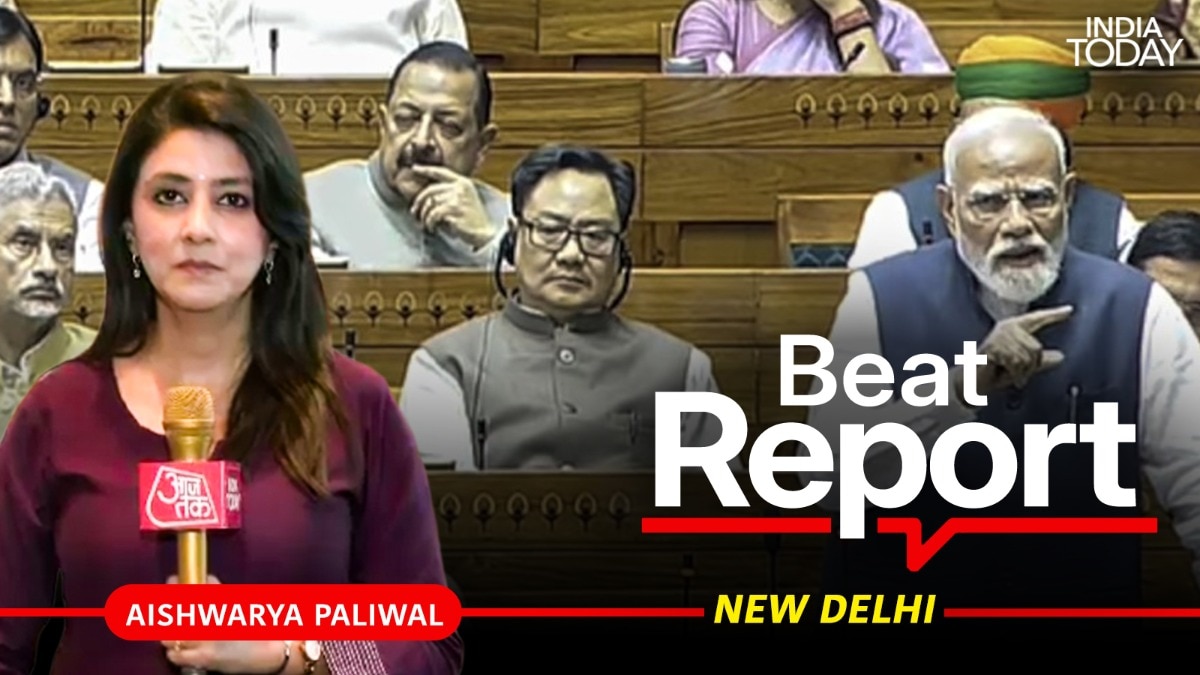
Inside the Lok Sabha on Thursday afternoon, politics wasn’t just spoken. It was performed, in words, in silences, and in everything in between.
As a political reporter, it was striking to see both Prime Minister Narendra Modi and Priyanka Gandhi Vadra wearing blue on the opening day of the debate on the Women’s Reservation Bill.
Prime Minister Modi was scheduled to address the House on amendments to the bill. I reached the visitors’ gallery at 2:40 pm, a full 20 minutes before he was to rise. Even before the speech began, the atmosphere hinted at careful planning.
Across the four public galleries, one detail stood out: a visible, deliberate presence of women. In one section, a group dressed in traditional Bengali attire filled the space. The political messaging was hard to miss, especially with West Bengal heading into elections. The optics were not subtle; they were strategic.
THE ARRIVALS: A STAGE FILLS UP
The Lok Sabha felt like a cricket match, with both sides — the Opposition and the ruling party — fielding their strongest players. At 2:48 pm, Priyanka Gandhi Vadra walked in, draped in a dark blue sari. A minute later, Finance Minister Nirmala Sitharaman entered and took her seat in the front rows. Soon after, actor-turned-MP Kangana Ranaut arrived in a pink sari, adding to the growing presence of key figures.
At 2:52 pm, Home Minister Amit Shah entered in a crisp light blue kurta. Within moments, BJP MP Nishikant Dubey approached him. The two exchanged a few words and notes. By 2:55 pm, Defence Minister Rajnath Singh had taken his seat next to Shah, completing the front row of the government’s top leadership.
THE OPPOSITION: PREPARATION AND ABSENCE
On the Congress benches, Priyanka Gandhi appeared laser-focused. Pen in hand, notepad ready, she looked less like a politician and more like an attentive and observant student preparing for an exam. At 2:57 pm, KC Venugopal briefly conferred with her.
Across the aisle, however, the Opposition benches told a mixed story. While the Congress had a visible presence, key figures such as Rahul Gandhi, Akhilesh Yadav and Asaduddin Owaisi were notably absent at that point.
At 2:58 pm, Prime Minister Modi entered the Lok Sabha, accompanied by ministers including Kiren Rijiju, Jitendra Singh and Arjun Ram Meghwal. As he stepped in, slogans of ‘Bharat Mata ki Jai’ echoed through the House. The treasury benches were vocal; the Opposition largely watched in silence.
EARLY MOMENTS: DISTRACTIONS AND ENTRY WAVES
Even before the speech began, disruptions surfaced. As Hardeep Singh Puri entered around 3 pm, Congress MP Varsha Gaikwad raised slogans referencing Epstein, a moment the BJP benches chose to ignore. Prime Minister Modi began speaking at 3:02 pm.
Soon after, at 3:05 pm, Akhilesh Yadav entered with his MPs, followed by Awadhesh Prasad. At 3:07 pm, Dimple Yadav also took her seat.
NOTES, NODS AND POLITICAL SIGNALS
Six minutes into the speech, at 3:08 pm, Priyanka Gandhi began jotting down points, reacting in real time to the Prime Minister’s remarks. The pattern continued throughout: listen, note, prepare.
PM Modi opened on a lighter note, taking a subtle swipe at the Congress while referring to consultations with political parties. His gaze briefly shifted toward the Opposition benches as he spoke; Priyanka Gandhi promptly noted the remark. For a political observer, such small gestures like a glance, a note, a pause often reveal more than words.
THE DEBATE HEATS UP: OBC FLASHPOINT
At 3:16 pm, Samajwadi Party MPs, led by Akhilesh Yadav and Dharmendra Yadav, stood up to raise concerns about OBC representation. The Prime Minister seized the moment, identifying himself as an OBC and turning the argument into a political counterpoint.
Akhilesh Yadav responded at 3:19 pm, acknowledging the statement but pressing for fair treatment of OBCs. It was a brief exchange that injected energy into the debate.
RAHUL GANDHI’S ENTRY AND OPPOSITION SIGNALS
At 3:20 pm, Rahul Gandhi finally entered the House. As he walked past Priyanka Gandhi, he tapped her shoulder — a small gesture between siblings that stood out.
Moments later, he signalled to Akhilesh Yadav with a thumbs-up; Akhilesh responded with folded hands. It was brief but telling sign of Opposition coordination.
SPARSE BENCHES AND SPONTANEOUS MOMENTS
The Trinamool Congress benches remained largely empty, with leaders such as Mahua Moitra absent.
At 3:29 pm, Kalyan Banerjee suddenly stood up to speak. His microphone was not active, but the Prime Minister, in a lighter vein, remarked that he should be allowed to speak — a subtle jab with a political undertone.
A STATESMAN’S OFFER: CREDIT AND CONSENSUS
As the debate turned to credit-taking, PM Modi struck a conciliatory tone. He offered the Opposition full credit for the Women’s Reservation Bill, even suggesting government-funded advertisements featuring leaders chosen by them.
It was a calculated move, blending magnanimity with political messaging. The underlying message was clear: consensus over conflict, at least in framing.
STRATEGY HUDDLES AND FINAL MOMENTS
As the speech progressed, Congress leaders Rahul Gandhi, KC Venugopal and Manickam Tagore gathered to discuss their next steps. Priyanka Gandhi, however, remained focused, continuing her note-taking.
After 37 minutes, at 3:39 pm, the Prime Minister concluded on a lighter note, thanking members for the “kala tika” — a reference to DMK MPs wearing black.
AFTER THE SPEECH: QUIET STRATEGY CONTINUES
Once the Prime Minister finished, attention shifted back to the Opposition benches. Rahul Gandhi, Priyanka Gandhi, KC Venugopal and Manickam Tagore formed a tight huddle, deep in discussion. Their focus had already moved to the next phase — strategy, response and Priyanka Gandhi’s upcoming speech.
Soon after, the four leaders walked out together, their conversation continuing beyond the floor of the House.
A PERFORMANCE BEYOND WORDS
What unfolded in those 37 minutes was more than a speech. It was a layered political moment — marked by optics, timing, sharp exchanges and subtle gestures. From carefully curated galleries to spontaneous rebuttals, from silent note-taking to visible coordination, every element contributed to a broader narrative.
– Ends
Published By:
Devika Bhattacharya
Published On:
Apr 16, 2026 21:14 IST