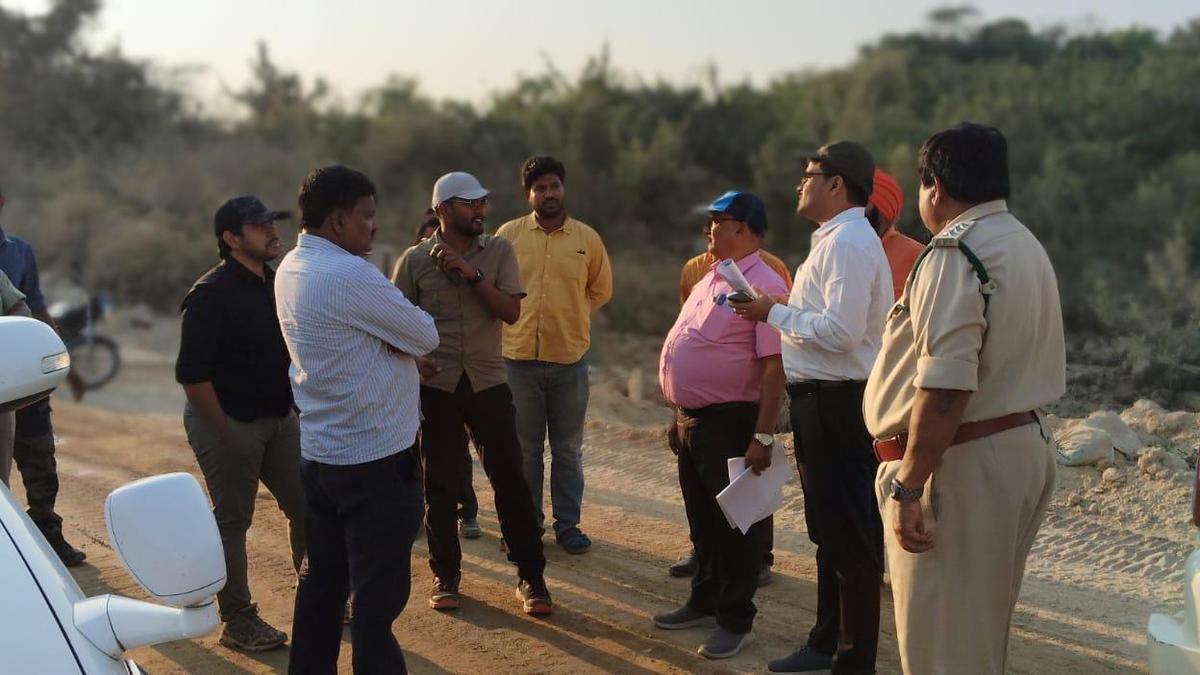
A team of forest and NHAI officials inspecting an elephant pass along the Chennai-Bengaluru Expressway near Palamaner in Chittoor district on Saturday.
| Photo Credit: BY ARRANGEMENT
Wildlife experts and senior forest officials on Saturday (March 28, 2026) launched the first round of inspections of mitigation measures along the forest stretch of the Bengaluru–Chennai Expressway, which passes through the Koundinya wildlife sanctuary zone in Chittoor district. The initiative primarily focuses on safeguarding elephant movement and ensuring regulatory compliance. The Expressway is tentatively scheduled to open to the public soon.
Divisional Forest Officer (Chittoor) G. Subburaj, Sub-Divisional Forest Officer C. Venugopal, Forest Range Officer (Palamaner) R. Narayana, and noted wildlife expert Rakesh Kalava, along with senior officials of the National Highways Authority of India (NHAI), were part of the inspection team.
The team reviewed the mitigation measures proposed by the Forest Department and approved by the Standing Committee of the National Board for Wildlife (SC-NBWL), which include provisions for safe and unobstructed movement of the wildlife species, particularly the elephants.
DFO Subburaj said that among the key features is the construction of dedicated underpasses covering a total of 3,475 metres, including a continuous stretch of about 1,400 metres with a minimum vertical clearance of eight metres. “These are intended to allow elephants and other wildlife to move across the expressway without disturbance,” he said.
The stretch falls within an important ecological corridor linking the Koundinya Elephant Reserve with the Sri Venkateswara National Park (SVNP). It forms part of a larger transboundary habitat used by migratory elephant herds moving between Andhra Pradesh, Tamil Nadu, and Karnataka. Disruption of this corridor in the past has led to increased human-elephant conflict, crop damage, and accidental deaths, Mr. Subburaj said.
The inspection team stated that well-designed mitigation structures, along with measures such as solar-powered fencing, signage, speed regulation, and habitat restoration, are necessary to strike a balance between infrastructure development and conservation. “We insist on strict adherence to environmental clearances and regular monitoring,” the DFO said.
“The initiative will greatly reduce wildlife deaths, maintain ecological connectivity, and serve as a model for integrating conservation safeguards into large infrastructure projects across the country,” wildlife expert Rakesh said.
Published – March 28, 2026 07:33 pm IST