Boston Legacy FC
Players, coaches, analysts, and fans have different ideas, but the common refrain among stakeholders is that this is the year to build a foundation for the future.
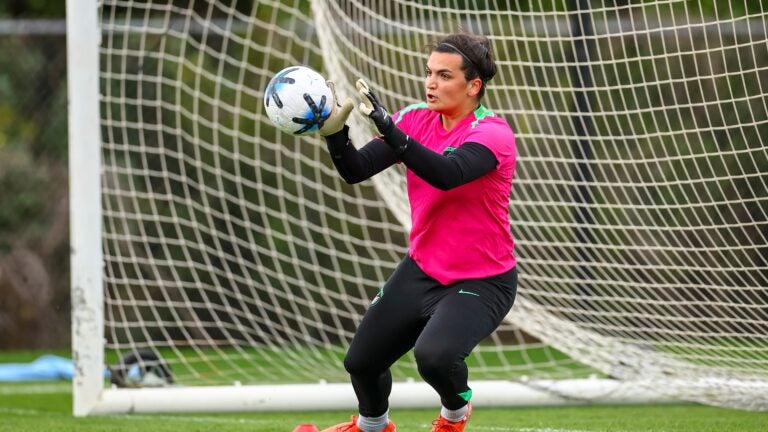
“We could lose every single game or we could win every single game, but as long as we’re doing the process right, we’re developing, and we’re getting better every single step of the way, we’re doing it right,” said Legacy goalkeeper Laurel Ivory, a fifth-year NWSL veteran. Will Vragovic for the Boston Globe
If history is any indication, it’s unlikely the duck boats will roll down Boylston Street for Boston Legacy FC this fall.
NWSL expansion teams have finished at or near the bottom of the table in their inaugural seasons — with only a few exceptions — and it’s difficult to accurately forecast the Legacy’s performance, as the roster is packed with international players whose numbers from past seasons don’t translate directly to the NWSL.
So, what does success look like for Boston Legacy FC in Year 1?
Players, coaches, league executives, analysts, and fans have different ideas, but the common refrain among stakeholders is that this is the year to build a foundation for the future.
Coach Filipa Patão and general manager Domè Guasch have said repeatedly over the past few months that success means being competitive — not necessarily winning every game, but approaching every game believing they can.
“We could lose every single game or we could win every single game, but as long as we’re doing the process right, we’re developing, and we’re getting better every single step of the way, we’re doing it right,” said goalkeeper Laurel Ivory, a fifth-year NWSL veteran.
Though winning championships is the standard in Boston, playoff performance is an unrealistic measuring stick for the Legacy in Year 1.
Take the Houston Dash, for example. The league’s first expansion team, Houston joined the NWSL in 2014 and didn’t qualify for the postseason until 2022 (though it won the NWSL Challenge Cup in 2020).
Only two expansion teams in league history — San Diego in 2022 and Bay FC in 2024 — have made the playoffs in their first season, and neither made it past the semifinals.
It’s unlikely that any future expansion team will replicate San Diego’s stunning debut season.
Led by longtime US national team superstar Alex Morgan, who requested a trade from Orlando to be closer to her southern California hometown, the Wave went 10-6-6 and finished third in the league standings.
They earned a spot in the playoffs, where they beat Chicago in the quarterfinals, before falling to eventual champion Portland.
Bay FC came somewhat close to that level of success in its first year, earning a seventh-place finish and a playoff spot with an 11-1-14 record, but San Diego’s first year stands alone.
Replicating San Diego’s first-year statistical success became even more difficult for expansion teams after the 2024 season, when a new collective bargaining agreement abolished expansion and college entry drafts.
As a result, Boston and fellow expansion club Denver Summit FC built their inaugural rosters by signing free agents, and it’s much harder to attract top talent as a fledgling club than as an established one.
The sooner an expansion club can build a culture and identity on and off the field, the sooner that will translate to winning games, said former NWSL star and current CBS Sports analyst Lori Lindsey.
“We’ve seen [it] has historically taken some expansion teams some time to adjust and get that out, which totally makes sense,” Lindsey said. “But I think as the league grows, the sooner you can do that, then you attract the exact players that you want quicker. Add then it’s easier to grow into that identity and become successful on the field more quickly.”
One other way to quantify Year 1 success could be attendance and fan commitment.
The single-game attendance record for an expansion club in its first year is 32,000, set by San Diego in the penultimate game of the 2024 regular season at Snapdragon Stadium.
Boston could come close to that figure in Saturday’s opener, as the team announced it has eclipsed 25,000 tickets for the inaugural game at Gillette Stadium.
But Denver is set to blow the NWSL attendance record — not just the expansion team record — out of the water.
A whopping 40,091 fans watched Bay FC host Washington at Oracle Park last season, and NWSL commissioner Jessica Berman announced this past week the Summit had sold more than 50,000 tickets for their inaugural home opener at Denver’s Empower Field at Mile High on March 28.
But Year 1 success is not just about attendance at the first game; it’s about sustained interest over a long season.
The Legacy have 3,800 full-season ticket-holders — a figure that doesn’t include partial-season packages, which many fans preferred because the team will play half of its home games at Gillette Stadium and half at Centreville Bank Stadium in Pawtucket, R.I.
The projected capacity of White Stadium, the Legacy’s future home, is 10,000, meaning it is possible it will be half-full of season ticket-holders when the team begins play there in 2027.
“They’ve already shown that their foundation is becoming successful because of how many tickets are already sold for the games,” said former NWSL star and current ESPN analyst Ali Krieger. “That, in itself, shows that there is support, there is passion, there is interest, and there’s investment in both of these cities, and I think that, so far, is really successful.”
Get the latest Boston sports news
Receive updates on your favorite Boston teams, straight from our newsroom to your inbox.