

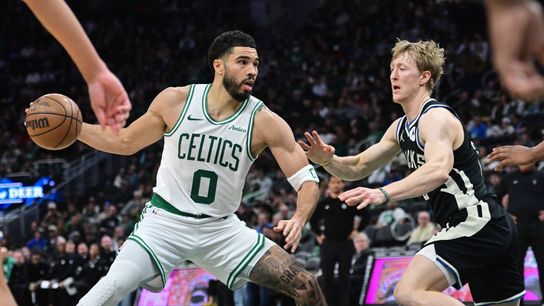
Much to Giannis Antetokounmpo’s dismay, the Milwaukee Bucks are playing for Ping-Pong balls right now. So, when the Boston Celtics walked into Fiserv Forum on Friday night, they got the game many expected.
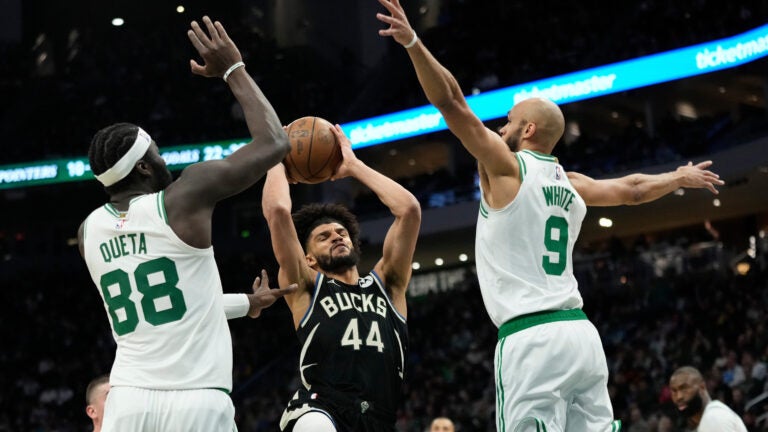
It was a complete blowout in the Celtics’ favor, as they picked up a 133-101 win over the Pete Nance-led Bucks. From the moment the game started, it was an absolute slaughter in Milwaukee.
But just because Boston didn’t play the highest possible level of competition doesn’t mean nothing can be taken from the game.
So, what are those takeaways?
1. The Tatum-Brown connection
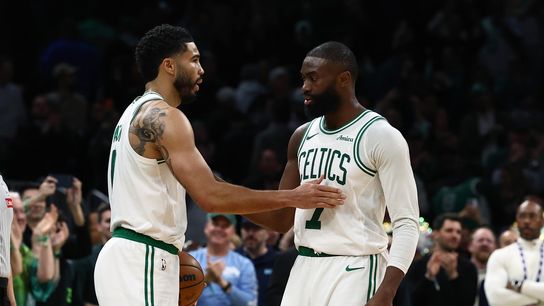
As the days (and games) have gone on, Jayson Tatum and Jaylen Brown have slowly gotten more and more comfortable together. Not just as two players coexisting and thriving in the same lineup, but as partners on the court.
One of the most intriguing actions the Celtics ran against Milwaukee was when they had Tatum screen for Brown.
In the first quarter, Tatum screened for Brown, and the Bucks’ defense was thrown into a state of disarray. Ousmane Dieng switched onto Brown because Milwaukee didn’t want to give him space. But then, Kyle Kuzma was late getting through the Neemias Queta screen.
Myles Turner had to step up to stop Tatum, and by then, Tatum had an opening for a dump-in pass to Queta, who scored in the paint.
The Bucks’ desire to stop both Tatum and Brown eventually led to them giving up a bucket. And when you put both Celtics stars in the action, the pressure intensifies even more.
Boston ran the same play in the third quarter, and the Bucks switched up their coverage. But it still worked out for the Celtics.
Milwaukee switched more quickly, but since that left Brown with a one-on-one matchup, the Tatum-Queta off-ball screen still forced Turner to take his attention away from the paint.
He went to cover the potential pass to Tatum, so Brown attacked and drew free throws inside.
The more the Celtics can exploit the immense on-court gravity of Tatum and Brown, the better.
In years past, zone defense would burst the Celtics’ bubble. Their offense would crumble, they would turn the ball over, and their opponent would benefit from transition opportunities. This was particularly true in past playoff series against the Miami Heat.
But when the Bucks tried to run zone on Friday night, the Celtics were a well-oiled machine.
Here, Milwaukee goes to a 2-3 zone. Jericho Sims is in the middle, with Taurean Prince and Dieng in the corners. Cormac Ryan and Gary Harris are up top.
Look at the way the Celtics load up at the top of the key.
If Tatum takes Luka Garza’s screen, Boston will get a three-on-two on the left side of the floor, because Baylor Scheierman and Derrick White are spaced on that side.
But instead, Tatum rejects the screen, catching Harris out of position. That gives him infinite space to work in the middle of the floor. Milwaukee immediately collapses, so Tatum kicks the ball out to White.
From there, all White has to do is drive the closeout. He gets an easy floater because Sims is still trying to guard Tatum and Garza in the paint.
Just one possession later, the Bucks are still in zone, and Boston finds a different way to break it down.
Tatum goes to the middle of the floor, draws in Sims, and then goes back up to the top of the key, where he receives a pass from Payton Pritchard. But since Sims needs to drop back into the paint, the Bucks end up in a compromised position.
Harris helps over onto Tatum, but that leaves Pritchard open. So Tatum swings it to him, forcing Prince to help. From then on, the Bucks scramble, and the Celtics make two more quick passes, finding White for an open triple.
3. The Tatum-Queta connection
Pairing Tatum and Brown together — with Tatum as the screener — has worked well for Boston. But the Tatum-Queta connection may be even stronger.
Queta has enjoyed a breakout campaign this season, and now that Tatum is back on the floor, he’s been getting even more quality looks around the basket.
On this play, Queta goes to screen for Tatum, but as soon as AJ Green reacts, Tatum rejects the screen. This gives him a clear driving lane into Turner, who is forced to step up.
Tatum makes the read and dumps the ball to Queta, who gets a nice look over the smaller Green.
Here, it was Tatum who benefited from the play.
Turner is in drop defense, so Queta sticks the screen. Kyle Kuzma couldn’t get around it, and Tatum gets a wide-open top-of-the-key three, which he gets fouled on.
Then, on this play, Queta realizes that the Bucks have both defenders above the 3-point line, likely in an attempt to pressure Tatum. So, rather than setting the screen, he immediately slips it.
Nance tries to recover in time, but he’s too late. Tatum feeds a pinpoint pass in to Queta, who throws down a one-handed slam.
And on this one, Queta doesn’t even have to do anything.
Ryan makes the mistake of clapping at Tatum after making him lose the ball for a moment. After one quick bump, Tatum drives right past the Bucks defender, and as soon as Turner shows help, he dumps a pass to Queta for an easy two-handed dunk under the rim.
The Tatum-Queta link-up has been a sight to behold since Tatum’s return.
Though the Celtics cruised to a 32-point victory in Milwaukee, there were some brief signs of carryover concern from their win over the Miami Heat on Wednesday.
At the end of the third quarter in Miami, transition threes allowed the Heat a small window to make a comeback (which they didn’t end up taking advantage of).
The Bucks had some of those chances on Friday night. Boston was simply late to close out, or they were on their back foot to the point where they were unable to take away the shot.
In the scramble of getting back in transition, it can often be difficult to locate every opposing player.
And sometimes, even when it’s not a transition opportunity, the long-range threat of a good 3-point shooter can cause a mad dash.
Though these plays aren’t completely avoidable at all times, they are a perfect way for opponents to mount a comeback. They are the exact type of momentum-shifting opportunities Boston needs to look to avoid at all costs.
On the flip side, when the Celtics manage to get a stop on defense, transition threes have a chance to be their greatest weapon. Sam Hauser learned that on Friday night because, somehow, he was the guy Milwaukee forgot to account for.
6. Boston’s interior defense
This year’s Celtics play defense differently than the Celtics of old.
Rather than playing largely individual defense and trying to take away threes, Boston protects the paint at all costs this season. They’ll give up strategic threes to shooters they don’t deem as serious threats, choosing instead to close out late in the pursuit of not giving up layups.
On this play, all five Celtics players end up in the paint in an effort to prevent a shot at the rim. Turner ends up getting an open three because of it, which he misses.
It’s a similar case here. Green tries to drive inside, but White and Queta both meet him there. The Bucks end up kicking the ball back out and settling for a contested Kuzma corner three.
Here, four Celtics end up in the paint, but Turner still tries to take a shot. Queta ends up getting the block.
And that right there is part of why the Celtics are so confident in their interior defense: They have one of the NBA’s most underrated paint protectors in Queta.

-544x306.jpg "BSJ Game Report: Celtics 133, Bucks 101")