Get your news from a source that’s not owned and controlled by oligarchs. Sign up for the free Mother Jones Daily.
This story was originally published by Canary Media and is reproduced here as part of the Climate Desk collaboration.
David Stevenson stood in a circle of friends and colleagues in an Orlando, Florida, hotel lobby. Everyone but him wore a lapel pin that read “I ♥ Fossil Fuels.”
“You want one?” asked a conference attendee, offering me the pin with a smirk. “It can be a souvenir.”
Stevenson, with a soft wave, gestured to the man to leave me alone. I was the only credentialed member of a legacy news organization attending this gathering, covering it for South Carolina’s largest newspaper, The Post and Courier, where I worked at the time. One organizer of the meeting, the Heartland Institute’s 2023 International Conference on Climate Change, blamed the media’s “constant lies” for the ban on some members of the press.
But Stevenson, then a policy director for the conservative think tank the Caesar Rodney Institute, had personally advocated for me to cover the event. He favored transparency and had no problem talking to me for hours about his primary political cause: making sure no offshore wind farms were ever built in US waters.
The conference drew luminaries from the world of climate skepticism, from Alex Epstein, author of The Moral Case for Fossil Fuels, to Judith Curry and Ross McKitrick, a cherry-picking duo of marginal researchers more recently known for authoring a controversial 141-page government report downplaying the effects of human-caused climate change for the Trump administration. Rep. Lauren Boebert (R-Colo.) gave a keynote speech, mocking Democrats’ climate concerns. She held court next to the hotel pool that night, smoking a cigar with leaders from major conservative think tanks underneath palm fronds swaying in the breeze.
Stevenson saw himself as an outlier there. He leaned over during one session to tell me, cheekily, that he might be the “only person here who believes in climate change.”
And yet, despite that belief, Stevenson has dedicated the better part of a decade to obstructing a source of clean energy that can help replace the fossil fuels that are baking the planet. In fact, that’s why he was at the Heartland Institute’s conference: to rail against offshore wind farms.
The following day, Stevenson laid out his case in an expansive and mostly empty ballroom. It’s too expensive, he argued from a lectern, and the United States was not effectively assessing its environmental impact. He suggested a plan to get the public to care about this issue: putting whales front and center.
Stevenson stopped short of blaming wind companies for the spate of whale carcasses that had washed up on New Jersey and New York beaches just weeks prior. He agreed with the scientific evidence that “vessel strikes”—not wind development—were the biggest threat in that region. Still, the potential for harm to whales could be a powerful tool in federal court, he speculated, as well as in the court of public opinion.
Earlier in his career, Stevenson helped develop coatings used to make first-generation solar panels and wind turbine blades.
At the time, Biden officials were approving new offshore wind projects at “breakneck speed.” Republican opposition was somewhat scant; GOP lawmakers in deep-red South Carolina had just put forth a pro–offshore wind bill. However, nuclear power—the energy sector Stevenson wanted to see advance—appeared to be on the downswing, with many US facilities having recently shuttered.
We parted ways after two days together at the conference, and I ultimately decided not to write a story about Stevenson. He seemed like little more than a gadfly to an increasingly powerful, multibillion-dollar offshore wind industry. I didn’t think much of it when he told me at the time that the industry would “crumble” before it even reached South Carolina.
I should have believed him; Stevenson was right.
The once high-flying offshore wind industry has been brought to its knees this year by President Donald Trump. In just the past few months, the Trump administration halted a nearly finished wind farm, clawed back $679 million in offshore wind grants, and moved to cancel permits for three other massive wind farms. Multiple fully permitted projects have been shelved. New development in the US seems impossible.
The stakes are high, particularly for the Northeast, where offshore wind was meant to not only slash emissions but also lower power bills, shore up grid reliability, and revitalize down-on-their-luck port towns with well-paying jobs. Strangling the sector for four years will be a devastating blow to these hopes.
Trump himself has a deep disdain for offshore wind, sparked by his failure to block a project from being built within view of his Scotland golf course a decade ago. But there is perhaps no other single person more responsible for watering the seeds of offshore wind opposition than Stevenson.
A January 2025 study by a Brown University research group placed Stevenson at the center of the network of activists and political operators driving America’s anti–offshore wind movement. The data showed he had an outsize influence in galvanizing lawsuits and public protests against wind farms. The analysis also tied Stevenson to a larger web of “dark money” networks that are financially backed by the fossil-fuel industry.
“The Brown study actually was fairly accurate about writing down all the people involved.…I was probably the common denominator for those groups,” Stevenson told me earlier this year.
Stevenson doesn’t fit into the neat box of being a climate denier. He doesn’t think we should continue burning fossil fuels forever. Instead, he’s someone who seeks to block certain solutions that address climate change, for reasons of his own—namely, “affordable and reliable” energy sources like nuclear and solar are better options, in his view. But scholars I spoke to about this discordance weren’t surprised at all.
“Outright climate denying seems to be decreasing,” said Alaina Kinol, a PhD candidate at Northeastern University who studies resistance to climate policy. “What we’re seeing more is obstruction,” she added, “and tactics that delay action.”
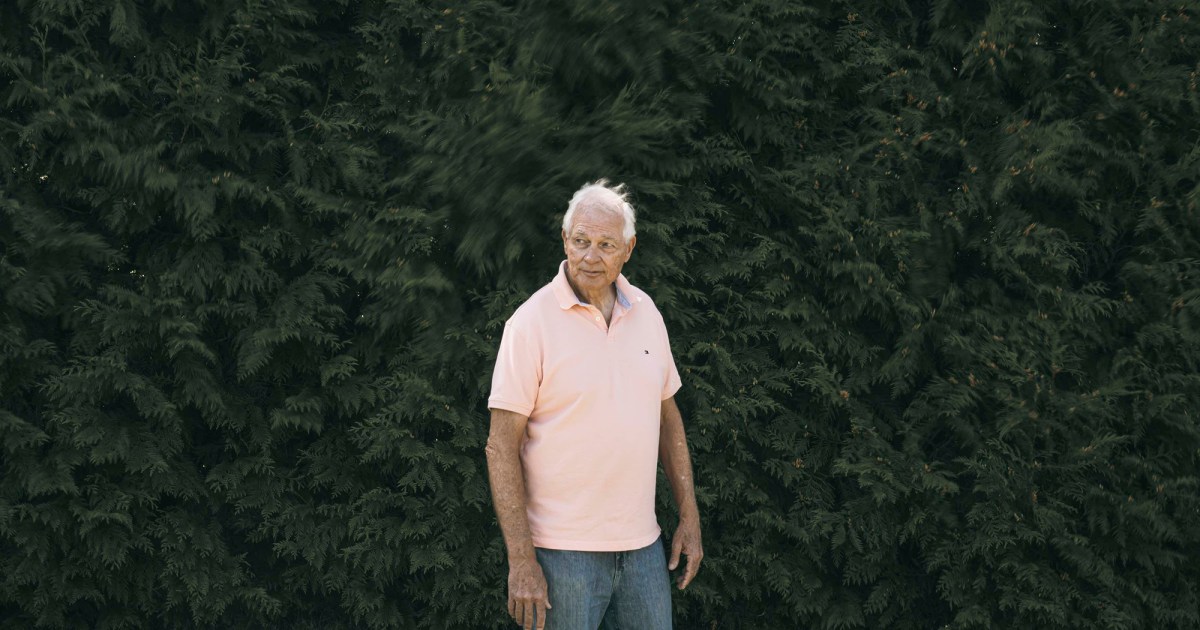
Stevenson, now 75, describes himself as “a lifelong conservationist.”
In the driveway of his Lewes, Delaware, home sits the hybrid vehicle he often drives to a nearby beach. Solar panels glint atop the roof, which Stevenson custom-designed in 2013 to be at the “optimum angle” to soak up the sun. A framed newspaper article about one of his cross-country bike rides hangs on the wall of his home office, nestled alongside photos of his seven children and 19 grandchildren.
His career has intersected with clean energy—and even wind—at various points.
While working for DuPont in the 1980s, Stevenson helped the chemical giant develop the long-lasting coatings used to make first-generation solar panels and wind turbine blades. In 1999, after leaving the company, he started his own construction business and acquired certifications in energy efficiency and home weatherization. He said he eventually co-founded the Delaware Green Building Council to promote this kind of work.
But despite Stevenson’s environmentally minded career and interests, he’s built a reputation as someone dedicated to preventing, rather than enabling, renewable energy.
“They told me that I was nuts for taking on offshore wind.” Stevenson told me.Greg Kahn/Canary Media
After selling his construction business to one of his sons, Stevenson became interested in shaping state policies. A self-described libertarian, he found a home around 2010 at the Caesar Rodney Institute, a Delaware affiliate of the State Policy Network, which the Brown University researchers call “the nation’s most prominent network of conservative state-level think tanks.”
According to the DC-based research firm Energy Policy Institute, CRI is among a half dozen “front groups” backed by fossil-fuel interests that regularly attack renewable energy in their local regions.
For a few years, Stevenson worked on a variety of issues at CRI, from data centers and solid-state fuel cells to pipeline infrastructure and Delaware’s carbon-emissions fee. His initial brush with offshore wind came in 2010, when he sent a measured letter to the Obama administration regarding Bluewater Wind, the first proposed wind farm off the coast of Delaware. He voiced opposition to wind tax credits but acknowledged “one of the benefits of windmills” is how quickly they can be built.
It wasn’t until 2017 that he focused deeply on offshore wind, and by then his stance on the energy source was more firmly negative.
Plans for Skipjack Wind Farm—a 966-megawatt Danish-led project slated for waters off Maryland’s coastline with onshore stations in Delaware—were advancing quickly. They took Stevenson by surprise. “My initial response was just the high cost,” he recalled, though he also worried about the turbines ruining the “pristine view.”
The project was led by Ørsted, the world’s largest developer of offshore wind, which had bought the lease from the developers of Bluewater Wind. Stevenson said he tried to enlist help to fight the company, turning to Washington connections he’d forged during his time serving on Trump’s first transition team for the Environmental Protection Agency.
“I knew a lot of people; we had a lot of conversations,” Stevenson recalled. “They told me that I was nuts for taking on offshore wind.”
Filings show that the think tank Stevenson worked for was accepting donations from fossil-fuel interests.
At the time, Trump officials were actively backing the sector. Former Interior Secretary Ryan Zinke described himself as “very bullish on offshore wind” and executed key lease auctions put forth by the Obama administration—first near North Carolina, then near Massachusetts. Anti-wind policies wouldn’t emerge until the latter half of Trump 1.0, when Zinke’s successor, David Bernhardt, began slow-walking federal permits for offshore projects.
Stevenson received little response from his Washington connections. Undeterred, he simply led an anti-wind campaign on his own.
He attended town hall meetings and submitted public comments. He and fellow residents of local coastal communities organized against the wind project under the name Save Our Beach View, mailing over 35,000 letters and posting constantly to Facebook.
The messages contained several misleading statements. Independent journalist Michael Thomas reported that the letters, for example, “falsely claimed that the project could cause coastal residents’ property values to drop by between 20% and 30%; power costs could rise by 400%; key industries like tourism could see their revenues fall by 50%.”
Nevertheless, Stevenson’s efforts delayed the permitting process for an onshore substation, which in turn delayed wind turbine construction off the Delmarva coast from a planned 2022 start date to 2026 at the earliest. In January of this year, days after Trump took office for his second term, Ørsted moved to refinance the project, likely kicking it even further down the road.
Ultimately, Stevenson said, he “won the battle.”
In 2019, emboldened by his win against Skipjack Wind, Stevenson started searching on social media platforms and in news articles for the names of other residents across the Northeast who were resisting offshore wind farms. He reached out to some of them by phone—“just cold-called them,” he said with a laugh.
He found that there were plenty of individuals, as well as some small groups, protesting with little experience. For example, a handful of activists known as Protect Our Coast NJ didn’t know how to establish themselves as a nonprofit entity. Stevenson said he helped them do it.
Stevenson also started to organize monthly calls among activists from different states. His reach slowly grew from Massachusetts down to North Carolina, with the idea of spreading the tactics he honed in Delaware to other states. What Stevenson would bring them—as the Brown University researchers put it—was “political power.” Filings show that Stevenson’s employer, the Caesar Rodney Institute, also accepted donations from the American Fuel and Petrochemical Manufacturers in both 2019 and 2020.
His network of grassroots activists evolved into the American Coalition for Ocean Protection, which made its public debut in 2021 with a press conference in front of the Massachusetts Statehouse. Four other State Policy Network think tanks had also joined by then.
There, wearing a blue sport coat and flanked by maps of planned wind farms, Stevenson announced that the Caesar Rodney Institute had set up a $75,000 legal fund to support residents along the East Coast who wanted to sue to halt offshore wind development. He publicly set a goal of raising $500,000 for the campaign.
Stevenson would later admit that while the coalition’s fundraising “did pretty well,” it never reached anywhere close to his financial goal. No matter. It was the coalition’s relentless messaging and coordination, not so much the money, that would become its greatest weapon.
In January 2023, right-wing media took an interest in whales. There had been a slew of marine mammal deaths along the East Coast in prior weeks, and conservative media put the blame on seismic surveys for the future offshore wind developments ramping up along the New Jersey coast. Fox News host Jesse Watters interviewed a leader of Protect Our Coasts NJ, a founding coalition member that Stevenson had helped become a nonprofit.
This wasn’t the first time the media had amplified baseless speculation about wind power killing whales. The Daily Caller, a conservative news site, had run a similar story in 2017. But in early 2023, the claims were getting attention from Fox, local news, and even the Associated Press.
Stevenson was in near disbelief when he heard Tucker Carlson, then a commentator on Fox News, mention offshore wind and whales in multiple segments.
Still, even then, Stevenson refused to repeat blatantly false claims about the sector’s impact on whales. He posted statements on CRI’s website that the exact harm to the critically endangered North Atlantic right whales by wind development was still “unknown” and told me that his official position was to “wait and see” what federal scientists find after investigating the recently washed-up whale carcasses.
I asked at the time if he thought the explosion of attention on whales and wind power would peter out. He replied that it would, adding that eventually all these newcomers would oppose wind farms because of “the economics.”
But if Stevenson didn’t personally amplify the message, he didn’t swear it off. Nor did he discourage the groups he collaborated with from peddling it. In fact, he nearly won an award for elevating the issue: In June 2023, his campaign against offshore wind was a finalist for the Best Issue Campaign award presented at State Policy Network’s annual meeting. (The nomination highlighted the fact that the campaign had prompted a US General Accountability Office report into the matter. That analysis, released earlier this year, found no evidence that the wind industry harms whales.)
Some 39 gigawatts of new offshore wind capacity was projected by 2035. Under Trump, that’s been downgraded to 6 gigawatts.
Over time, the whale issue metastasized, coming to define political debate over offshore wind farms. Eventually, Stevenson himself embraced some of its more conspiratorial claims. In a statement posted to the Cesar Rodney Institute website in summer 2024, he wrote: “We have patiently waited for indisputable evidence that offshore wind is killing whales despite federal agencies repeatedly stating that no such evidence exists. It does now.”
The “evidence” was two documents posted online, neither of which had been peer-reviewed. One report, by the consultant Robert Rand, looked at the acoustic output of wind vessels in the US—during both seabed surveys and pile-driving activities—and claimed that the underwater noise levels were much higher than federal scientists had estimated and could result in hearing loss and “harassment” of whales. The second report, by a retired computer science professor, used correlation alone to link the timing of New Jersey whale deaths to local wind farm survey work.
Douglas Nowacek, a professor at Duke University leading a multiyear investigation of wind farm impacts on wildlife, discredited these conclusions.
As it stands, according to the National Oceanic and Atmospheric Administration, “there is no scientific evidence that noise resulting from offshore wind site characterization surveys could potentially cause whale deaths. There are no known links between large whale deaths and ongoing offshore wind activities.”
In fact, government data overwhelmingly links whales’ deaths to other causes. For nearly a decade, agencies have carefully documented humpbacks in the North Atlantic washing ashore at an increasing rate. The species is not endangered, but in 2016, its plummeting population warranted a government-assigned designation: an “unusual mortality event.”
In this ongoing phenomena, 40 percent of the dead humpback whales autopsied by experts revealed injuries that only vessels or fishing gear could inflict. The rest, according to government data, were too decomposed to determine the cause of death. Scientists generally agree that climate change, which is driving up ocean temperatures and pushing whale prey farther north, could also be playing a role in the die-off. The whales are expending more energy than ever just to catch a meal. Some juveniles have washed up emaciated.
I asked Stevenson, soon after Trump’s second inauguration, if he still trusted NOAA’s ability to objectively assess the impact of turbine development on whales, and he was clear: “No.”
Trump wasted no time coming after offshore wind when he took office in January 2025. On day one, he issued an anti-wind executive order that paused all permitting activity, and derided the installations as “big” and “ugly” to an indoor stadium full of supporters.
For Stevenson and a dozen others in his influential cohort, the executive order was a good step—but it wasn’t enough to simply block new projects from advancing. In February, they petitioned Interior Secretary Doug Burgum to issue stop-work orders to the installations already being built, alleging that the projects posed a risk to whales. This piggybacked off legal complaints guided by Stevenson and coalition members against Coastal Virginia Offshore Wind, South Fork Wind, and Vineyard Wind 1.
And it wasn’t long before the Trump administration tried to give the Stevenson-led coalition what it wanted. All five of the offshore wind projects under construction in US waters either have been delayed by recent stop-work orders or are reportedly under threat of receiving one.
“Talking points that preach wind farms as bad news for whales or national security are “a known and studied strategy.”
Some in the coalition opposed such moves, recognizing that stopping projects already underway would raise energy costs. Steve Haner, a senior fellow at the Virginia-based conservative think tank Thomas Jefferson Institute for Public Policy, refused to endorse Stevenson’s petition to pause the five projects under construction—objecting especially to halting America’s largest project, a 2.5-gigawatt wind farm being built off the Virginia coast.
Under a hypothetical cancellation, according to Haner, “the ratepayers are on the hook” for the billions in sunk costs.
A test turbine at the Coastal Virginia Offshore Wind project, off Virginia Beach, November 2025. A row of transition pieces awaiting turbine installation are visible in the distance.Clare Fieseler/Canary Media
Empire Wind, one of the two projects ordered to pause this year, has since resumed construction—but only after the developer, Norwegian energy firm Equinor, launched a monthlong lobbying blitz. According to Norway’s largest newspaper, the company mobilized “500 phone calls and meetings”—an effort employees dubbed “Operation Gandalf”—which helped secure a reversal from Trump.
Still, Stevenson pushed for more wins, advocating for a complete overhaul of the Interior Department’s approval process for wind. In May, he penned another letter with some coalition members to Burgum requesting those changes.
At the time Trump was reelected, BloombergNEF expected 39 gigawatts of offshore wind generating capacity to come online in America by 2035. The research group hedged that number to 21.5 gigawatts if Trump managed to repeal wind tax credits during his term.
Interior’s Doug Burgum now claims a wind project paused by Trump makes the US vulnerable to underwater drone attacks.
Today, with tax credits already sent to an early grave and no new permits issued, that prediction has fallen off a cliff. BNEF downgraded its projection two months ago to just 6 gigawatts. In other words, Trump’s assault has been so effective that it’s likely no new offshore wind farms will be built here for the next decade—save for the five already under construction.
Opponents of the sector have won the war on wind in the near term. “They are clearly feeling emboldened by Donald Trump,” said J. Timmons Roberts, a professor of environmental studies and sociology at Brown University who led the study that placed Stevenson at the heart of America’s anti-wind movement.
It’s not just Trump: Over the past year, more Republicans have grown verbally hostile to offshore wind. Burgum has played up reliability concerns, which lack evidence, and raised alarm bells about the impact to tourism and fishing, while peddling false claims that climate change predictions were overblown. This fall, the defeated Republican candidate for New Jersey governor, Jack Ciattarelli, made banishing wind farms a core agenda item, selling anti-wind tote bags and koozies on his campaign website.
Under Trump, government officials are rolling out more eyebrow-raising narratives—ones that go beyond whales—for halting wind projects. Some defy science and logic, like Burgum’s claims that New England’s Revolution Wind, the other project paused by Trump, makes the US vulnerable to underwater drone attacks. (A federal judge has since lifted the stop work order.)
Kinol, the Northeastern University researcher, says these kinds of narratives fit under the umbrella of “climate obstruction.” The term, she said, describes “the intentional use of misleading, misinforming, or misdirecting narratives to slow or prevent climate action.”
The concept has been around since the 1990s, when scholars first investigated the American Petroleum Institute’s downplaying of climate change. But as the debate about climate change—and what to do about it—evolved, so did the opposition. Kinol said talking points that preach wind farms as bad news for whales or national security are “a known and studied strategy.”
“This is an example of ‘downside emphasis.’…A wind farm opponent emphasizes the downsides of renewable energy,” said Kinol. “The reason why it’s a well-known tactic of obstruction is because the same emphasis on protecting species is not present for the same groups when they’re talking about fossil-fuel build-out.”
These kinds of arguments are “disingenuous,” said Kinol, and ultimately in service of a phenomena she and her colleagues call “climate delay.”
Stevenson is one example of what is now a clear trend: The denial of climate change is being steadily replaced by attacks on solutions to address it. This twist is detailed in a new book written and edited by Roberts and three colleagues titled Climate Obstruction: A Global Assessment. The book came out in early fall, just in time for its authors to witness their ideas play out in real life, with a decade-long delay of US offshore wind farm development now becoming reality.
Nowadays, Stevenson seems to have mixed emotions about his achievements. On two of our most recent phone calls, his tenor had changed.
“Well, I think it was the right move,” he said in early fall, referring to the Trump administration’s stop-work order pausing the building of Revolution Wind, which was still in effect when we spoke. “But it is not something I’m going to dance around the table happy about, because there are people that get hurt by this, that are losing their jobs.”
All his efforts have “paid off,” he said. America’s elevated reliance on cheap natural gas—which, when burned, releases fewer carbon emissions than coal—was “better policy” for now. He views gas as an essential bridge fuel until nuclear, geothermal, and solar can be built. But he expressed some “disappointment” that Trump has increasingly gone after solar and wants to now expand coal production.
Republican moderates in Washington have expressed similar sentiments. Meanwhile, utility bills, which Stevenson called his “primary motivation” for his anti-wind work, have skyrocketed in the Northeast and are projected to only climb higher if Trump’s policies continue to strangle the offshore wind sector.
Stevenson has increasingly drifted from the direction that other coalition members are taking. Protect Our Coast NJ—which first fanned the flames of misleading claims about whales—has embarked on a different disinformation campaign: spreading the false idea that offshore wind cables cause cancer. Embracing outlandish claims, whether it’s whale-killing “windmills” or cancer-causing cables, is a broader trend among Republicans who buy into conspiracy theories with their party’s rise to power.
Conspiratorial sentiments are plaguing other clean energy sectors, too, from exaggerated claims of bird-killing onshore turbines to markedly false statements about toxic solar panels. Anti-renewables talking points circulate online, penetrate town hall meetings, and are taken up by groups pushing back against renewables now more than ever. A June study released by Columbia University identified 498 contested wind and solar projects across 49 states in 2024, marking a 32 percent jump in opposed projects, compared to just one year prior.
“You want a healthy amount of skepticism in a democracy…You don’t want 100 percent believers,” said Dietram Scheufele, a social scientist at the University of Wisconsin-Madison who studies public perspectives on science and technology. But he warned that skepticism in the US is “on steroids,” pushing people from the middle into polarized political camps and toward conspiratorial thinking.
Stevenson, for his part, is stepping away from his work in the anti–offshore wind movement, and seems relieved to be doing so.
On our most recent call, in late November, he told me that he had resigned from CRI and that his anti–offshore wind coalition was, for all practical purposes, disbanded. (He remains a named plaintiff in four lawsuits opposing wind development.)
He’d rather be “solving the nuclear waste problem,” he told me. The energy source has long had a toxic-byproduct issue, not to mention cost overruns, which, to be sure, eclipse any expense associated with offshore wind over the long run. The Trump administration is looking to revive America’s nuclear industry, and that’s where Stevenson wants to build his legacy.
Even this work advocating for nuclear power could be seen as a form of “climate delay,” according to a popular research framework used by Kinol and Roberts. Nuclear plants put forth today can take a decade or more to start providing power; many of the proposed wind projects that Stevenson’s coalition targeted would have come online well before then.
Stevenson also told me that he is starting a new position. Soon, he’ll become the director for energy and environmental policy at the Michigan-based Mackinac Center for Public Policy. This think tank, like CRI, is part of the State Policy Network. ExxonMobil and the Charles G. Koch Charitable Foundation are among the center’s funders.
I congratulated Stevenson on his new job. He thanked me. His tone warmed as he reminded me that we’d probably had a dozen phone calls over the years.
I said it was quite possible that his legacy would be as the man who helped crush a renewable energy sector that could have done much to address the planet’s biggest problem. I asked Stevenson what he thought about that view—that readers might see it that way.
“I don’t care if people hate me or not,” he said. “I’m doing what I think is right.”