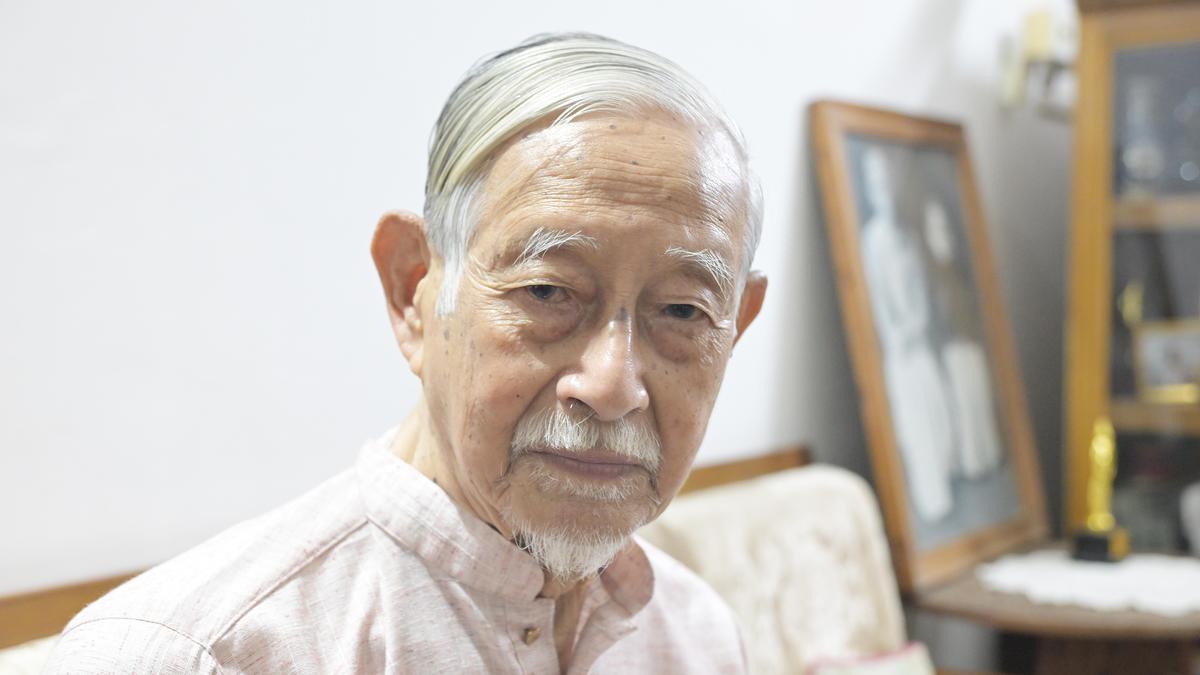
At 87, writer and activist Hiren Gohain, one of Assam’s foremost public intellectuals, shows no sign of slowing down. The Assam Nagorik Sanmilani, a citizens’ collective led by him and retired IPS officer Harekrishna Deka, was at the forefront of calls for Opposition unity and seeking judicial intervention over a “sustained pattern of hate speeches” by Chief Minister Himanta Biswa Sarma. He discusses issues foregrounding the Assam election campaign with The Hindu. Edited excerpts:
You were an adviser to the regional party Raijor Dal during its early days before dissociating yourself. Why then did you issue appeals for the Opposition to come together this Assembly election?
I used to be adviser but Akhil Gogoi [Raijor Dal chief] refused to have any truck with the Congress, which allied with the AIUDF and other parties in the previous election. Since I was supporting the alliance, I felt it unethical to remain with Akhil Gogoi and resigned.
Things have changed a lot since then. This time, I had this notion of an Opposition unity quite early. We had an all-Assam citizens’ convention in Guwahati last year and told political parties that they could draw strength from each other and the electorate is much more likely to support such an alliance than individual parties. To our delight they agreed, but it took a pretty long time. They are holding joint campaign meetings everywhere now.
How are the new regional parties different from their 1980s predecessor, Asom Gana Parishad?
The AGP got completely exposed during the anti-Citizenship (Amendment) Act agitation. Its MP Biren Baishya made a fiery speech against the Act in Rajya Sabha but [later] raised his hand in support. The party remained with the BJP but said they would continue to struggle against the CAA. It has become law and apparently they are still against it. The All Assam Students’ Union also lost most of its clout due to a similar position.
Has the political discourse today has touched a new low? We have never heard the pejorative term ‘Miya’ being bandied about so freely in the past as now.
During the Assam Movement, some diehard supporters used the word among themselves. But it was never a part of the public rhetoric. The Chief Minister [Himanta Biswa Sarma] goes on saying I am not going to allow the ‘Miyas’ to rest and I shall harass them as much as I can, this is why I became CM. Imagine a Chief Minister saying something like this.
As part of a group of concerned citizens, you moved the courts over the alleged hate speeches. The next High Court hearing is scheduled for April 21.
Since this is the incumbent Chief Minister, the court should have said something about it. Some steps should have been taken to restrain him in the meantime. The hearing has been postponed to a very safe date.
There hasn’t been much forward movement since the 2019 National Register of Citizens excluded 19.06 lakh people…
This is begging for an answer for a long time. It’s been seven years. Neither has the government accepted it nor rejected it on some rational ground. It was NRC State Coordinator Prateek Hajela’s brainchild, how to ensure that real citizens find entry by considering the legacy data. They were so strict that even natives had to suffer a lot. My own citizenship was confirmed after several visits to the NRC centre. The NRC is sound. There is no evidence of corruption, mismanagement. The BJP says there are lakhs and lakhs of Bangladeshis in the NRC and they are going to correct it. They should bring evidence.
The citizenship issue raises the question, who is an indigenous Assamese that Clause 6 of the Assam Accord seeks Constitutional protections for?
That is a riddle I have not been able to solve. There is a sense among people that some are more native, others are not, but it’s a question of citizenship. There is scope for migrants from other States to come and settle here. Are they indigenous? No. It is a very complicated term and concept. It cannot be applied in legal terms.
You facilitated talks between the Government of India and ULFA over 15 years ago. To all intents and purposes, has militancy run its course?
I remember when I was studying in Delhi in 1959-60. There were students from Andhra Pradesh, Punjab in the hostel… most of these States were as poor as Assam, but they became far more developed and richer. Assam does have a grievance against the Centre and I share it too. Given this background, extremist regionalism does rear its head from time to time. But you have to be callow to think short-term violence brings results… it never does. People bore the brunt of it. They may not take kindly to this kind of violence as they once used to.