National News
Conservatives have rebuked Gu, who was born in the United States but won Olympic medals for China. The reaction has sparked conversations among Chinese Americans about identity and straddling two worlds.
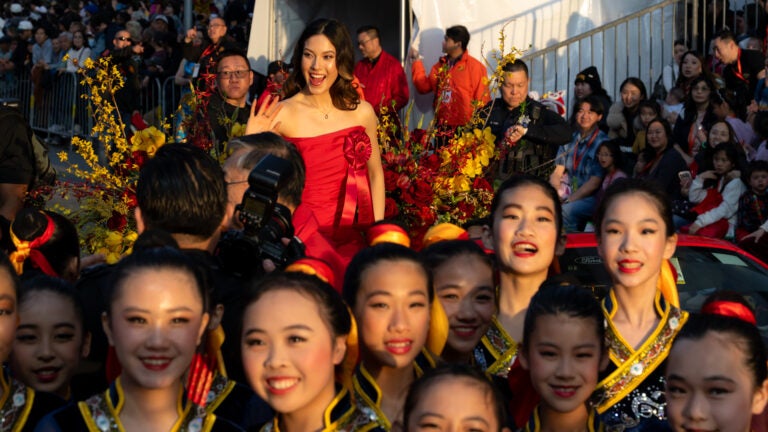
Eileen Gu, the decorated Olympic freestyle skier, was cheered by crowds when she served as grand marshal at the San Francisco Chinese New Year Parade. Mike Kai Chen / The New York Times
updated on March 12, 2026 | 2:16 PM
6 minutes to read
In San Francisco, there was little trace of the online vitriol that had been directed at Eileen Gu for weeks.
Gu, the decorated Olympic freestyle skier, wore a wide smile as she sat atop a red convertible during the annual Chinese New Year parade last weekend, making hand hearts for the crowds, who returned the love to their hometown girl.
Bells clanged. Parade-goers snapped photos. Teenagers tried to run alongside the car.
“Welcome home, Eileen!” several supporters shouted in unison.
Ordinarily, the celebration would have just been the latest party featuring a triumphant athlete. After all, Gu won three medals in freestyle skiing during the Winter Olympics last month.
But because she won those medals for China, the United States’ main geopolitical rival, Gu has been branded a “traitor” and “ungrateful” by conservatives online. The parade itself drew a new round of criticism for Gu and, to some degree, San Francisco, a liberal city often mocked by the right.
The mixed reaction to Gu stands in contrast to the wider embrace for Alysa Liu, the figure skater who captured American hearts — and the gold medal — with her joyful performance competing for Team USA. Liu, like Gu, was born in the United States, has a Chinese immigrant parent and lives in the Bay Area.
Liu has been mobbed upon her return, to the point where she recently had to ask fans to give her space after someone chased her to her car. And every ticket has been claimed for a Thursday rally in her hometown, Oakland, where thousands were expected to attend and the event was to be broadcast on local television.
While Gu’s decision to compete for China became a lightning rod for the right, the divergent reactions to the two medalists have also spurred conversations among Chinese Americans about what it means to be an American in the current era.
Immigrants and their descendants have long tried to maintain connections to their heritage, no matter their family’s nation of origin, balancing those ties with pressures to assimilate and forge their own identities. For some Chinese Americans and scholars of Asian American history, the criticism of Gu has been deeply unsettling.
In a sports world where it is not uncommon for American athletes to compete for other countries, the intense focus on Gu reflects a view of Americanness that seems to offer little space for those who might have natural affinities for cultures or countries outside of the United States — especially when that country happens to be a geopolitical competitor like China.
In more than a dozen interviews, many Chinese Americans said they had ties to China and Chinese culture similar to those of Gu. She was raised by her mother and her maternal grandmother, both immigrants from China. She grew up visiting relatives in China. And she speaks Mandarin Chinese fluently — with a Beijing accent.
Gu, during a training session at the 2026 Milan Cortina Winter Olympics. Gabriela Bhaskar / The New York Times
Gu has said that she chose to represent China because she could inspire more young people there. While many Chinese Americans said they might not have made the same decision, they felt that competing for China seemed like a logical extension of her identity and did not make her any less of an American. And wasn’t part of being an American having the freedom of choice, anyway?
“She is representing her background,” said Justin Chi, 36, a software engineer who grew up in Southern California.
Kevin Leung, 51, an accountant in the Bay Area, saw a different motivation behind Gu’s decision, pointing to the millions of dollars she has made in sponsorships from Chinese companies and the Chinese government. Which, in some sense, he suggested, was also quintessentially American.
“It’s her way to make money,” Leung said. “It’s capitalist.”
The United States has undergone vast demographic shifts in the past quarter-century. One in four children in the United States has at least one immigrant parent, compared with 13% about 25 years ago, according to the Migration Policy Institute, a research center in Washington.
In California, straddling cultures and countries is even more normal. The state is home to more than one-fifth of the country’s immigrants. Nearly half of children have an immigrant parent.
Having a transnational identity is especially common among Chinese people, who constitute the largest Asian group in the country. And it is particularly resonant in the Bay Area, where Gu grew up and now resides as an undergraduate at Stanford University. While there are fifth-generation Chinese Americans in the Bay Area, there are also parts of San Francisco’s Chinatown where as many as 4 in 5 people were born abroad.
The city and its surrounding region have long been a hub for “astronaut families,” in which at least one parent shuttles back and forth to a job in Asia. Some second-generation Chinese Americans grew up visiting family and relatives in Asia each year.
Alysa Liu, a figure skater who won gold medals for the United States at the Winter Olympics, has been widely embraced by Americans and will be celebrated at a rally in Oakland, Calif., on Thursday. Vincent Alban / The New York Times
Gu has often said, “When I’m in the U.S., I’m American, but when I’m in China, I’m Chinese.” Many people can relate.
“It’s a feeling of not fully belonging in either place,” said Cleo Cao, 25, a tech consultant in the Bay Area who was among the thousands who attended the San Francisco parade.
But plenty of Chinese Americans have criticized Gu’s decision to represent China, as well. They say that loyalty to the United States should come first, regardless of cultural affinities. They agree with Vice President JD Vance, who said that athletes who benefit from American education and freedoms should represent the United States.
Some in particular have highlighted Gu’s evasiveness in response to questions about the Chinese government’s human rights abuses and internet censorship, in contrast to her public comments on anti-Asian hate and racial justice in America.
She also has consistently dodged questions about her nationality. China requires that its athletes hold a Chinese passport but it doesn’t allow dual citizenship.
“I don’t deny the sincerity of her connection with China,” said Xiao Qiang, a professor at the University of California, Berkeley, and a human-rights activist. “But I still find her actions troubling.”
Gu did not respond to multiple requests for comment.
Gu has often said that “When I’m in the U.S., I’m American, but when I’m in China, I’m Chinese.” Mike Kai Chen / The New York Times
For decades after the normalization of U.S.-China relations in 1979, ethnic Chinese scientists, businesspeople and athletes were celebrated by American leaders and universities as bridge builders. But over the past decade, as the U.S.-China relationship has grown frostier, those cultural and educational ties have frayed.
It did not go unnoticed by Chinese Americans that Zoe Atkin, another American-born Stanford student, won a bronze medal in freestyle skiing for Great Britain last month but did not attract the same rancor that Gu did.
“This is another opportunity to attack China,” said Gordon H. Chang, a historian at Stanford University. “It’s more about Sinophobia than it is about Gu.”
Back in San Francisco, the honor shown to Gu in the historic Chinese New Year parade carried a deeper symbolism, said Ellen Wu, an associate professor of history at Indiana University.
More than 70 years ago, as the Red Scare was taking hold, the Chinatown organizers of the parade appointed a Chinese American combat veteran as the grand marshal and put up anti-Communist signs in an effort to display their sacrifices for the United States and combat suspicions of disloyalty.
Generations later, Gu and her mother, Yan Gu, stepped forward Saturday night to light the ceremonial firecrackers, kicking off the parade. Local politicians, including Rep. Nancy Pelosi, the former House speaker, then watched the procession from the grandstand. At the end of the route, Mayor Daniel Lurie helped Gu light more firecrackers.
“It doesn’t matter if you’re undocumented, or a political asylum-seeker, or a student, or a foreign citizen. We don’t care,” said David Ho, who advises the Chinese Chamber of Commerce, which organizes the parade. “This is a Chinese New Year parade. Everyone needs to check their citizenship at the door.”
This article originally appeared in The New York Times.