Readers Say
A majority of respondents were against the decision — “Read the room. We don’t want this.”
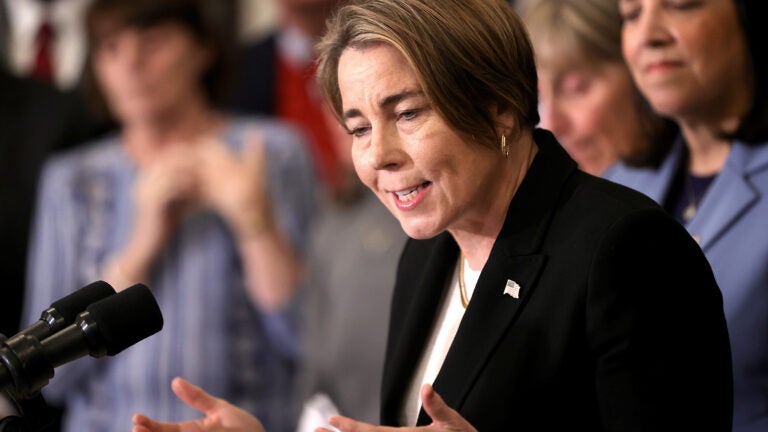
Governor Maura Healey held a press conference at the Massachusetts State House on January 29, 2026. (David L. Ryan/ Globe Staff)
February 26, 2026 | 4:52 PM
6 minutes to read
Readers across Massachusetts have raised alarm bells after Gov. Maura Healey announced the state will roll out an artificial intelligence assistant for executive branch employees, becoming the first in the nation to do so.
-
All Mass. residents to get free access to Google AI training classes, Healey says
-
Massachusetts becomes first state to use ChatGPT in the executive branch, drawing criticism
The AI assistant — operated by OpenAI’s ChatGPT — will be introduced in phases across the executive branch’s nearly 40,000 employees, beginning with the Executive Office of Technology Services and Security.
The Healey administration said the tool will function in a secure, “walled-off” environment to protect sensitive state data and prevent employee inputs from being used to train public AI models.
“This is about making government faster, more efficient, and more effective for the people we serve,” Healey said. “AI has the potential to transform how government works, which is why we’re excited to partner with OpenAI on this AI Assistant, which will ensure a safe and secure environment for employees and improve their ability to deliver better service to the people of Massachusetts.”
But many of the more than 100 readers who responded to our poll expressed deep skepticism of the technology, with the majority (65%) opposed to Healey’s decision. Thirty percent of readers said they agree with the move.
Do you agree with Healey’s use of a ChatGPT AI assistant for state workers in the executive branch?
Do you use an AI tool that’s officially approved by your employer?
“I think that the demonstrated security and privacy risks far outweigh any potential benefit,” reader E.S. from Greenfield said.
Several readers also questioned the environmental toll of generative AI tools.
“AI and ChatGPT are unreliable, not to mention the environmental damage that both are doing,” said Kelly from Somerville.
Still, a significant number of readers welcomed the move, arguing that the state government should not lag behind the private sector when it comes to technological advancement.
“Those who fear or loathe technology are the ones who will be left behind and in the unemployment line,” said P.M. from Marshfield.
Indeed, Healey has touted AI in recent years as a way for Massachusetts to lead the nation in innovation. She earmarked $100 million in 2024 to create an Applied AI Hub in the state, and on Thursday announced that every Massachusetts would have access to free Google AI training courses.
“This resource will strengthen our workforce, our companies and ensure that Massachusetts remains the global leader in AI-led innovation and breakthroughs,” she said in a news release.
Below, readers weigh in on the Massachusetts executive branch using AI.
Responses have been lightly edited for grammar and clarity.
Do you agree with Healey’s use of a ChatGPT AI assistant for state workers in the executive branch?
No
“I think that the demonstrated security and privacy risks far outweigh any potential benefit, and either way, the environmental disaster that is created by AI data centers is at fundamental odds with core tenets of the political priorities of Massachusetts … Massachusetts has plenty of intellectual firepower and doesn’t need a deeply flawed AI chatbot to do its work for it.” — E.S., Greenfield
“Opposed until we have far better legal restraints on this technology.” — Debra S., Acton
“I think AI is a data security risk for any organization that uses it, a legal risk (because LLMs tend to hallucinate and provide inaccurate information), and it puts state government on the path to be run by technocracy, as supposed to the actual people of the Commonwealth.” — James, Mission Hill
“I am firmly against them and do not want AI or tech data centers in our state.” — Rachel S., Ashland
“Unnecessary. AI isn’t artificial intelligence; it’s simply a huge database and only knows what it has access to, which can lead to problems. There are also concerns of its impact on the environment, which makes it odd that Massachusetts is jumping on board. At a time when there is cost-cutting across the Commonwealth, it seems inappropriate to give money to a Trump-aligned billionaire.” — Carol P., Cambridge
“AI and ChatGPT are unreliable, not to mention the environmental damage that both are doing. They produce incoherent babble that still needs to be proofread by a human. I’d rather do the work myself than have to double check and rewrite drivel written by a computer.
I’m extremely disappointed by Gov. Healey’s decision to utilize AI in the state government. Read the room. We don’t want this.” — Kelly, Somerville
“Allowing use of algorithms known for hallucinating and unable to fact-check or critically think for ‘research’ is a recipe for disaster and everyone involved in letting this happen should be ashamed.” — K., Cambridge
“There are valid applications for AI, but this isn’t one of them. The state shouldn’t be encouraging the use of AI trained on the indiscriminately stolen work products of millions of people just so people can cut corners. Also, the impact of OpenAI on natural resources is gross. An acceptable use of AI would be an LLM trained on the state website so residents could ask for what they are looking for in plain language and get an answer.” — Anonymous reader, Cambridge
“Gen AI has very limited use cases and is not reliable for complex tasks. The chatbots generate more work as most of what they do is error-prone but one must be careful to catch mistakes. This is well-known now. There are additional concerns that they may erode worker skills or that the most low-skilled workers may begin relying on them, only to create work for others as they must fix the errors they have introduced.” — Ray, Cambridge
“AI is dangerous. Little to no regulation. Will replace millions of jobs including government, the arts, industry. Unstoppable.” — Etienne, Bellingham
Yes
“I think it’s great to have authorized tools for state workers. Otherwise they may use unauthorized tools. I know I would if it made my job easier in regards to paperwork.” — Casey, Peabody
“Our government needs to be as efficient as possible. Automating what can be automated by AI is a step in that direction. Many tedious tasks can be done by AI and while a human still needs to check the output it saves a great deal of time. Obviously personal data needs special considerations but it sounds like the AI won’t have access to them.” — David, Ayer
“Those who embrace technology will be on a fun and exciting track. Those who fear or loathe technology are the ones who will be left behind and in the unemployment line.” — P.M., Marshfield
“They make people more productive, but they do eat away at skills. There is a balance between automation and people. But with the AI walled off and prevented from sharing the data outside the enterprise, it’s generally a way to improve productivity and improve the results from state workers.” — John S., Ashland
“For tasks like email drafts, these tools can be helpful. However, most employer-driven GenAI tools are restricted internally, with no access outside and strict regulations for training. This is a wise decision considering the current trajectory. I just hope leaders in this field outline plans to assist workers in leveraging these tools, enhancing productivity, while also reducing the burden of additional work which could provide more time for family.” — Eva L.
“Enterprise versions of AI tools that are secure are incredibly helpful in boosting my productivity. I don’t worry that it will replace me, and use it regularly for content generation, strategizing, research, and planning. I always verify important information in other sources. Used properly and with a critical eye, AI tools are effective and time savers!” — Lisa R., Chelsea
“People are going to use AI one way or another. It’s a company’s job to provide them with an approved one if they’ve secured it properly.” — Tom, Billerica
“We need to embrace it. The private sector is already using it. The government should not fall behind.” — Kevin, Newton
“I am all for people to use them in ways that both make them more productive and give them the ability to think more critically.” — Mike, Watertown
Boston.com occasionally interacts with readers by conducting informal polls and surveys. These results should be read as an unscientific gauge of readers’ opinion.
Annie Jonas is a Community writer at Boston.com. She was previously a local editor at Patch and a freelancer at the Financial Times.
Sign up for the Today newsletter
Get everything you need to know to start your day, delivered right to your inbox every morning.