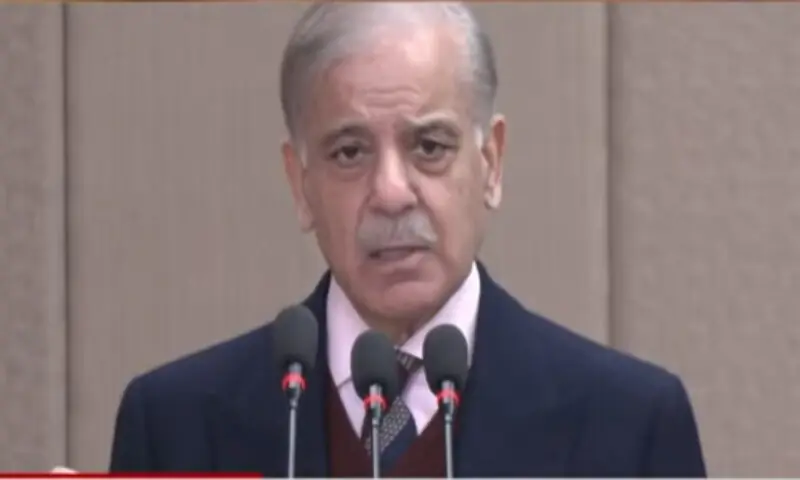
Prime Minister Shehbaz Sharif on Friday reintroduced the state-run health insurance programme — popularly known as the Sehat Card Programme — in the federal capital, Azad Jammu and Kashmir (AJK), and Gilgit-Baltistan.
Speaking at the launch ceremony of the facility in Islamabad, PM Shehbaz said, “Access to health facilities is the right of every citizen, and such facilities should be delivered to their doorsteps.”
The prime minister added that through the launch of the Sehat Card, his government had taken yet another swift step to serve the nation.
“This step is the revival of the same scheme that my leader, Nawaz Sharif, had initiated in 2016 for the first time,” he said.
The scheme was originally introduced in 2016 when the PML-N government was in power. It was made available to citizens in Punjab, Balochistan, and the then Federally Administered Tribal Areas (present-day Khyber Pakhtunkhwa) and the Islamabad Capital Territory (ICT), with expansion plans.
In 2019, the PTI-led government relaunched the programme under the title of Sehat Insaf Card after making some changes to it, such as the provision of up to Rs720,000 worth of medical expenses of the family of each beneficiary annually, while those earning less than Rs150,000 per annum were also covered, provided such people also contributed a little to the insurance plan.
The service was partially suspended in the federal territories for three years, while residents of Islamabad, AJK and GB were suffering since March 2024, as the service was completely suspended because the federal government had failed to clear its dues.
“Nothing is more precious in life than health, as it is needed to pursue education, to earn money, take part in sports, and defeat the opposition. Nawaz Sharif’s services will be remembered and spread on a priority basis.
“Today, the Sehat Card is being issued for Islamabad, AJK and the people of GB.”
Congratulating the Health Minister, Mustafa Kamal, health secretary, and all the members of his team, PM Shehbaz added: “It should be noted that the elite in Pakistan and across the world can afford expensive treatment for themselves and their families, but it’s very hard for a common man, orphan children and labourers to earn money.
“If they or their family members fall sick and die without treatment, the lives of their dependents become very dark.”
He added that good health and the right to treatment were every Pakistani’s right.
“I hope the health minister, the secretary, and his team, through a third party, will ensure the treatment will be provided properly. And I hope this programme will continue at speed, and you will monitor it,” he said, addressing Kamal and his team.
PM Shehbaz also said that he would talk to the chief minister of Sindh regarding the initiative based on Kamal’s suggestion.
“In Punjab, this programme is onging and billions of rupees are being spent on it. Likewise, in Balochistan and KP, the programme is running successfully. I am sure Sindh has a similar programme, and its CM is very active regarding health and education. But I will talk to him and resolve the issue so this facility will take shape there as well.”
Total of 70 hospitals to be added to covered regions: Kamal
Speaking during the ceremony, Kamal thanked the prime minister for his guidance and efforts to make the initiative possible.
“This programme was initiated in 2016 by your government, and provinces took it up. However, it was abandoned in the federal territories for the last three years, so we’ve proposed its revival.
“Now, the government will provide free-of-charge health facilities to citizens living in Islamabad, GB and AJK, making up nearly 10 million people,” he said.
Detailing the benefits of the Sehat Card, the health minister said that citizens would be able to use their card instead of cash at hospitals.
“Today, you have resolved the problem of a lot of people. May Allah help us in sustaining this initiative. Over the last four to five weeks, your efforts led to the revival of a dead programme. When we talk about healthcare, it is a matter of preventing people from falling sick, ensuring adequate gaps in childbirth, immunising children, and providing them with clean drinking water.
“Our ecosystem of health is not in an ideal condition. Our hospitals are overpopulated, so we blame doctors for this, but a doctor, who should ideally treat 35 patients, is responsible for 350 patients.”
Kamal added that under the initiative, more hospitals will be added to all three regions, “We will add a total of 70 hospitals in Islamabad, AJK and GB,” he said. “Akin to that, people possessing the CNICs of these territories can get treatment from 16 hospitals in Karachi as well.
He, however, stated that Sindh is the only province where this card cannot be utilised. “We have shortlisted 10 urban and rural districts of Sindh. We request the prime minister to include Rs24 billion for two years in the budget. For the third year, we will make the programme self-sustainable,” Kamal said.