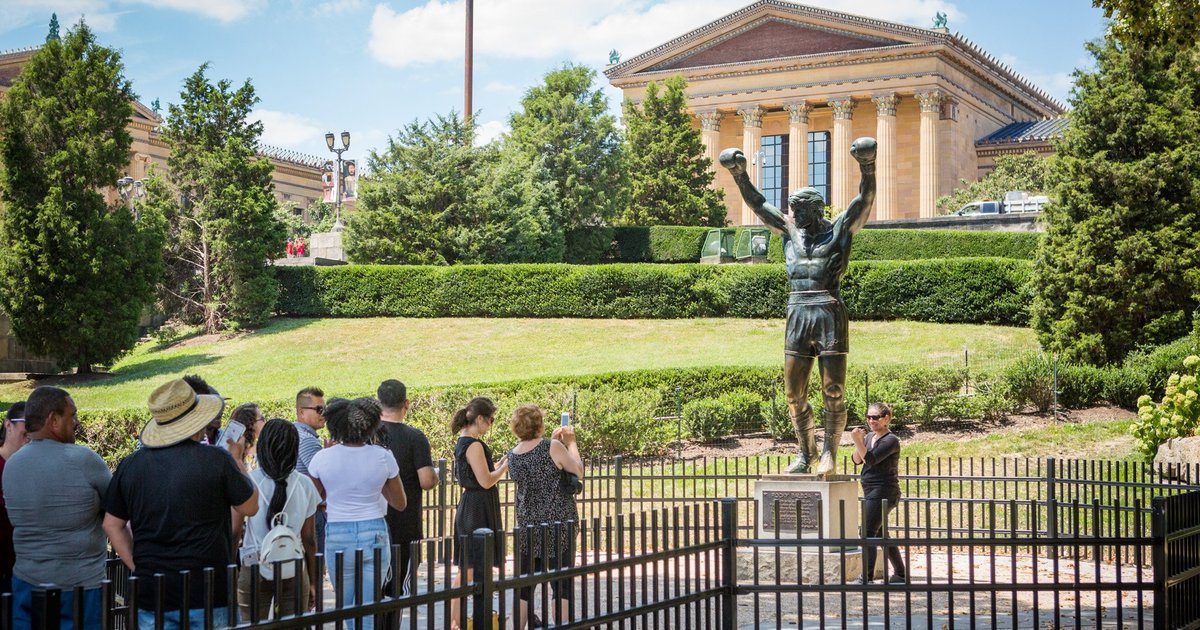
After spending nearly two decades at the base of the Philadelphia Museum of Art‘s steps, the Rocky statue on Wednesday morning is being transported inside to the Dorrance Galleries, where it will stand for the next five months as the centerpiece of a new exhibit that examines people’s love affair with the landmark.
MORE: Streaming guide: Watch this Oscar nominee and these dramas about journalism
From April 25 until Aug. 2, “Rising Up: Rocky and the Making of Monuments” will feature over 150 art pieces and artifacts spanning over 2,000 years to explore the significance of tributes to fighters and underdogs. Guest curator Paul Farber, who was born and raised in Philadelphia, hopes the exhibition can act as a mirror to people’s connections with the Rocky statue.
“I pride myself that this is likely the only exhibition that features works from the Metropolitan Museum of Art, the Philadelphia Museum or Art and a boxing gym in Feasterville,” he said. “We really wanted to cover the map to look at the way boxers have been seen not just as heroic, but as outcasts and underdogs from the beginning.”
Farber has dedicated his career to studying how people shape public spaces into powerful totems of culture. As the director of Monument Lab, he has spearheaded public art displays at City Hall and Independence Mall, but this will be his most extensive project yet.
Provided Image/Philadelphia Museum of Art
This photograph taken by Alex Webb in 2016 at the Rock Ministries Boxing Club in Philadelphia will be one of 150 pieces of art on display at the Philadelphia Museum of Art’s ‘Rising Up’ exhibit.
Born the same year the Rocky statue was erected, Farber, 43, recalled growing up with the movie entrenched in the city’s culture, but he said he waved off the phenomenon of the statue and the millions of visitors it attracts every year as nothing more than a “tourist trap.” But a conversation with his mother, who Farber called his “toughest critic,” is what changed his mind.
“She cut through my skepticism and invited me to think about the line,” he said. “Every day of the year, no matter the time, no matter the weather, no matter the season, there’s people lined up to be with the statue.”
Farber began to interview people waiting in line to take a photo with the statue, even landing his own podcast with WHYY about it. He recalled a conversation with a harm reduction worker in Kensington who viewed herself as Rocky’s little sister and would create shrines to gun violence victims on the museum’s steps. He also spoke with someone who escaped the Taliban, chose Philadelphia as his new home because of the “Rocky” movies and would use the statue as a sacred place to pray for his family.
“[The statue] is the ultimate site of pilgrimage for underdogs and our steps are the ultimate people’s pedestal,” he said. “It’s where you go to celebrate, to mourn, to protest, to rally and to kind of see ourselves in the city. … The show is an attempt to name and mark what already happens, which is people’s deep connection to place, power and possibility in Philly.”
Over seven years, Farber collaborated with the Philadelphia Museum of Art, independent researchers and organizations around the city to evaluate the depictions of boxers and underdogs throughout art history.
Provided Image/Philadelphia Museum of Art
This Greek pottery, estimated to have been created around 500 B.C., is part of a long history of fighters depicted in art. The vase will be displayed in the exhibit.
The exhibit looks at how fighters were enshrined as heroic outcasts, dating back to ancient Greece, and evaluates the evolution of boxing as an organized sport and the ways in which race, class and pop culture shaped its reception.
A gallery called “Philly Power” specifically focuses on two local boxing gyms with connections to the statue. The exhibit also includes a small drawing by Muhammad Ali, models of the Rocky statue, a mural of Philadelphia boxer Bernard Hopkins made by incarcerated people in SCI Phoenix prison, an essay from former Eagles safety Malcolm Jenkins about his experience with the word “underdog,” and the Rocky statue, which will be displayed inside the museum for the first time.
“I want to show that there is something playing out at this museum and outside of its walls that we want to honor,” Farber said. “… We have a job to do — it’s not just to bring people inside, it’s to reflect what is incredibly creative and genius and guttural about what we do outside on the steps of the museum.”
The exhibit’s run time overlaps with several premier sporting and cultural events that are coming to Philadelphia, including the World Cup and America’s 250th anniversary, which its curators hope can be a chance to display the unique culture of the city while appealing to a shared resilience that has kept “Rocky” so relevant for generations.
“Rising Up: Rocky and the Making of Monuments” will open Saturday, April 25. Tickets to the exhibit can be purchased for $35 online.