It is now six months since Anthony Albanese announced his government would recognise Palestine, overturning more than 70 years of Australian support for Israel and further inflaming anti-Jewish sentiment throughout this country.
Since then, the Prime Minister has made no progress in advancing the ersatz conditions he put on the recognition of a sovereign state that doesn’t even exist.
This is what Albanese said when making the announcement on August 11 after just one phone call with the corrupt and undemocratic head of the Palestinian Authority, Mahmoud Abbas: “Our government has made it clear that there can be no role for the terrorists of Hamas in any future Palestinian state. This is one of the commitments Australia has sought — and received — from President Abbas and the Palestinian Authority.
Sign up to The Nightly’s newsletters.
Get the first look at the digital newspaper, curated daily stories and breaking headlines delivered to your inbox.
By continuing you agree to our Terms and Privacy Policy.
“The Palestinian Authority has re-affirmed it recognises Israel’s right to exist in peace and security. It has committed to demilitarise and to hold general elections.
“It has pledged to abolish the system of payments to the families of prisoners and martyrs.
“And promised broader reform of governance, financial transparency and the education system, including international oversight to guard against the incitement of violence and hatred.
Prime Minister Anthony Albanese. Credit: SARAH YENESEL/EPA
“This is an opportunity to deliver self-determination for the people of Palestine in a way that isolates Hamas, disarms it, and drives it out of the region once and for all.”
Albanese went to the United Nations to recognise Palestine formally without putting in place any of the routine monitoring systems which are undertaken by the US, the European Union and the United Kingdom:
• a compliance framework.
• a reporting schedule.
• a verification mechanism.
• a sanctions or suspension pathway.
There is simply no penalty for failure to meet the conditions. Our recognition will remain intact.
Albanese acted on the word of a 90-year-old despot who has avoided facing an election for 19 years and has been accused by a host of investigating agencies of massive embezzlement, nepotism and interfering in attempts to inquire into allegations of blackmail and improper acquisition of land and property.
It was hardly surprising that Albanese had nothing to report when he appeared with Speers again last weekend and was asked about Trump’s plans for a Board of Peace to oversee the reconstruction of Gaza.
Since Albanese’s decision, the only part of the undertakings to take effect has been the end of payments to terrorists, which the PA had already ended in February when Abbas signed a decree cancelling the “Martyrs Fund” and prisoner stipends.
Other than that token condition, Hamas remains armed and in control of many parts of Gaza, and there has been no progress in PA governance and elections.
The PA remains deeply unpopular with most Palestinians.
Abbas’ appearance at the UN on September 25 was long on rhetoric, but he was unable to report even one area of achievement towards his undertakings.
Some recent history. When Albanese appeared on the ABC Insiders program on July 27, even light questioning from David Speers about any intention to recognise Palestine showed how unprepared he was for such a momentous decision.
“Are we about to do that, no we are not,” Albanese said.
“But we will engage constructively. I want, the United States as well, will have a critical role in this. They have to play a role.”
Speers: “Would you be willing to do this without the United States?”
Albanese: “Australia will always make our decisions as a sovereign state. But the role of the United States is critical.”
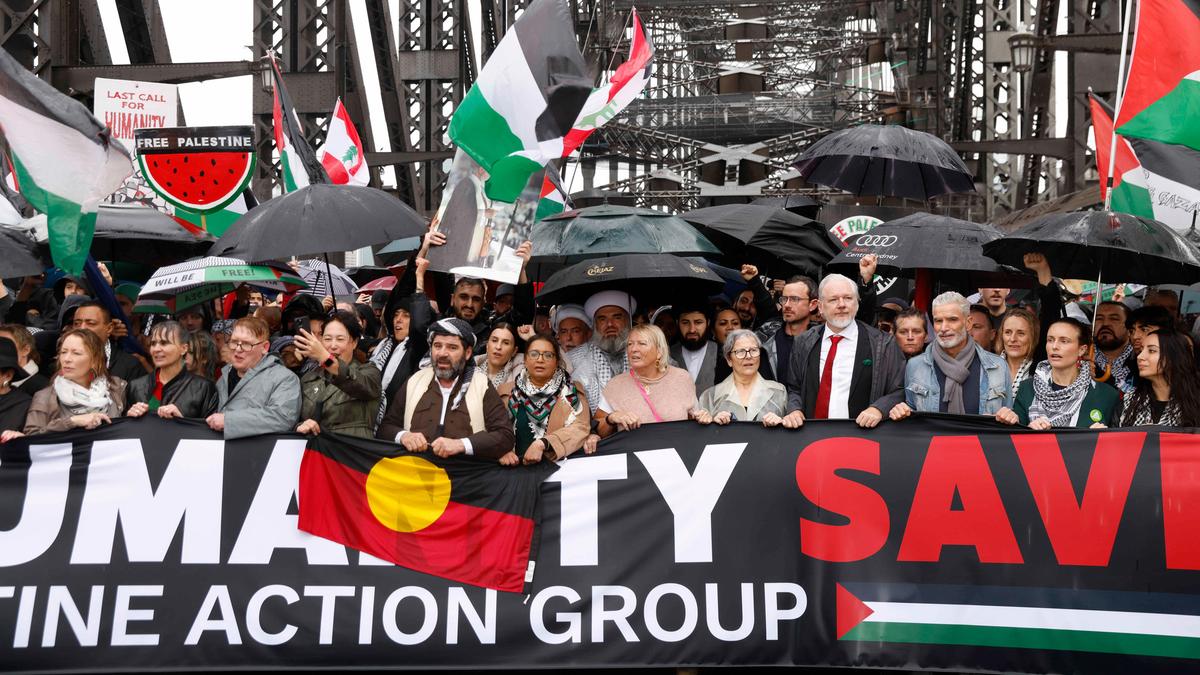
Albanese didn’t talk to President Donald Trump about his plans which ramped up after an anti-Israel mob walked over Sydney Harbour Bridge on August 3, decked out in Hamas colours and with pictures of Iran’s despotic leader Ayatollah Ali Khamenei on display.
So it was hardly surprising that Albanese had nothing to report when he appeared with Speers again last weekend and was asked about Trump’s plans for a Board of Peace to oversee the reconstruction of Gaza.
“Look, we’ve been focused this week obviously on domestic concerns,” Albanese said.
“We’ll give it further consideration, but Australia has been a founding member of the United Nations. It was a former Labor leader, of course …”
Speers: “And would this undermine the UN, this Board of Peace?”
US President Donald Trump. Credit: AAP
Albanese: “Well, it’s unclear what the objectives of this are, which is why we will give it further consideration. My government is one that always has an orderly, considered approach to all of our policy, including our international engagement.”
It appears Albanese was cut off from making a reference to “former Labor leader” Doc Evatt who helped establish the UN Committee on Palestine in 1947 and later presented a plan that allocated 56 percent of the mandated territory to a Jewish state, the rest to Palestinians.
Evatt then championed the cause of Israel in the general assembly and when it came to the vote, Australia’s was the first recorded.
So it’s a shame Speers didn’t give Albanese a chance to go down the Evatt rabbit hole. For entertainment value alone.
However, he did lead the Prime Minister down another one with a fallacious question about Trump’s comments on the role of NATO troops in Afghanistan.
“I want to ask you about these extraordinary comments from the US President about the role NATO and other allies played during the war in Afghanistan,” Speers said.
“Here’s what he (Trump) said. ‘They’ll say they sent some troops to Afghanistan and they did. They stayed a little back, a little off the frontlines.’ Prime Minister, 47 Australians died in Afghanistan. More than 260 were wounded. What’s your response to these comments?”
The problem with Speers’ question is that Trump said nothing about “other allies” in his egregious comments about NATO soldiers. Speers invented that.
Anyone who saw the Fox News interview understands that Trump was asked about whether NATO would “be there” if the United States “ever needed them.”
It was part of Trump’s ongoing spat with his NATO partners about the level of their defence spending — which he had already bullied them to lift to 5 per cent of their GDPs — including ridiculous speculation about testing them by calling for their help with the “invasion” of America’s southern border.
After 9/11, NATO for the first and only time invoked Article 5, which states that an attack against one member is an attack against all.
However, the US chose to run the Afghanistan war (Operation Enduring Freedom) outside NATO, because Washington doubted NATO’s military effectiveness.
NATO’s International Security Assistance Force and Resolute campaigns were not Article 5 operations.
“I’ve always said, ‘Will they be there, if we ever needed them?’ And that’s really the ultimate test,” Trump said in the Fox interview. “And I’m not sure of that.”
Apart from the fact that neither the questioner nor Trump was talking about anything other than NATO, the Australian troops who fought in Afghanistan didn’t fight under NATO command.
Specifically because Australia is not part of NATO, our troops in Afghanistan remained under Australian national command at all times.
So NATO countries have a right to outrage over Trump’s comments, but ours is a mixture of fabrication and over-reaction.
Anyway, back to Palestine.
While Abbas gave lip service to the PA formally recognising Israel’s right to exist — something the chants of “river to the sea” abrogate — this commitment is not accepted by any of the Palestinian political factions.
Just like the other undertakings that Albanese foolishly accepted, instead of making compliance a condition for recognition when achieved.
In an outstanding contribution to the national debate last weekend, the president of the Zionist Federation of Australia, Jeremy Leibler, traced what he called Western societies’ “growing preference for grievance-based collectives over individual moral accountability” as a defining modern moral failure.
Leibler fingered anti-Zionism — the objection to Israel’s right to exist — as an expression of the phenomenon.
“This shift is routinely presented as compassionate and inclusive,” Leibler wrote.
“In reality, it has proven corrosive to liberty and fatal to moral clarity and cultural confidence.”
Leibler argued that Israel is not criticised as a country among others, but prosecuted as a moral crime.
Its citizens and supporters — and by extension all Jews — are stripped of individual agency and reduced to symbols of collective guilt that no other nation or movement was asked to bear.
“This same collectivist logic also underpins a strain of activism that claims to speak for Palestinians while excusing violence and rejecting coexistence,” Leibler wrote.
“It has little to do with Palestinian welfare, which would demand accountability from leaders and movements that have governed, and too often destroyed, Palestinian lives.
“In too many influential activist circles, the organising purpose is not peace or statehood but the elimination of the Jewish state.
“Violence is contextualised. Terror is sanitised. Murder and rape are rationalised as resistance, while any attempt at moral or factual challenge is dismissed as illegitimate.”
If only those children — and the infantilised adults leading them, including those in politics — who mindlessly chant ‘river to the sea’ understood the murderous intent behind their words.