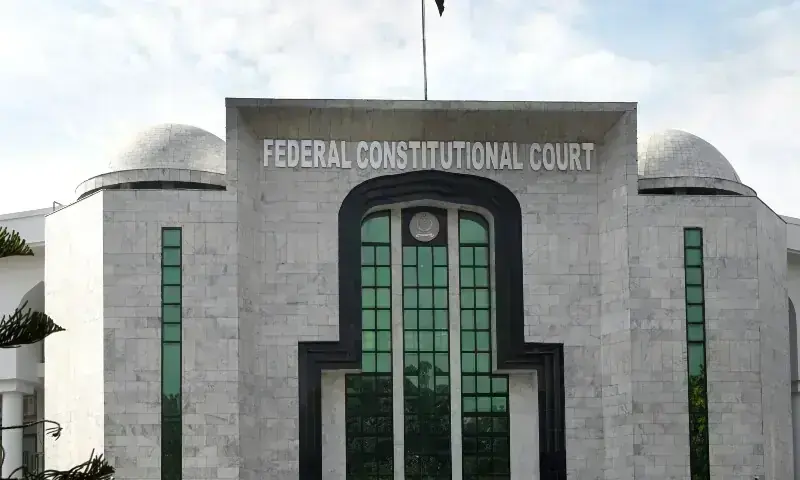
ISLAMABAD: The Federal Constitutional Court (FCC) on Thursday ruled that any mistake or slackness on the part of a party engaged in court proceedings does not entitle it to file an application under Section 12(2) of the Code of Civil Procedure (CPC).
Section 12(2) of CPC allows an aggrieved party to challenge a final judgement, decree, or order before the same court on grounds of fraud, misrepresentation, or lack of jurisdiction. “A party, when associated with the proceedings, has every right to plead its case and rebut the other side’s case to protect its rights. However, when a party contests a suit or proceedings and remains unsuccessful thereafter, it has no right to file an application under Section 12(2) CPC,” observed Chief Justice Aminuddin Khan, who authored the judgment.
Headed by the CJ, a two-judge bench comprising Justice Ali Baqar Najafi had taken up a civil appeal by Mian Tahir Raza against the May 14, 2019, Lahore High Court (LHC) rejection.
The FCC upheld the high court order with an observation that the court cannot disagree with the findings recorded by the LHC; therefore, this appeal fails and stands dismissed.
Judgement notes error of fact cannot be corrected in writ unless it leads to jurisdictional defect
The dispute originated from a 1985 declaration suit filed by respondent Mubasher Ahmed, who claimed ownership of a property and challenged a registered power of attorney in favour of respondent No.2, as well as a registered sale deed transferring the plot to the present appellant. The appellant had purchased the property from respondent No.2, who acted as attorney for the plaintiff.
The respondent No.2, the alleged attorney, filed a written statement in the court and thereafter he disappeared, whereas the appellant filed a written statement and contested the suit. After full contest, recording of evidence, and a full-fledged trial, the suit was decreed on April 17, 1993.
The appeal preferred by the appellant against the said judgement was dismissed by the Additional District Judge, Lahore. Subsequently, a civil revision was filed in the LHC, which too was dismissed, whereas the high court agreed with the concurrent findings recorded by the fora below and held that the same were supported by the evidence on record, which called for no interference.
The appellant opted to file an application under section 12(2) CPC mainly on the ground that the appellant came to know after the decision of the civil revision that the plaintiff and his father played some fraud on the court to claim that the plaintiff was a minor at the time of the preparation of the power of attorney. The application was summarily accepted by the high court without recording of evidence, considering the facts narrated in the application under section 12(2) to be correct.
The judgement was assailed before the Supreme Court and the matter was remanded back to the trial court. The civil judge, First Class, Lahore, on Nov 11, 2008, dismissed the application. The revision filed there against it was also dismissed on Sept 14, 2009, as well as a petition by LHC on May 14, 2019 against which the present appeal was filed before the FCC.
While deciding the matter, the FCC held that in civil matters, once the trial court and the appellate court have reached a concurrent finding of fact based on the evidence, the court in its writ jurisdiction will not substitute its own conclusion for that of the lower forums simply because a different view was possible.
It said the Supreme Court in 1974 Muhammad Hussain Munir had held that the high court’s jurisdiction under Article 199 was limited to seeing whether the lower forum acted within its jurisdiction or not. The FCC said an error of fact, however grave, cannot be corrected in writ jurisdiction unless it leads to a jurisdictional defect.
The FCC observed that during the proceedings the appellant was required to show some jurisdictional defect to the high court, or committed by the fora below, but the appellant failed to do so, therefore, the writ petition was rightly dismissed.
Published in Dawn, April 3rd, 2026