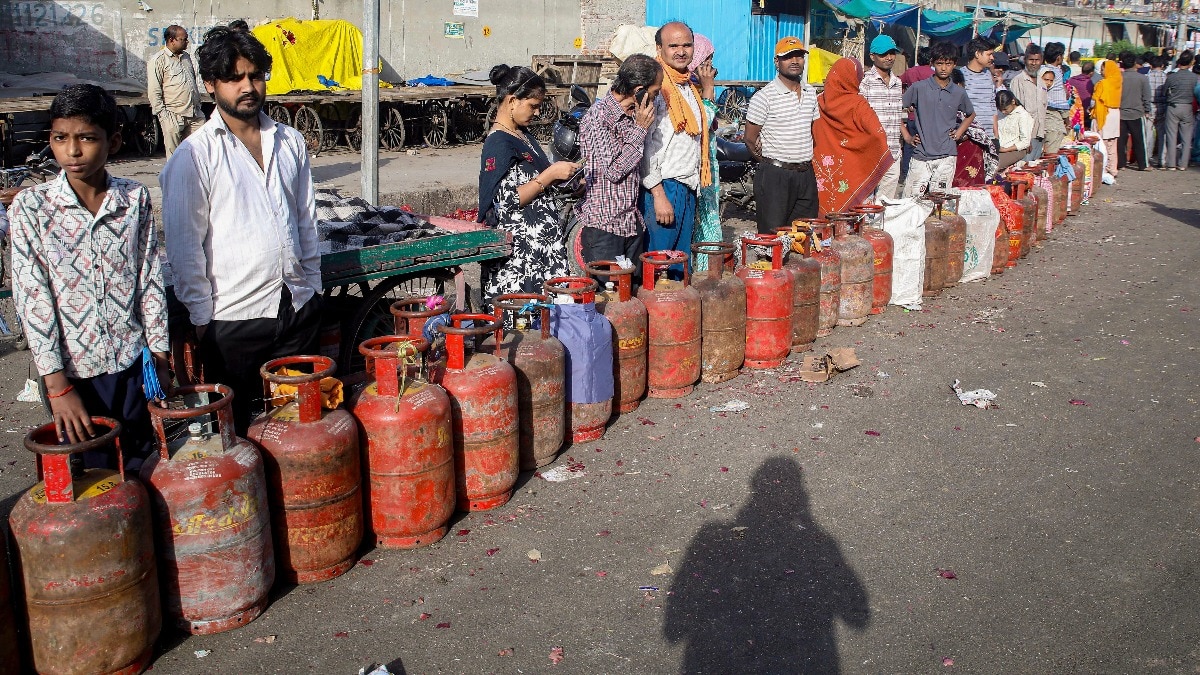
As concerns over fuel supplies rise due to the ongoing crisis in the Gulf, the gap between official claims and ground reality is becoming increasingly visible in India’s capital. While authorities maintain that there is no shortage of LPG, an India Today undercover investigation has revealed a thriving black market where gas cylinders are being sold at exorbitant rates — and often in plain sight.
The sting operation exposes how LPG cylinders are being hoarded, illegally traded, and diverted from legitimate consumers across multiple locations in Delhi.
Read Full Story
BLACK MARKET FLOURISHES NEAR ALIPUR POLICE STATION
Acting on a tip-off, the India Today Special Investigation Team reached a shop located just a few metres from the Alipur Police Station in Outer Delhi.
The allegation: LPG cylinders were being hoarded and sold illegally.
At the shop, the team met a man named Ankit and asked if he could provide a gas cylinder. His response was direct. He enquired whether the reporters had an empty cylinder and then quoted a price of Rs 4,300.
This is nearly five times the official price of a domestic LPG cylinder, which stands at Rs 913 in Delhi. When asked if the price could be negotiated, Ankit refused, saying this was the rate at which he himself was procuring the cylinders. He confirmed that Rs 4,300 was the “going rate” in the black market.
INFLATED PRICES, OPEN TRANSACTIONS
To verify the operation, the reporters carried an empty cylinder and attempted to make a purchase. At the same location, they witnessed a labourer paying Rs 4,300 in cash for a cylinder, highlighting how even the economically vulnerable are being forced to pay inflated prices.
Since the reporters had an Indane cylinder, while Ankit was dealing in cylinders from another supplier, he demanded an additional Rs 200 for the exchange. This pushed the total cost of the cylinder to Rs 4,500.
Despite the illegal nature of the transaction, Ankit went to the extent of weighing the cylinder before handing it over, giving the deal an appearance of legitimacy. The payment was completed via UPI, further indicating how openly such transactions are being conducted.
When asked if more cylinders could be arranged the next day, Ankit readily agreed, suggesting a steady and organised supply chain behind the operation.
A NETWORK EXTENDING BEYOND ONE LOCATION
The investigation then moved to the Cake Chowk area, where another operator named Sitaram was found facilitating similar transactions.When approached for two cylinders, Sitaram quoted Rs 4,000 per cylinder. He immediately contacted a man named Sanjay to arrange the supply, demonstrating the existence of a coordinated network of suppliers.
During the call, Sitaram confirmed that Indane cylinders would be available and assured delivery within 15 to 30 minutes. He directed the reporters to meet him near the local drain in Swaroop Nagar to collect the cylinders.
MAUJPUR: ILLEGAL TRADE HIDDEN IN PLAIN SIGHT
From Outer Delhi, the investigation moved to Maujpur in East Delhi, where LPG black marketing was found to be operating openly under the cover of everyday businesses.
Like this stationery shop doubling as an LPG supplier. At this stationery shop run by Sanjay Jain, the initial response was a refusal. However, after making a phone call, he agreed to arrange a cylinder within 2–3 hours for Rs 3,400.
He confirmed that the cylinder would be from the Indane supply chain.
FLOUR MILL SHOP ACTING AS MIDDLEMAN
At another location, a flour mill selling wheat flour and spices, illegal LPG trading was also taking place.The shopkeeper, Girish Jain, contacted his network and assured delivery of a cylinder for around Rs 3,500. He asked the reporters to share their mobile number and promised to call once the cylinder arrived.
STOVE REPAIR SHOP FACILITATING ILLEGAL SUPPLY
A third shop in the same area, dealing in cooking stove repairs, was also part of the network.The shopkeeper, Shubash, asked whether the reporters had an empty Indane cylinder. Upon confirmation, he agreed to arrange a refill for Rs 3,500. All these small-shop operations demonstrate how widespread and normalised the black market has become.
A WELL-ORGANISED SUPPLY CHAIN
Across all locations, from Outer Delhi to East Delhi, the investigation revealed a deeply entrenched and organised network of LPG black marketers.The pattern was consistent:Cylinders were sold without booking slips. Prices ranged between Rs 3,400 and Rs 4,500, far above official rates. Suppliers operated through informal networks and phone calls. Deliveries were arranged within hours.Transactions were conducted both in cash and digital payments. In many cases, small shopkeepers acted merely as intermediaries, connecting buyers to larger suppliers.
EXPLOITING PANIC AND DEMAND
The investigation suggests that panic triggered by global supply concerns is being actively exploited by black marketers.With delivery delays and restrictions on LPG cylinders, many households and small businesses, especially those dependent on cooking gas for daily operations, are left with little choice but to turn to the black market. This has created a parallel economy where illegal operators are making significant profits by diverting cylinders meant for genuine consumers.
THE BIGGER QUESTION
The findings raise serious concerns about the integrity of the LPG distribution system. If authorised agencies are strictly enforcing booking rules, how are such large quantities of cylinders entering the black market? Is there diversion happening within the supply chain? Or is there a larger nexus enabling this illegal trade?
For now, the question remains: when will the authorities act against this blatant exploitation?
– Ends
Published By:
Sayan Ganguly
Published On:
Apr 1, 2026 18:29 IST