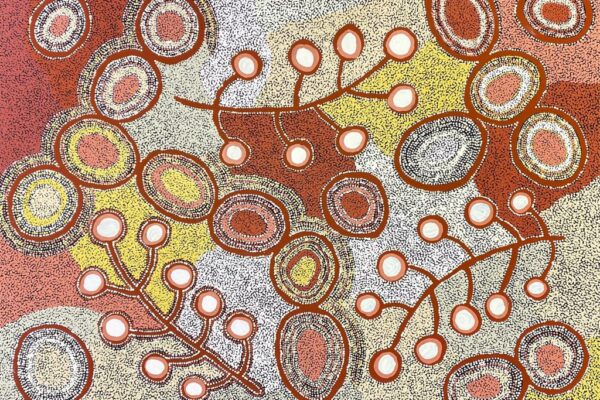
Please be advised that this post contains the names of deceased persons. In lieu of images of the deceased, which are offensive to Aboriginal persons, this post contains images of art by contemporary Aboriginal artists.
TW: genocide, slavery, exile, sexual violence, imprisonment, forced labor
For this month’s Kickass Women in History, we go to Tasmania, an island state of Australia, home of the Palawa people. The Palwala people called their home Lutruwita, and early British colonizers referred to it as Van Diemen’s Land. From 1803 to 1853, Van Dieman’s Land was Australia’s primary penal colony. Later on, the island’s name was changed to Tasmania to avoid the stigma of its penal colony history.
Tarenorerer was a Tommeginne woman born around 1800. Between 1800 and 1850, more than 70,000 people were exiled from England and forcibly deported to Van Diemen’s land and subjected to forced labor. This was an incredibly violent time in Tasmania. The convicts were disproportionately male and sexual violence against women was pervasive, while the convicts in general struggled to survive a harsh environment and harsh treatment from their overseers.
Two Women, by Alison Munti Riley
While life was difficult for the convicts, it was worse for the Aboriginal people who were murdered on sight. The convicts and their overseers carried out systemic genocide against Aboriginal Tasmanians during a conflict known as ‘The Black Wars.’ While most of the genocide focused on mass murder, George Augustus Robinson developed the “Friendly Mission,” a plan to forcibly deport Aboriginal Tasmanians to Flinders Island.
When Tarenorerer was in her teens, she was captured and taken from her family by another clan and sold to White sealers on the Bass Strait Islands. During her captivity, she learned to speak English and to use guns.
Tarenorerer escaped in 1828 and became the leader of the Plairhekehillerplue clan of Emu Bay. She led them in a guerilla war against the colonizers. She taught her followers to lie down flat when the settlers were shooting and to fire when the settlers were reloading. They killed colonizers and livestock, taunting colonizers until they left their shelters and came out into the open. Robinson called her “an Amazon,” considered her to be extremely dangerous, and sought to capture her to no avail.
Ngangjari Ngura (Healing Country) 884-21 by Betty Muffler
Eventually Tarenorerer’s people ran low on supplies and experienced conflict with other Aboriginal groups. She fled, and was captured by sealers who took her to Bird Island to hunt seals and shearwaters. No one knew who she was until she tried to escape, was captured again, and revealed her real name.
Tarenorerer was imprisoned but this did not stop her from stirring up shit in the best way. According to History Podcast:
However, she did manage to cause a little havoc whilst in Robinson’s camp. She spread a story amongst the Aboriginal people- who were willingly travelling with Robinson -that there was a boat full of soldiers with guns coming from Launceston to chain them up, put them in jail and shoot them. Robinson, of course, was not very happy with this little upset to his “friendly” mission, so he sent her away with his scout Parish to search for more women to join his party. Upon her return, she again threw the camp into chaos by telling them that the white men were intending on shooting them.
Tarenorerer died in 1831 of influenza. The Black War continued for approximately another year, costing over a thousand Aboriginal lives. The process of “transportation” (forced deportation to Australia) ended in 1868. Today, an annual National Day of Healing, also called National Sorry Day, happens every May and recognizes the harm caused to Aboriginal communities by violence, dispossession, and removal of children for forced assimilation.
Additional resources:
Images of Aboriginal Australian art courtesy of Vogue Australia.