Standing outside Gate No. 2 of the Indira Gandhi Pratishthan, a sprawling convention centre in Lucknow, 66-year-old Vinay Gautam on March 13 urged a small group of young men to step inside and listen to the speakers at a political gathering.
“How many times will you get the opportunity to hear about the great Kanshi Ram? These people are not only observing his birth anniversary, but also discussing his agenda and political ideas,” he told the men.
“You are here only because of him [Kanshi Ram] and [B.R.] Ambedkar,” Gautam added, chiding them for what he described as a lack of awareness. “These days, you people fail to understand these important things,” he said.
A Dalit activist who worked with Kanshi Ram in the 1990s, Gautam was among thousands of people attending the Samvidhan Sammelan (Constitutional conference) organised by the Congress party at Lucknow’s Indira Gandhi Pratishthan, a venue that holds events such as political gatherings, art exhibitions, and weddings.
Kanshi Ram, the founder of the Bahujan Samaj Party (BSP), would have turned 92 years old this year on March 15. Not a landmark birthday, but his legacy has dominated political discourse in Uttar Pradesh over the last two weeks. Leaders across the political spectrum invoked his name, describing him as an “icon of downtrodden social and caste groups”.
Rahul Gandhi, the Leader of the Opposition in the Lok Sabha, wrote to Prime Minister Narendra Modi, urging that Kanshi Ram be conferred the Bharat Ratna posthumously.
The Samajwadi Party (SP), once the bête noire of the BSP in U.P., also marked Kanshi Ram’s birth anniversary across district offices and at the headquarters.
“Kanshi Ram is a true icon of marginalised social groups. We will carry forward the mission initiated by him,” SP chief Akhilesh Yadav said on March 4, adding the proposal of observing March 15 as PDA Diwas, which is dedicated to the cause of the broader unity of the Pichhda (backward), Dalit, and Alpsankhyak (minorities) people.
Gautam, however, is delighted, irrespective of political parties’ agendas. “It shows the impact of the person and his relevance. That even 20 years after his death, over 4,000 people have come to hear his words,” he said.
At the Samvidhan Sammelan, Gandhi described the late leader as a fighter who had struggled all his life for social justice. Had India’s first Prime Minister Jawaharlal Nehru been alive during the time of Kanshi Ram, the Congress would have made him the Chief Minister, Gandhi said.
“He [Rahul Gandhi] is using Kanshi Ram’s name to reach out to Dalits,” said Gautam. “But at least Rahul Gandhi is trying to build a bridge with the community by acknowledging the shortcomings of his party,” he added in the same breath.
The Congress, when Nehru served as the Prime Minister, saw four CMs of U.P., all from upper castes.
By the time of his death in 2006, Kanshi Ram’s name had come to be associated with mobilising the Bahujan (marginalised majority), including Scheduled Castes (SCs), Scheduled Tribes, Other Backward Castes (OBCs), and minorities.
In Uttar Pradesh, SCs make up around 21% of the population, minorities about 20% and OBCs are estimated by political parties to constitute up to 40%. “Kanshi Ramji’s idea was to transform the Bahujan Samaj from a vote-giver to a power getter,” said Gautam.
Mobilisation on identity
Born into a Ramdasia Sikh family in Rupnagar district of Punjab, Kanshi Ram joined a government job in Pune in the late 1950s, where he later claimed that he witnessed discrimination against Dalit employees. During this time, he began to read lawyer-cum-activist-cum-social reformer B.R. Ambedkar, with his book, Annihilation of Caste, making a particular impression. Influenced deeply by Ambedkar’s writing, he adopted the call to “educate, agitate, and organise”.
Around the mid-1960s, he experienced a sense of disenchantment with the leadership of the Republican Party of India, which represented marginalised castes and went on to establish the All India Backward and Minorities Communities’ Employees Federation (BAMCEF) in 1978. It is an organisation representing government employees from marginalised castes, aimed at creating a solidarity network among hundreds of oppressed castes, spanning religions.
In 1981, he formed another social organisation known as the Dalit Shoshit Samaj Sangharsh Samiti or DS4, aiming to consolidate the Dalit vote. When he founded the BSP, he said that if 50% of Bahujans could unite and form an alliance, establishing a government would be feasible.
BSP founder Kanshi Ram and Mayawati, now its national president, at a rally in Lucknow in 2002
| Photo Credit:
The Hindu
MP and founder of the social group Bhim Army, Chandra Shekhar Azad, whose political party is called Aazad Samaj Party (Kanshi Ram), reiterates Kanshi Ram’s slogan: “Jiski jitni sankhya bhari, uski utni bhagidari”, a statement in favour of proportional representation, which is perhaps the most popular slogan used by political leaders from all parties even today.
“It has become the sine qua non of representational politics, mirroring modern demands for a caste census and proportional representation in elections,” said Ajit Kumar Jha, an Oxford University researcher, who followed Kanshi Ram’s politics closely in the 1990s.
However, the BSP failed to gain traction in other States. In 1989, the party won 13 out of 425 seats in the U.P. Assembly and four out of 543 seats in the Lok Sabha poll (three in U.P. and one in Punjab) that year. In the 1992 Punjab Assembly poll, the party won nine out of 117 seats, polling over 16% of the votes, but could win only one seat in the next election. The BSP’s appeal was to the Dalits in U.P.
“The real legacy of Kanshi Ramji is in building a new India on the ideology of the Constitution and social justice. He lived by the ideas of Buddha, Kabir, Ravidas, Phule, and Ambedkar,” said Laxman Yadav, an activist.
It is this legacy that other parties are now trying to claim. “Our party’s PDA is the same as the Bahujan Samaj that Kanshi Ram referred to. We speak for the oppressed and the marginalised,” said Umesh Choudhary, an SP worker based in Lucknow.
Another SP leader, Ameeque Jamei, said, “At a time when atrocities on Dalits, OBCs, and minorities are at their peak under the BJP rule, the ideas and struggle of Kanshi Ram become more relevant.”
The BSP and SP found a fit in the post-Babri Masjid U.P., with an alliance in the 1993 Assembly elections. “Mile Mulayam-Kanshi Ram, hawa mein ud gaye Jai Shree Ram,” signified the coming together of the Bahujan.
Under the guidance of Kanshi Ram, the BSP formed governments with the support of the Bharatiya Janata Party (BJP) thrice in U.P. with Mayawati as Chief Minister. Only in 2007 was the BSP able to form the government without the BJP’s support, after which it saw a rapid decline. In the 2009 Lok Sabha polls, the BSP polled 27.42% votes, winning 20 seats, while in 2024 its vote share dipped to 9.39%.
The symbolism and pushback
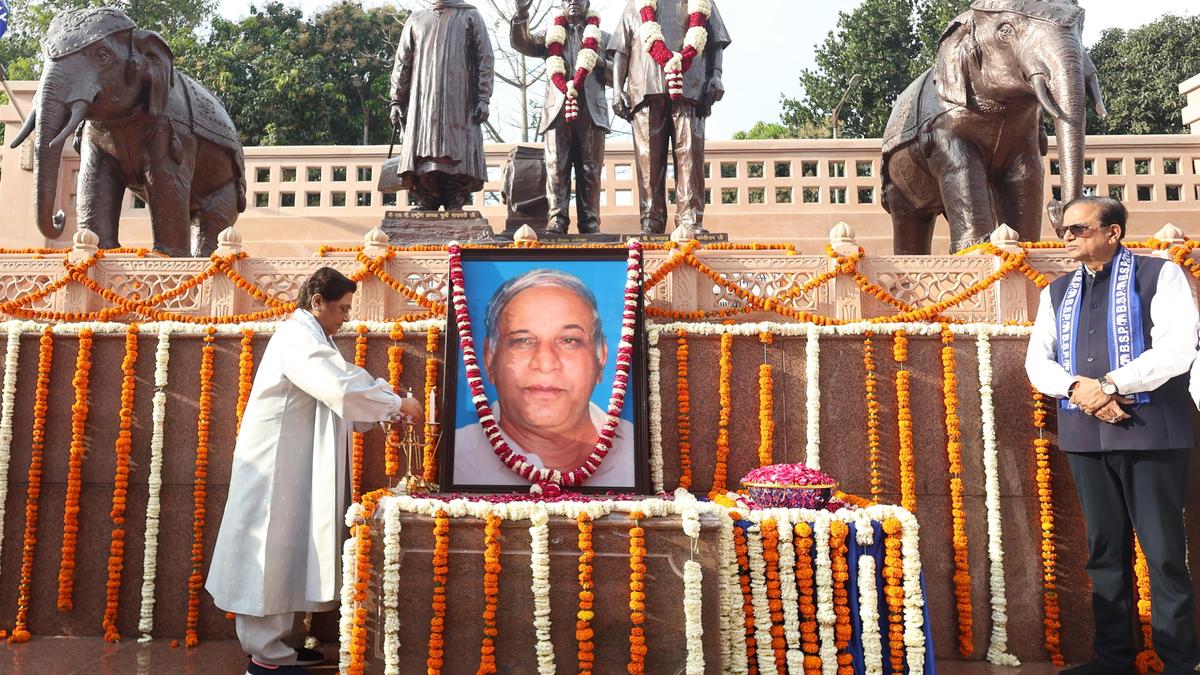
In symbolic moves, the BSP government constructed parks, memorials, and universities dedicated to icons like Dr. B.R. Ambedkar and Kanshi Ram. “These statues resulted in a feeling that people from our social group contributed equally in the making of the Indian republic,” says 62-year-old Mohan Ram, a BSP voter, who attended most of Kanshi Ram’s rallies in Lucknow.
Over the last few years, many of these statues have been vandalised, with activists saying that breaking the statues symbolises the discomfort and fear of feudal forces. The BJP has been in power since 2017.
“Baba Saheb and Kanshi Ramji are not just historical personalities. They are symbols of equality, justice, and self-respect. These incidents cannot be dismissed as mere acts of anti-social elements, but must be seen as social justice taking a hit,” says Laxman.
“The challenge for any party is whether it can expand its social base. The BSP failed in this. I travelled with Kanshi Ram in Madhya Pradesh during the 1993 Assembly election. He would eat at party workers’ houses like a family member,” says Manindra Nath Thakur, a political scientist at Jawaharlal Nehru University.
He adds that in the latter part of his life, Kanshi Ram moved “from the identity-based politics of the 1990s” to “culture-centric politics in the early 2000s”.
On October 9, 2025, the Congress began a 45-day Dalit Gaurav Samvad (Dalit pride conversation), on the death anniversary of Kanshi Ram, holding meetings and conferences in localities with a high SC population. Over 500 such meetings took place across U.P.
On March 15, the Congress also organised State-wide events to observe the birth anniversary of the Dalit icon. “From the beginning, our party has been very clear that we want an egalitarian, democratic society. To achieve this, Kanshi Ram’s ideas fit, hence we celebrate and follow him,” says Anil Yadav, a Congress leader.
Asad Rizvi, a Lucknow-based journalist, says that all these moves are to bring the Dalits under the Congress umbrella.
On November 4, 2025, at a public rally, Gandhi spoke about how “10%” of the population controls major institutions, and that tribals, SCs, OBCs, and minorities have little representation in private firms, the judiciary, the bureaucracy, and the armed forces. “This was what Kanshi Ram said all his life, aiming to unite the marginalised,” says Rizvi.
Meanwhile, Mayawati said on X that she is the “sole successor” and that the SP and Congress are anti-Dalit.
Under the INDIA alliance in the 2024 Parliamentary polls, a section of Bahujan voters supported the coalition to win 43 out of 80 seats.
mayank.kumar@thehindu.co.in