Local News
This is the first time scientists with the New England Aquarium have seen blue whales in southern New England waters.
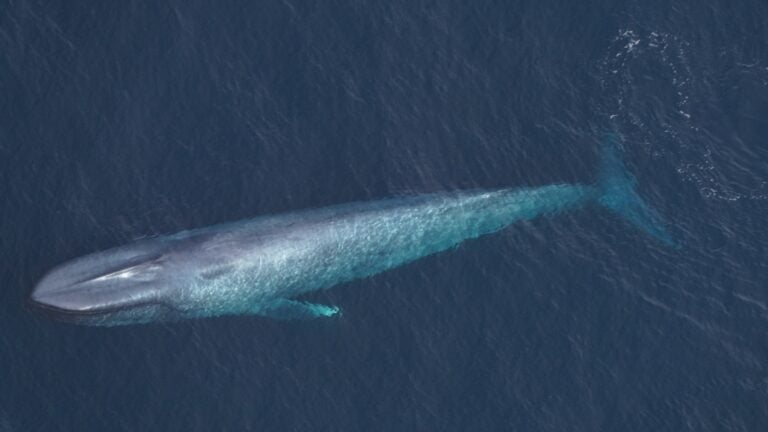
A blue whale seen by the New England Aquarium’s aerial survey team over Northeast Canyons and Seamounts Marine National Monument on Feb. 27, 2026. New England Aquarium
Scientists from the New England Aquarium spotted multiple blue whales in waters off of southern New England last week, in what they describe as an exceptionally rare occurrence.
Blue whales, the largest animals to ever have existed on Earth, are an endangered species that can be found globally. Relatively little is known about a population that lives in the western North Atlantic Ocean, which is thought to contain between 400 and 600 individuals, according to the aquarium.
An aerial survey team saw one blue whale on Feb. 27 swimming near the Northeast Canyons and Seamounts Marine National Monument, an area located about 130 miles southeast of Cape Cod. The solitary whale was seen near the base of Lydonia Canyon, the easternmost canyon in the monument.
The next day, the aerial survey team spotted two blue whales just 15 miles south of Martha’s Vineyard. This is the first time the aquarium has documented a blue whale in its southern New England survey area.
Researchers normally study this blue whale population during the summer, when they feed in the Gulf of St. Lawrence, off of Canada. It is uncommon to see the animals outside of this area, according to the aquarium.
Researchers at the aquarium have only seen blue whales in New England waters twice before. One sighting occurred in the Northeast Canyons monument in 2020, and another occurred off the coast of Maine in 2023. Other sporadic sightings have been reported, including off of Cape Ann in 2024.
“Seeing blue whales outside of their Canadian feeding grounds is rare in the Atlantic,” Katherine McKenna, a scientist at the aquarium’s Anderson Cabot Center for Ocean Life who was aboard both survey flights, said in a statement. “Finding them in two different areas of the ocean just 24 hours apart was a first for us.”
A map released by the New England Aquarium shows the locations of recent blue whale sightings in the waters of southern New England. – New England Aquarium
The sightings likely indicate that oceanographic conditions in the waters of southern New England are “ripe” for blue whales searching for food, Orla O’Brien, another scientist with the aquarium, said.
The diet of a blue whale mostly consists of krill. They typically spend summers feeding in polar waters before moving closer to the equator in colder months, according to NOAA. However, individuals in certain areas are believed to not migrate at all, and migratory patterns are generally not well known. Their distribution is largely influenced by food availability.
“Blue whales can range over huge swaths of the ocean unseen by scientists, so each sighting gives us an important glimpse into their winter and spring movements,” O’Brien said.
The average lifespan for a blue whale is estimated to be between 80 and 90 years. Like other whales, they are at risk of being entangled in fishing gear and being struck by vessels, especially in heavily trafficked areas.
While surveying the Northeast Canyons monument last week, scientists documented more than 300 animals, including three endangered fin whales, three endangered sperm whales, about 50 pilot whales, and hundreds of dolphins, according to the aquarium.
The Trump administration rolled back protections for species within the Northeast Canyons monument last month.
“This Monument supports amazing species from the seafloor to the sea surface, and we see evidence of that during every aerial survey. Removing protections for Northeast Canyons and Seamounts Marine National Monument puts these species at risk,” Jessica Redfern, associate vice president of ocean conservation science at the Cabot Center, said in a statement at the time.
Ross Cristantiello
Ross Cristantiello, a general assignment news reporter for Boston.com since 2022, covers local politics, crime, the environment, and more.
Sign up for the Today newsletter
Get everything you need to know to start your day, delivered right to your inbox every morning.