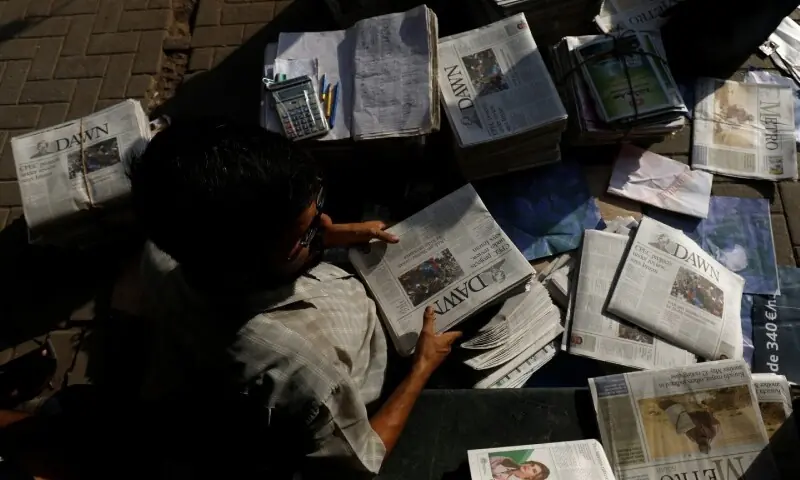
The Human Rights Commission of Pakistan (HRCP) and the All Pakistan Newspaper Employees Confederation (Apnec) on Tuesday condemned the ban on government advertisements to the Dawn Media Group and its outlets and lamented the attack on freedom of expression.
The HRCP expressed grave concern over the “rapidly shrinking space for independent and critical news reporting in the country”, including the ban on government advertisements to the Dawn Media Group and its outlets.
The development comes as several media bodies have condemned the government’s unannounced restriction on advertisements to Dawn Media Group’s TV and radio outlets — imposed after curtailing ads to its flagship newspaper — and called on the authorities to immediately rescind the ban.
“The HRCP expresses grave concern over the rapidly shrinking space for independent and critical news reporting in the country, including the reported 13-month ban on government advertisements to the Dawn Media Group, which has recently been extended to Dawn News and CityFM89,” the commission said in a post on social media platform X on Tuesday.
“This is ironic, given that Mohammad Ali Jinnah, the founder of Dawn, championed press freedom,” it said.
The commission added that the selective withdrawal of state advertising, which constituted public funds, had increasingly been used as a “coercive instrument to pressure media organisations, influence editorial choices and penalise critical journalism”.
“We reiterate that freedom of expression and democratic accountability cannot survive where economic coercion is used to discipline the press,” it said.
The HRCP also urged the government to end such “discriminatory practices and restore an enabling environment for free, independent and responsible journalism”.
‘Economic murder’
The All Pakistan Newspaper Employees Confederation (Apnec) has condemned the banning of advertisements in media outlets as the ‘economic murder’ of media employees and urged the government to stop targeting Dawn.
While addressing a meeting, Apnec Secretary-General Asghar Khan strongly condemned the closure of Dawn Media Group’s advertisements and demanded that the practice be stopped immediately and that advertisements be distributed according to merit and law
“Ban on Dawn newspaper advertisement would be considered an attack on freedom of the press.”
“Apnec fully believes in freedom of expression and democracy and has always fought against brutality and undemocratic tactics in media houses in the past,” he added.
The chairman of the confederation, Shakeel Yamin Kanga, termed the closure of advertisements as an economic murder of media employees and an attack on freedom of expression and said that the government should not play with the lives of media workers.
“All Pakistan Newspaper Employees Confederation stands with its colleagues in this difficult time,” he said.
The confederation also pledged that if the government did not take any action, there would be a nationwide protest.
Last week, the Council of Newspaper Editors (CPNE) said Dawn was among Pakistan’s most respected media outlets, and stopping the release of government ads to the group amounted to financially crippling the organisation.
The All Pakistan Newspapers Society (APNS) also spoke out against the stoppage of government ads to the group’s outlets, saying it was “dismayed”.
The Pakistan Broadcasters Association (PBA) slammed the ban on ads for Dawn Media Group outlets as well, saying it had always resisted “using advertising as tools to control media and free expression”.
The Joint Action Committee (JAC), comprising representatives of multiple journalist bodies, also criticised the restriction, saying the government was using official advertising as a tool to pressure media organisations.
Earlier this year, the Pakistan Federal Union of Journalists (PFUJ) noted in its ‘Islamabad Declaration’ that Dawn has been denied advertisements by the federal and Punjab governments since October 2024 “because of its professional and critical approach in reporting and editorials”.
This was not the only way in which authorities have tried to obstruct Dawn’s reporting — after the so-called ‘Dawn Leaks’ saga, the paper’s circulation was blocked in large parts of the country, especially the cantonment areas.