There was a clear, definable turning point in the Sydney Kings’ season.
Look at them now and we see a team that is the favourite going into the 2026 NBL Championship Series, having not lost a game since early January. But it took many bouts of adversity and a healthy self-examination to get to that point.
Editor’s Picks
Let’s paint the picture. It’s year two of Brian Goorjian’s second tenure as head coach of the Kings, and the off-season recruitment of electric American guard Kendric Davis and four-time Olympian Matthew Dellavedova early in free agency to put alongside one-time MVP Xavier Cooks were regarded as big-boy moves from a big-market team. Suddenly, the Kings’ roster looks like one with a heap of top-end talent, depth, and arguably the greatest coach in league history; the expectations were set accordingly.
The Kings are now just three wins away from another championship. Photo by Scott Gardiner/Getty Images
A combination of injuries and a lack of discernible identity saw them jump out to a slow start to the regular season; they opened their campaign 3-5, punctuated by a heartbreaking – and, frankly, disconcerting – one-point home loss to the Tasmania JackJumpers at the buzzer. A brief recovery followed, but back-to-back losses soon after left them 7-7, searching again.
All of a sudden, the Kings were on the back foot, and the upcoming schedule was daunting. Ahead of them was a three-games-in-six-days stretch in the middle of December: at Perth, at Melbourne, and then against the Adelaide 36ers in Canberra. There was a genuine feeling around Kings HQ that, if they lost those games, then there’d be very real pressure on Goorjian and his coaching staff.
Before those three games, there was some truth-telling around the team.
“We had to learn each other, get back to the drawing board,” Davis told ESPN.
Kendric Davis on the attack for the Kings. Photo by Jason McCawley/Getty Images
“Goorj sat down and met with me, X, and Delly to speak about changing up the style of play, and the guys bought into it.”
The Kings leant into what their roster dictated: a defence-first group that’s led by a pride of long, athletic, determined wings, and a mega-talented on-ball engine in Davis, who excels in space. Cooks added his elite two-way connectivity to the pack, while Dellavedova’s minutes reduced as he assumed a do-it-all plug-and-play role.
Of course, the Kings would go on to win all three of those games. More importantly, though, they found themselves.
“We lifted our pride in our defensive ability,” Cooks told ESPN.
“We started off so bad on that end. We took pride in being the No. 1 defence, because we know what that means in the postseason. From there, the joy came back. We were playing in transition, everyone was getting involved. It started to click, a new style of basketball for us.”
It was the beginning of a stretch where they won 17 of their last 19 contests, including 11 straight to finish the regular season, but how was the change so swift?
Ask around the Kings, and you’ll hear a similar sentiment floating around.
“It really started with Bul Kuol,” Cooks said. “He really took that step of being that fiery guy on the defensive end, and we fed off that.”
Davis had the same assessment: “Bul started it out for us,” he said.
It’s effectively a consensus.
“We shifted the pickup point, and a lot of that started with Bul,” Dellavedova told ESPN.
Kuol was the Kings’ persistent perimeter defensive specialist, who completely shifted the way the team operated by assertively picking the ball up full-court – and being an all-round nuisance to his opposition – every possession. It was the catalyst for the Kings’ defensive rating to shoot up to No. 1 in the league – it remains there – which facilitated an offence that had more pace, maximising Davis and the bulk of that roster.
“We really unleashed Bul, and it got contagious after that,” Dellavedova said. “I think that defensive pressure, and being able to get stops, and forcing a faster pace allowed us to play faster. Playing fast is KD’s thing.”
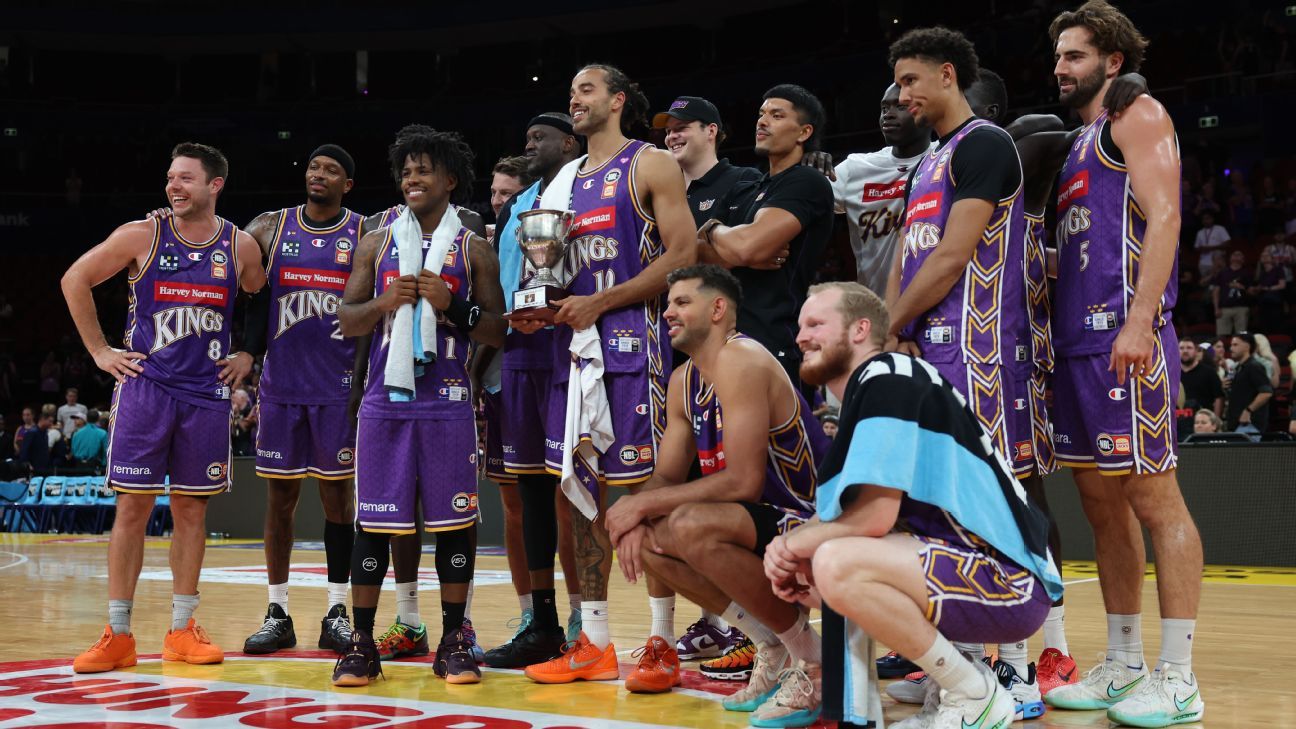
Matthew Dellavedova shares a moment with Makuach Maluach after the Kings’ win. Photo by Mark Metcalfe/Getty Images
That contagiousness, combined with the defensive personnel on the roster – “everyone on that team can guard,” one rival player told ESPN – made for a perfect and obvious storm when forming an identity over the course of the season.
“We like smothering teams like OKC,” Davis said.
The shift led to positive outcomes, which helped keep the standards high.
“Guys on our team know that people shouldn’t get one-on-one buckets against us,” Cooks said.
“Being able to switch makes it more of a one-on-one game. If someone gets scored on, the boys will turn to you and say ‘c’mon, now, you’re better than that’. We hold each other to a really high standard on that end.”
Unfortunately, the Kings suffered a major blow in early January, with Kuol suffering an ACL tear that would rule him out for the remainder of the season; just like that, the person guiding their new-found identity, and someone who inserted himself into the Defensive Player of the Year conversation, would be unavailable moving forward.
The Kings, however, leant very wing-heavy over their off-season, so an adequate replacement was, to put it aptly, waiting in the wings.
“When Bul went down, Makuach stood up and he became that head of the snake,” Cooks said.
That’s Makuach Maluach, a 6’6 guard/forward who had shown glimpses of being an effective three-and-D player in the NBL, but wasn’t afforded an extended opportunity because of the Kings’ depth in his position. Despite that, Goorjian made a concerted effort in the off-season to make sure the team re-signed Maluach; such was the 72-year-old’s confidence in the still-unproven-but-intriguing athlete.
Maluach stepped into a starting spot in early January and never relinquished it, carrying the torch handed to him by Kuol – who is in constant communication with his fellow wing on the sidelines – by guiding the Kings’ defensive identity.
“He loves guarding the best guy,” Cooks said of Maluach. “When he gets scored on, you can see he’s frustrated. I love guys who take pride on that end, because a lot of people glorify offence so much that defence gets missed.”
Maluach consistently guards the primary offensive player on the opposing team, has been hitting the three-ball at a high rate lately, and consistently makes game-changing plays; the most memorable, to date, was a block of a Jo Lual Acuil Jr. shot attempt at the rim in Game 1 of the Kings’ semifinals series against the Perth Wildcats.
“He’s like my all-time favourite teammate,” Davis said.
“Just seeing his willingness to grow, he’s a great teammate, always asking questions. Always.
“‘Hey KD, do you think I should’ve shot that?’. Hell yeah, you’re open, right? ‘KD, my bad, I let Doolittle get going too much, I’ll watch film and be better’.
“He’s always trying to grow. When you’re always trying to grow and always asking questions, you normalise developing the way he has. He’s mad about the right things. It’s always team first. What you’re seeing is a guy who put the team first, and the basketball gods rewarding him for being a great teammate and a great guy.
“Everyone on our team will tell you he’s always willing to learn, and he works super hard; those two things, they go hand in hand with success.”
Xavier Cooks’ two-way presence has been central to the Kings’ rise into title contention. Photo by James Worsfold/Getty Images
There are a heap of things that contributed to the Kings’ rise from a 3-5 team on the brink of collapse and one that’s set to host Game 1 of a Championship Series against the Adelaide 36ers. Kuol, then Maluach, guiding a defensive identity is one, along with the way Cooks and Tim Soares have been two-way connectors for the group.
Of course, Davis has put together one of the best individual seasons in recent NBL memory, averaging 24.8 points and 6.7 assists per game, finishing in close second in Most Valuable Player voting , with an eye toward a Championship Series MVP.
Cooks calls Davis the “best player in the league”, while the newest King – NBA veteran Torrey Craig – says the speedy point guard is a “natural competitor”.
“We’ve been playing pool, we’ve been bowling; it’s hilarious, he competes at everything,” Craig told ESPN.
“Basketball is our passion and our love, so that’s what we’re going to be the most competitive at, and KD is that. He’s like a firecracker of competitiveness. He’s not afraid of anything, he’s not afraid of any moment. He’s the guy that wants to be in these moments, and wants to have the ball in his hands in these moments. You can’t ask more of a guy like that. He’s a natural-born competitor, and that’s what I love about him the most.”
Davis as a ball-dominant guard wasn’t always the plan, though. When initially signed, the idea was actually for Davis to operate more as an off-ball guard, with Dellavedova utilising his connective, organising skillset to guide the offence. A rocky start, combined with Dellavedova missing some games with an infection, led Goorjian to run the offence primarily through Davis, and the results were immediately positive.
Dellavedova humbly accepted this new role that naturally came with less minutes and usage, but his value remained. When the Kings aren’t able to push and things get stagnant in the frontcourt, Dellavedova is able to enter the game, take over the point, and facilitate running sets. Then, there’s his value on the defensive end, illustrated by his excellent job guarding the much larger Kristian Doolittle in the Kings’ semifinals series.
It’s this unique plug-and-play role, where he’s inserted to remedy whatever deficiency the Kings may be experiencing at any moment.
“Sh*t, you tell him to go and play centre, he’ll play centre,” Davis said of Delly.
“As long as it helps winning, that’s all he cares about. That’s what makes his impact what it is. Even when we were 3-5, it didn’t feel like it, because of Delly’s impact on the locker room. It goes a long way.”
Dellavedova is entering his third straight Championship Series – the previous two were with Melbourne United – so he has a distinct awareness of what it takes to win what’s expected to be a gruelling best-of-five series.
“I’m feeling good now, and this team is playing at a high level, “Dellavedova said.
“All throughout the year, guys have stepped up when they got an opportunity, and that’s allowed us to build a deep roster of a lot of guys that are ready to play.
“Xav, when he came back from his injury, came off the bench for a couple of games. Guys throughout the whole team have played different roles throughout the year. The focus the whole year has been to continue to get better, with the ultimate goal of winning a championship.”
Everyone wants to win a championship for different reasons. Dellavedova wants his first, after getting ever so close. Cooks wants to continue building his legacy in Sydney, while Davis wants to start the framework of his own.
Then, there’s Goorjian. You’d think a 72-year-old who’s a six-time NBL Champion and seven-time NBL Coach of the Year would act with the contentment of someone who’s achieved all he needs to in the league. Think again.
“There are days where we’re like, ‘who gave this dude pre-workout?’,” Davis said of Goorjian. “It’s just straight up energy. He won Coach of the Year, which was great, but I know he doesn’t care. He just wants a championship.”
Seeing how Goorjian’s coaching style has evolved over the course of his nearly four decades in the NBL is evidence enough that he’s willing to be malleable to win, but watching a Kings practice is particularly illuminating.
“A Goorj practice feels like a two-a-day Euro practice,” Davis said.
Goorjian continues to demand more as the Kings hit their stride. Photo by James Worsfold/Getty Images
It starts with a full-court pickup against each other, then they run through sets where the only way to move on to the next play is to get three stops in a row. Then, it’s four-on-three, where the same rule applies, and that includes getting a rebound against a team that has one extra player.
“If we get three stops in a row by luck, we’ve got to start over,” Davis said. “It’s got to be real stops. If coach feels like it’s just fluff and a guy missed, it’s not a stop.
“It makes sure we don’t bullsh-t. We had one day where Tyler [Robertson] was on scout team and we f-cking guarded for 35 minutes straight. We couldn’t get three stops in a row. That’s how intense practice is. Everything is intentional. Torrey came into practice when he got here and thought it’d be cool; then, after a few days, he was like, ‘sh-t, I see why you guys are so good’. This ain’t normal.”
In fact, Goorjian’s intense desire to win was one of the main reasons Craig joined the Kings in the middle of the season.
When the Kings first reached out to the eight-year NBA journeyman in the middle of the season, he was on the fence about it. Craig says he was hesitant to join the Kings, until his agent convinced him to jump on a FaceTime call with Goorjian.
“I just saw how much he wanted to win, and how invested he was,” Craig said.
“I’ve played for a lot of coaches like that. It brought back memories of playing for Mike Malone at the [Denver] Nuggets, Monty Williams at the [Phoenix] Suns; how invested these guys are with the team, with winning. I could just see that with Goorj.
“He won me over. I knew what type of coach he would be, and that’s what he’s been since I got here; he puts his all into what he’s doing. I think we practice harder than any team in the NBL. No team practices as hard as us. He wants to win bad. You can tell by the way he coaches, by the time he puts in, by his prep. You just love playing for guys like that.”
The Kings are three wins away from the franchise’s third title in five years. Entering Game 1 of the Championship Series as favourites traces back to that moment in December. There was a recalibration, and ultimately a decision to leap into an identity that perfectly matches their personnel.
The overarching talent of Davis and Cooks leads the way, but it’s the connective pieces that have been the catalysts for the Kings’ recent success.
Kuol was the spark and, even now as he’s sidelined, his imprint is everywhere. Maluach has carried that forward; where Kuol ignited the change, Maluach has sustained it, growing into a role that once felt aspirational and now feels essential. That same idea echoes in Dellavedova’s season; his role changed and usage dipped, and yet his influence never waned.
And hovering over it all is Goorjian, still chasing. For all the accolades, his edge hasn’t dulled. If anything, it’s intensified. “If it means sleeping in Qudos Bank Arena, he’ll do it,” Davis said of Goorjian. “I think all the players are ride or die for him.”