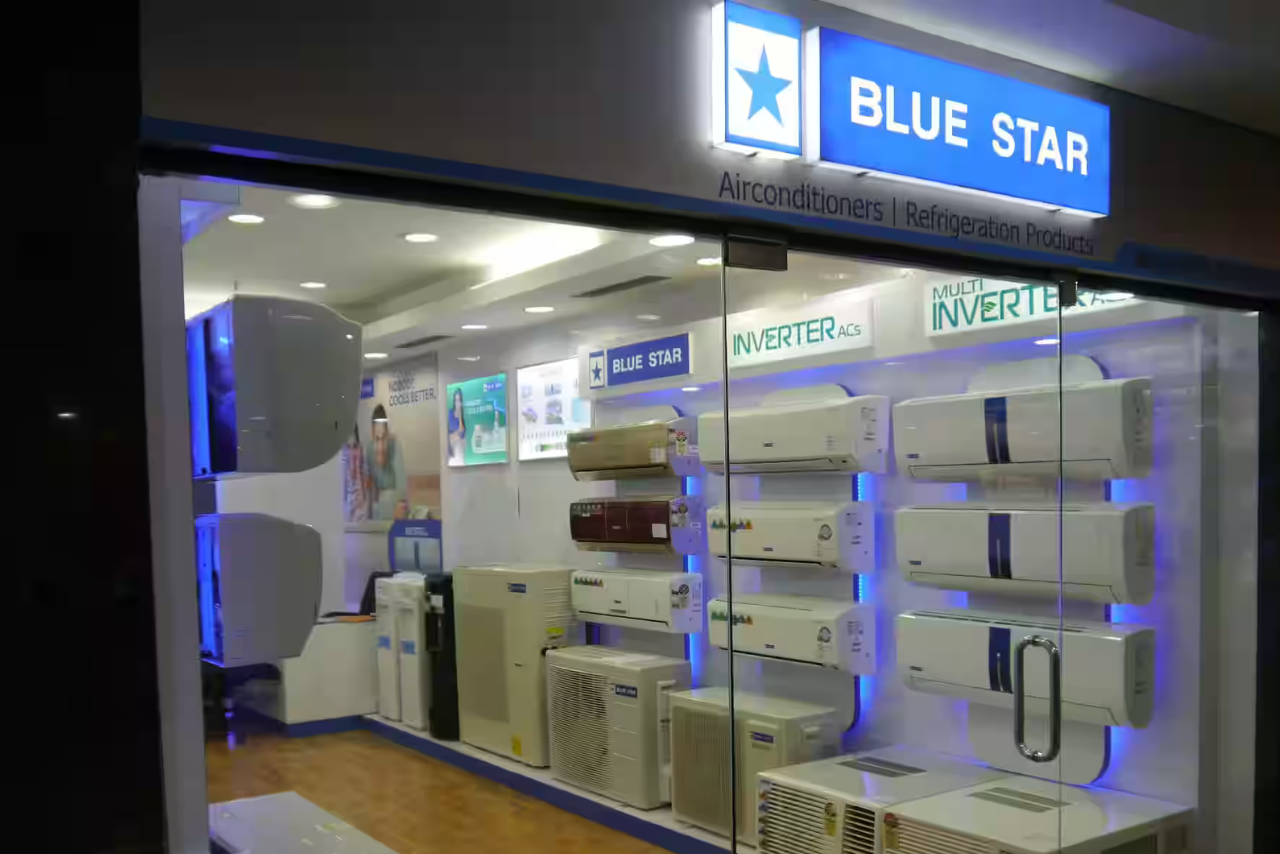
Synopsis: Blue Star is preparing for Summer 2026 by tightening inventory, improving supply chain resilience, and taking pricing actions to offset structural cost pressures. While FY26 demand remained uneven, modest RAC recovery, steady B2B enquiries, and margin discipline highlight efforts to reduce seasonality and build a more stable, weatherproof earnings base ahead of FY27.
Blue Star is heading into another critical summer after a year marked by uneven demand and weather disruptions across the cooling industry. While growth trends remain modest, management commentary this quarter suggests the focus is not just on volumes but also on preparing the business to handle demand swings better, offering an early glimpse into how the company is positioning itself ahead of Summer 2026.
Modest Growth, But A Clear Shift In Demand Signals
Blue Star reported a modest pick-up in Q3FY26 despite what it described as a difficult market environment through much of the year. The most important change was in Room Air Conditioners. For the first time in this fiscal, the RAC business returned to modest growth, helped by channels rebuilding inventory ahead of the January 1, 2026 energy label transition. That inventory build created a temporary demand tailwind at a time when many other end markets were still uneven. More importantly, the quarter also offers an early look at how Blue Star is positioning its operations, pricing and portfolio mix to reduce earnings volatility ahead of Summer 2026.
On reported numbers, revenue from operations grew 4.2 percent year-on-year to Rs. 2,925.31 crores in Q3FY26 from Rs. 2,807.36 crores in Q3FY25. EBITDA excluding other income improved to Rs. 220.72 crores from Rs. 209.38 crores, while the EBITDA margin stayed flat at 7.5 percent. Profit before tax, before share of profit and loss of JV and exceptional items, was marginally lower at Rs. 164.66 crores compared to Rs. 167.20 crores last year, showing that growth did not automatically translate into stronger operating leverage in the quarter.
Net profit fell sharply because of a one-time exceptional item linked to labour codes. Blue Star recognized an incremental estimated impact of Rs. 56.35 crores towards gratuity and leave encashment, following ICAI guidance, and classified it as an exceptional item for the quarter ended December 31, 2025. After this, net profit came in at Rs. 80.55 crores in Q3FY26 compared to Rs. 132.46 crores in Q3FY25. Management also made an important point for readers: while the accounting line is “exceptional,” the wage code burden is permanent in nature and will influence costs going forward, which is why the company’s pricing stance is turning firmer.
Room Air Conditioners: Inventory Discipline Helped Margins, Now Pricing Takes Center Stage
Blue Star’s management linked Q3’s RAC revival to two things: inventory discipline and cost actions. It explained that the energy label change created a risk for brands carrying high old-label inventory, because clearing that stock before the deadline would force heavy discounting. Blue Star claimed it had lower inventory pressure than many peers because it moderated production early and moved faster towards the new energy label product range.
🚀 Trade Crypto F&O with Delta — Open Free Account
This helped it avoid pushing large volumes with steep discounts, which it believes supported margin stability in RAC during the transition quarter. It also said cost reduction initiatives taken since Q1FY26 contributed to improving margins.
The company indicated it likely gained market share slightly in the quarter, though it did not quantify it and said market share data should become clearer when the industry numbers are published. It also highlighted its production of the new product range under the revised norms has already started and the company is gearing up for Summer 2026. Alongside this, it said it has taken both short-term and long-term steps to build supply chain resilience.
However, management was equally clear that the next challenge is pricing in Q4FY26 and into the summer. It expects depreciation of the rupee and rising commodity prices to push the company towards price increases in Q4. It also laid out how the consumer’s perception could be confusing this year. GST changes may create an impression of price relief, but the combined impact of the energy label transition, commodity inflation, and currency depreciation is expected to push prices up.
The management estimates that the net outcome could be around a 10 percent increase for consumers even after the GST impact, though it stressed this could vary due to high volatility in commodities and the exchange rate.
Inventory Levels And Seasonal Build-Up: A Manageable Starting Point
Inventory was a recurring discussion point because FY26 demand has been patchy. Blue Star estimated that industry channel inventory was around 8 to 10 weeks, while its own inventory was likely lower at around 5 to 6 weeks. It also clarified that inventory will never be zero and that two to four weeks of inventory is normal. In Blue Star’s case, it indicated it currently carries around two to three weeks of extra inventory versus normal, but it sees this as manageable rather than a structural concern.
The company also explained how inventory typically builds ahead of peak season. From January onward, companies start building inventory because demand spikes in late March, April and May and it is hard to meet that surge without a build-up. Blue Star said it could be comfortable with 8 weeks of inventory in January, 10 weeks in February, and 12 weeks in March if the summer is shaping up to be strong.
At the same time, it noted it will be more cautious given the recent experience of washout seasons and also because systems are changing. With more localization and stronger domestic manufacturing and component support, it believes it can manage inventory tighter than earlier years when the category depended more heavily on imports and long lead-time sourcing.
Importantly, the company said it does not view inventory as a major bottleneck for February or March. In its view, the single biggest variable that decides everything is the onset of summer. Management said near-term retail and channel trends look better than previous months but not spectacular, and that the market’s direction will become clearer as temperatures rise.
Commercial Air Conditioning And Projects: Strong Enquiries, But Selective Bookings
On the B2B side, management said enquiry momentum from buildings, data centers and factories was encouraging in Q3, but a few large order finalizations were deferred to the next quarter. It also highlighted hospitals and malls as areas showing strong growth potential, including demand from Tier-3 cities, which supports its medium-term optimism. Commercial office demand was described as healthy in select pockets, while data centers and factory segments continue to show stable and robust enquiry traction.
The company reiterated that it is staying selective in new order booking because it is focused on effective capital deployment. It also made a clear profitability distinction: infrastructure projects typically have lower profitability than commercial buildings, factories and data centers. As infrastructure projects approach closure, the company tends to book additional costs, and that can pull down segment margins. Blue Star said this effect has already contributed to margins being lower than last year in Q3, and it expects the margin drag to continue for the next two to three quarters as several infrastructure projects come to closure.
Even with that, management said it does not see a major concern of margin deterioration because product pricing actions, and price escalations in projects to offset higher labour costs, should protect profitability. The company also stated that while some parts may slow, this is not a scenario where projects become negligible. It expects growth to continue, but at a more measured pace, and framed a broad expectation of around 8 percent to 10 percent CAGR at the overall level, to be reviewed depending on how the first half of the next fiscal shapes up.
Refrigeration And Industrial Systems: Mixed Now, Summer-Linked Recovery Expected
Blue Star’s commercial refrigeration business remained weak in Q3. Management said it had expected a rebound from the festival season onwards, but the market stayed muted and most product lines declined, with storage water coolers being the key exception. It attributed the weakness largely to FMCG-related demand not returning meaningfully. It highlighted that segments like ice cream and QSR need to move into expansion mode for commercial refrigeration to see a sustained recovery. For now, the company’s expectation is that demand revival is more likely around the summer season rather than in the winter quarters.
In Professional Electronics and Industrial Systems, the Med-Tech Solutions business slowed because regulatory policy uncertainty remains unresolved. This is an overhang that is outside the company’s direct control and has affected the pace of growth. In contrast, Industrial Solutions continued to grow, driven by strong demand in the automotive and steel industries, and Data Security Solutions delivered steady performance. In other words, while certain regulated or policy-driven pockets are slow, industrial-linked demand lines are providing stability.
Pricing And Margin Framework: A More Disciplined Industry Structure
Blue Star’s management made its margin stance unusually explicit. It said the industry has structural cost pressures that are not going away. One key cost driver is consumer finance, which it said accounts for around 40 percent of sales and whose cost burden is shared with dealers. It also highlighted e-waste liabilities that increase each year, longer warranty expectations in the market, and the added cost of in-store demonstrators.
With these costs rising, management argued that businesses need to run with meaningful discipline to deliver return on capital, and it framed 8.5 percent margin as a bare minimum for category health. In a strong summer, it suggested 9 percent to 9.5 percent margins would be ideal for the category.
For guidance, it said Q4FY26 and FY27 margin outlook is around 8.5 percent, with the potential to inch higher if summer turns very harsh, but it preferred to revisit that closer to March. It also provided segment-level guidance: for Q4, Segment I (Electro-Mechanical Projects & Commercial Air Conditioning Systems) is expected to be 6.5 percent to 7 percent, closer to 7 percent, and Segment II (Unitary Products) is expected to be around 8.5 percent. It also clarified that infrastructure projects reaching closure can keep margins under pressure for a few quarters, but it does not see that leading to a large margin correction.
On pricing, the company said price increases are unavoidable given currency depreciation, commodity inflation, and the permanent nature of wage code-related cost burdens. It also noted this is a level playing field across brands. Timing may differ, but the industry will have to act. The company did accept that higher prices can influence demand elasticity and could reduce modelling assumptions on RAC growth, but it positioned pricing action as necessary because the category does not have high enough margins to absorb costs.
Outlook: FY26 Was Muted, FY27 Depends On Summer, But The Plan Is Broader
Blue Star’s message is that three quarters of FY26 were challenging, but early signs of revival are visible and Q4FY26 should be stronger for Room Air Conditioners, Commercial Air Conditioning, and Refrigeration products if the season behaves normally. Enquiry strength from factories and data centers is a positive support for the Electro-Mechanical Projects business, though the company remains careful about infra exposure because of lower profitability and closure-stage cost pressures.
More importantly, the company is trying to reduce dependence on a single good summer through what it calls the “weatherproofing Blue Star” program. The pillars are clear in its commentary: build balance through B2B businesses, keep a larger part of costs variable so spending can be dialled up or down based on demand visibility, and improve supply chain control through localization so inventory can be managed better than in past washout years. Management’s view is that even if summer disappoints, demand should not collapse the way it did in a washout year, partly because penetration is low and pent-up replacement and first-time demand eventually comes through.
Net net, Blue Star is entering FY27 with a cleaner inventory stance than the broader industry, a tighter grip on discounting, and a clear push towards price discipline to defend margins amid rising structural costs. The swing factor remains the onset and intensity of summer, but the company’s strategy suggests it is trying to build a more stable earnings base that does not get fully defined by one season alone.
Disclaimer: The views and investment tips expressed by investment experts/broking houses/rating agencies on tradebrains.in are their own, and not that of the website or its management. Investing in equities poses a risk of financial losses. Investors must therefore exercise due caution while investing or trading in stocks. Trade Brains Technologies Private Limited or the author are not liable for any losses caused as a result of the decision based on this article. Please consult your investment advisor before investing.