Multiple Authors
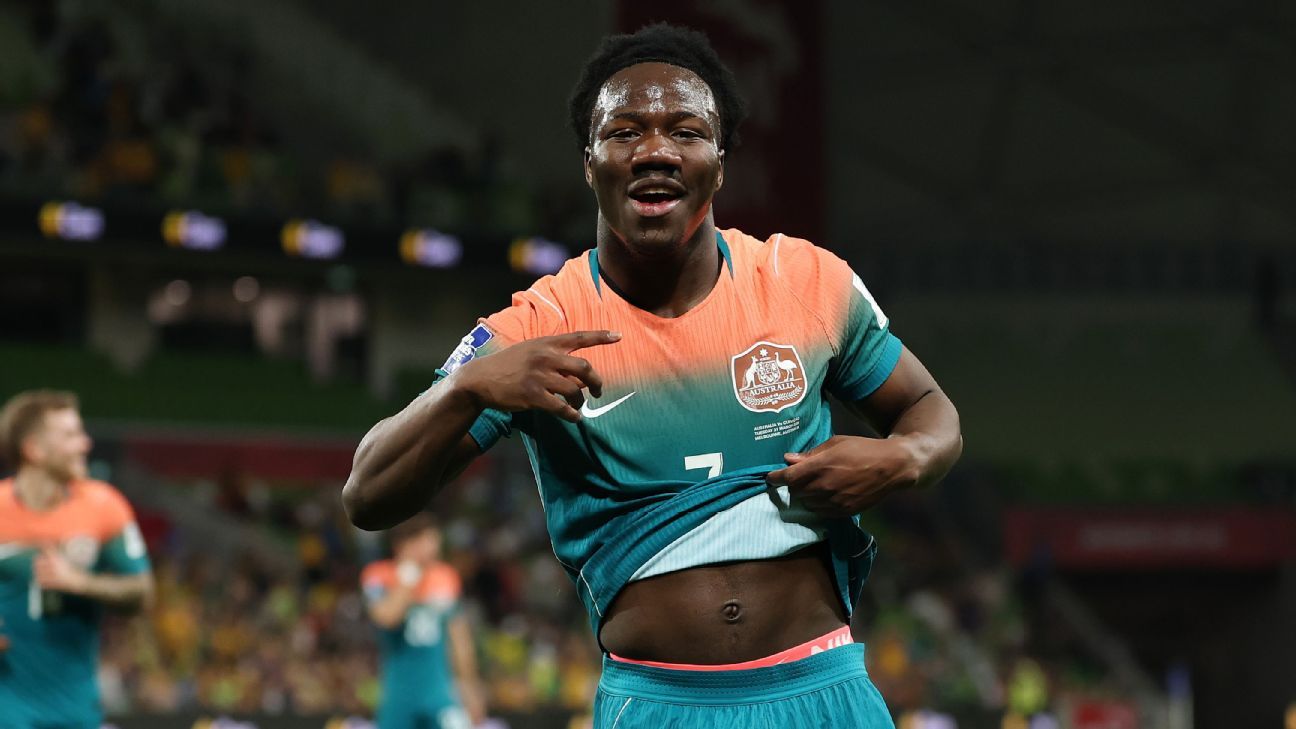
MELBOURNE — Nestory Irankunda’s favourite musician is Michael Jackson, and his favourite song from the King of Pop is “Smooth Criminal” — the classic in which Annie is laid low by a “smooth” attacker who leaves no trace. The Socceroos attacker, however, left plenty of evidence of his presence at AAMI Park on Tuesday, netting twice amid a four-goal, 17-minute explosion that saw his side run out 5-1 victors over Curacao and marking his first-goal with a Jackson-inspired celebration — wearing a silver glove thrown to him from the crowd and all — in which he performed the megastar’s signature crotch-grabbing dance move.
“He’s my mate,” Irankunda said of his mysterious assistant. “He’s a photographer, and he messaged me on Instagram asking me if I wanted to do something with Michael Jackson. I said yeah, for sure, because he knows I’m a huge fan of Michael Jackson and his music, and it was just great to bring it out and show the people.”
– Ogden: Late qualifiers Türkiye are now favourites for World Cup Group D
– Meet 2026 World Cup debutants: Cape Verde, Curaçao, Jordan, Uzbekistan
– As it happened: Italy miss third straight World Cup after losing to Bosnia
Together with Jordan Bos and Riley McGree, who came on alongside the 20-year-old attacker in the 66th minute, Irankunda played an integral role in helping the Socceroos use a devastating final 20 minutes to flip, or perhaps rescue, the prevailing narrative from their send-off fixture in Melbourne. It was the final game the Socceroos will play on home soil before the FIFA World Cup, as well as the final hit-out they’ll have before Tony Popovic names his extended squad for said tournament.
As there hadn’t been much to instil all that much excitement, nor confidence, heading into the World Cup before then. It’d been a bit of a punish, really. Though placed in the ascendancy by Awer Mabil’s first-half strike, the Australians had hardly created many looks on goal against the Caribbean nation to that point, who themselves had flashed danger on multiple occasions and finally grabbed an equaliser when Ar’jany Martha sliced behind the hosts’ defensive line five minutes into the second half. The air had been sucked out of the stadium by that strike, and skipper Mathew Ryan admitted post-game it’d felt like the team had needed to dig in their heels and persevere through some adversity. But then Popovic swung the changes.
It was a move in keeping with the themes of the team under his tutelage: grinding away against an increasingly worn-down opponent before breaking through with pace, purpose, precision, and brilliance from individual difference-makers. McGree had previously come off the bench to provide the assist for Aziz Behich’s late, qualification-sealing winner against Japan, for example, while all of Irankunda’s goals in the coach’s tenure have come in the second half of games. Symbolically, though, these switches almost felt like the coach had decided to lean forward in his chair and was doing away with niceties.
Nestory Irankunda’s 23-minute cameo inspired the Socceroos to a 5-1 win over Curacao on Tuesday. Morgan Hancock – FIFA
With a result suddenly in the balance and the coach, you’d anticipate on some level, wanting to avoid the extra stress that would come with a fatalistic narrative surrounding his team heading into a World Cup, the time for experimentation was over. Cameron Burgess came on to reinforce the defence and, moving forward, he was now going for the throat.
And the reward was almost instantaneous. Irankunda and McGree combined before the latter found Alessandro Circati for the go-ahead goal (his first for the Socceroos) just two minutes after coming on. Then Bos was fed by McGree, cut inside, and banked a curling effort in off the far post. And then Irankunda weaved around multiple defenders and struck an effort with enough venom that Eloy Room, though able to get a touch on it, couldn’t keep it out. Finally, Irankunda put the cherry on things, played through on goal by half-time substitute Nishan Velupillay and blasting an effort beyond Trevor Doornbusch, who at that point had replaced Room, to make it five.
It would have been enough to make those of the green-and-gold persuasion giddy, a clickbait headline brought to life: blink and you’ll miss it, 17 minutes that show how devastatingly effective they can be when it brings its young guns to bear. Coming to the end of long seasons but still with plenty of high-stakes club football to play, Irankunda, Bos, and McGree were all managed this series but will have fewer restrictions come June, when they’ll all ostensibly be key contributors. Elsewhere, Circati remains a Rolls-Royce of a defender, Kai Trewin was tested as a potential right wing-back option, and Paul Okon-Engstler showed further flashes in the midfield after coming on at half-time.
STAY IN THE KNOW WITH ESPN
Stay across all the big sports news — sign up to our weekly newsletters here!
SUBSCRIBE
The hope will be that, come the World Cup, even more game-breaking ability will be sourced from a healthy Mohamed Toure leading the line, too. With Norwich City striker absent through injury, Deni Jurić was in the XI for a second-straight game and, while his intelligent positioning during the press and his subsequent flick-on after helped set the table for Mabil’s opener, the Wisła Płock striker probably won’t be usurping the starting role just yet. Ante Suto, meanwhile, wasn’t used in his first window with Australia, with Irankunda instead tasked with leading the line as a second-half substitute in both games.
This is why, ostensibly, Australia securing automatic qualification has been so important: it allowed Popovic, after not really using them in qualifying, to slowly incorporate the likes of Touré and Irankunda into his squads in low-stakes friendlies. The Socceroos boss has been able to invest valuable minutes into them, and source opportunities to instill important lessons about not only what he expects on the park but, also, what kind of standards they need to be meeting off it to rise to the physical, mental, tactical, technical, and psychological level required. Irankunda’s three goals this window, for instance, have all come from him advancing into the penalty area and shooting — an aspect of his game that has been repeatedly drummed into him as needing improvement by Popovic over the past year.
“It’s been a huge focus,” Irankunda said. “To be with the national team, that’s what he wants from me — he wants me to get in the box, and he even wants me to do it at club level as well.”
Flashing back to the bigger picture, though, a more sober one, and Tuesday reinforced just how the Socceroos, albeit with different personnel from the off, will likely look to win games come June. They will establish a foothold that’s difficult to break down — remember, they’re excellent at defending — before getting their individual talent to take a moment that wins them the game. We saw it on Tuesday, saw it against Cameroon, and plenty of times before.
It doesn’t remove risk so much as change its context, minimising it defensively and raising the team’s floor but adding extra pressure and stakes to individuals in attack: being sharp enough amid scant clear-cut chances has defined the highs of this team — they outperformed their expected goals (xG) by nearly 10, 28.5 to. 38, under Graham Arnold and Popovic during qualifiers — while their clinical edge abandoning them, as their opponents forced their way through, correlated with losing run post-qualification.
Is this is a style of football that will deliver results against Group D opponents Türkiye, the United States, and Paraguay in just two months is a question that will define not just Popovic’s tenure but, given the impact of the national teams, the years ahead for Australian football too. Can it deliver results when it’s not Curacao standing across from the Socceroos but a battle-tested European or South American outfit, or a host nation? Can it take a punch, or two, and come back from a losing position? Were stiff tests Venezuela and Colombia omens, or learning experiences? Because, as it’s not often the easiest of watches, it needs to be effective to be palatable.
We’ll soon find out, because it’s the style of football that has brought Popovic to the ball, and now he will dance with it. He probably won’t moonwalk with it, though.