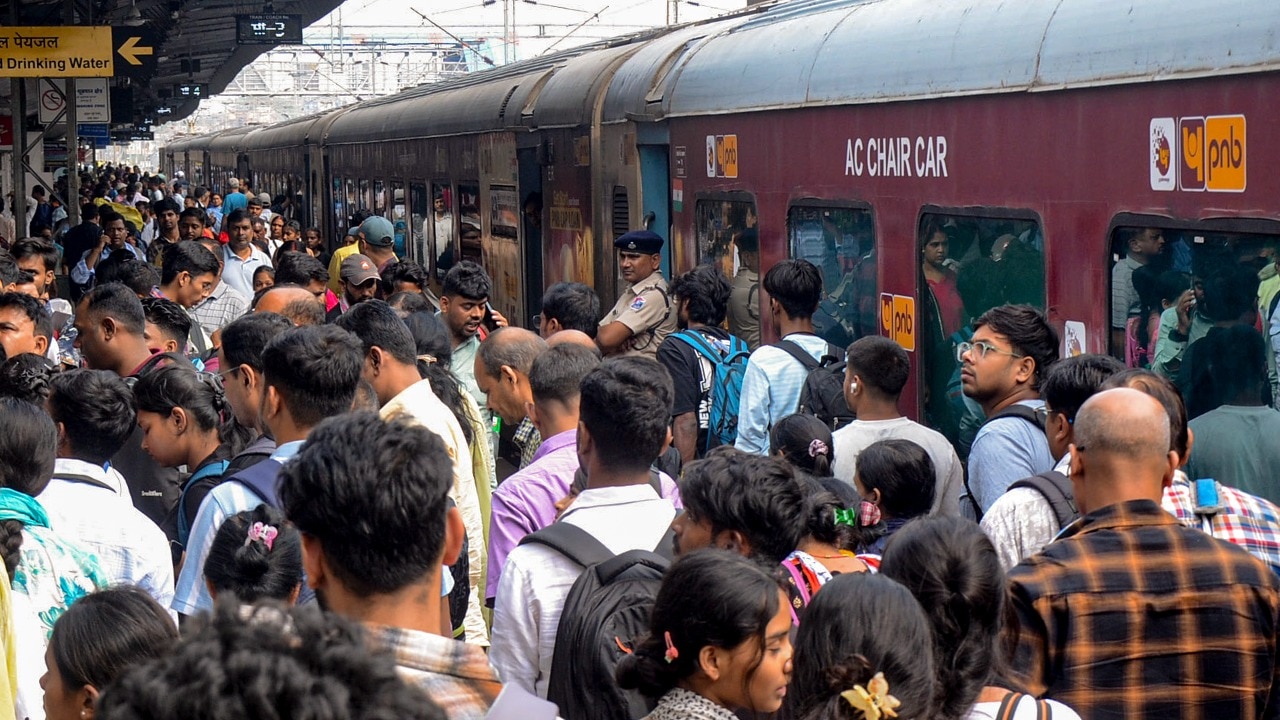
The festival of colours, Holi, on March 4, and Holika Dahan on March 3, has triggered a massive travel rush across northern and eastern India. For those who can afford flights, they are booking anyway, even though fares are sky-high. Tickets for some sectors have crossed Rs 20,000 per seat. But for those who cannot, and that is the majority of migrants in India, trains remain the only lifeline for long-distance travel across the Gangetic plain.
Because of the Holi rush, migrants looking for a last minute seat home are finding trains heavily overbooked.
Premium rail services like Rajdhani and Duronto Express, where fares are dynamic like flights, are showing REGRET status, meaning no seats available. Regular mail, express and superfast trains, where prices are static, saw tickets shoot into triple digit waiting lists on the very day bookings opened 60 days ago.
Even the Special Trains announced by Indian Railways to manage the Holi surge are running long waiting lists, especially on high-demand routes, from Delhi, Mumbai, Bengaluru to Bihar, Uttar Pradesh, Jharkhand, and West Bengal.
Holi and Holika Dahan traditionally draw millions back to their hometowns, especially in north and east India. Migrant workers and professionals based in Delhi, Mumbai, Bengaluru and other metros begin travelling nearly a week to days in advance.
This year too, bookings surged. And, as always, demand outpaced supply.
ARE RAJDHANI, DURONTO AND VANDE BHARAT TRAINS FULL FOR HOLI TRAVEL?
Yes. Premium trains are among the worst affected, as they are sought after for punctuality and better services than the rest of the trains.
On several routes, Rajdhani services are showing “REGRET” status across classes — 1AC, 2AC, and 3AC. In railway booking terminology, this means no seats are available, and even the waiting list has closed. Other Superfast and Express trains show waiting lists running into triple digits in 2AC, 3AC, and Sleeper classes.
Duronto, Tejas and Rajdhani services are showing similar trends in the dates leading to the Holi holidays. Vande Bharat expresses on key northern routes are also heavily waitlisted. Dynamic pricing has pushed fares higher, but it has not dampened demand.
For example, on the bi-weekly Dibrugarh Rajdhani, a ticket from New Delhi to Siliguri for 3AC is now at Rs 3,430 with a waiting list reaching around 113. For 2AC a ticket would cost Rs 4,635, but the waitlist is 37.
On the New Delhi-Patna Tejas Rajdhani, a 3AC ticket is priced at Rs 2,545 but has a massive waitlist reaching 231. A 1AC ticket is now reached Rs 4,260.
The Sealdah Rajdhani, from New Delhi to Kolkata is showing a 3AC ticket at Rs 3,125. The waitlist is touching 100. A 2AC ticket is up for sale for Rs 4,260, but the waitlist is at around 40. The 1AC has given up and is showing REGRET.
A 3AC seat on the Bengaluru-Kolkata Duronto Express is being sold for Rs 4005 with a waitlist of over 60. A ticket on the 1AC is touching Rs 7,000, which is as much as the fare of a flight ticket.
Tickets for the Vande Bharat Express from New Delhi to Ayodhya have also run into huge waitlists, with fares reaching Rs 2,700.
Even the passengers willing to pay premium fares are struggling to find confirmed seats on trains.
BIHAR-NATIVE BOOKS BACK-BREAKING BUS TICKET FROM DELHI
A 32-year-old management professional living in New Delhi’s Karol Bagh told India Today Digital that he had to rush to Anand Vihar Inter State Bus Terminal (ISBT) to get a bus ticket to his home in Khagaria district of Bihar for Holi, after he had lost all hopes of getting a train ticket.
“I went to Anand Vihar ISBT to check for bus tickets. Most of the buses were seasonal services and operators were asking whatever they wanted — Rs 3,000, Rs 4,000, anything. After checking at three to four bus stalls, I finally got a ticket for Rs 3,000 and that too to Darbhanga, which is around 120 km from my home in Khagaria district,” said Rahul Kumar Mahto. “This perilous 30-hour backbreaking journey now looks more promising than my Waiting List-115 ticket on the Vaishali Superfast Express”.
“The ticket I booked was without even seeing the bus. It was purely on trust and hope. The bus was not there at the time. There were just the stalls, and agents issuing tickets one after another for those who had to reach home somehow,” Mahto added.
ARE HOLI SPECIAL TRAINS PROVIDING ANY RELIEF?
The Indian Railways have rolled out hundreds of special trains to meet the Holi rush.
The Northern Railway alone plans around 300 specials from Delhi-NCR towards Bihar, Uttar Pradesh and Jharkhand. The Central Railway is operating 186 specials, including 94 dedicated Holi trips linking Mumbai and Pune to cities like Nagpur, Varanasi and Gorakhpur.
However, bookings show that many of these special trains are also waitlisted.
Routes such as New Delhi-Barauni, Anand Vihar-Patna and New Delhi-Gorakhpur have long waiting lists for classes. In several cases, sleeper and AC categories are fully booked days in advance.
These additional Special services have helped, but not enough to absorb peak festive demand.
In this case, several passengers are splitting their journeys or opting for alternate routes. Some are postponing travel. Others are cancelling, while others are waiting for Tatkal tickets, up for grabs a day before the journey starts.
Rahul Kumar Mahto, who got a bus ticket, is also one of them but said he had very less hope of getting a Tatkal railway ticket.
Tatkal railway ticket is an emergency quota ticket released one day before travel, allowing passengers to book last-minute seats at a higher fare.
So, now the annual Holi rush points to a structural pressure point in India’s transport system. This comes even as the Chinese railway network recently operated 121 million passenger trips during this year’s nine-day Spring Festival public holiday. This was 11.5% higher than the railway operations during the Spring Festival in 2025,China’s Xinhua News Agency reported on Tuesday. The Spring festival is also called the world’s largest annual migration, where almost 600 million people travel in and out of China.
For Indians, now, the advice is simple. Book early. Monitor cancellations. Stay flexible. Because when festivals like Holi, Diwali and Chhath approach, the travel network runs at a full stretch.
– Ends
Published By:
Sushim Mukul
Published On:
Feb 26, 2026