Luc Longley called it ‘compound learning’.
It’s something we see in every playoff series, in any league in the world, but feels highlighted in this NBL Championship Series. It is, in effect, exponential growth based on learnings and experiences over time. In layman’s terms, we can just say these teams are figuring each other out; and, perhaps more importantly, figuring themselves out against waves of adversity.
Editor’s Picks
Over the entire season, the Sydney Kings and Adelaide 36ers have now played each other eight times — four in this Championship Series — so they’ve learned a heap about one another. Longley is a co-owner of the Kings — and, of course, an Australian basketball legend — and mentioned pregame how impressed he’d been with his team’s compound learning over the course of the series.
Well, they’re not the only ones who’ve picked up a thing or two. Game 4 in Adelaide was yet another example of the chess match taking place between the 36ers and Kings, with the home team eking out a 92-91 win in a raucous Adelaide Entertainment Centre to send the series to a decider. We’re seeing adjustments, then adjustments to those adjustments, and it’s gotten us to a Game 5 of a Championship Series for the fourth straight season. This thing is tied at 2-2, and there’s reason for both teams to feel confident going into Sunday afternoon.
Here are some of the learnings from Game 4, and what could potentially carry over to the decider.
This Zylan Cheatham changes everything for Adelaide
When Cheatham plays with this sort of force, seemingly anything is possible for the 36ers.
That’s the nature of the impact he can have on a game. The American forward finished Game 4 with 23 points, eight rebounds, and nine assists, making big play after big play — on both ends — in the fourth quarter to lead his team to victory.
The difference for Cheatham was the aggression in the short roll, playing four-on-three basketball with force, trusting his floater game, and making quick decisions out of the middle of the floor. He hit multiple floaters late in the fourth quarter to keep the scoreboard ticking for the 36ers, and was a big part of the team’s ability to get good quality looks from deep.
“He’s done that stuff for us in different ways, but it always manifests itself a little bit different each game,” 36ers head coach Mike Wells said. “He’s been a huge part of what we do, on both sides of the ball. You’re looking at his offensive side, but I think his impact on the defensive side is just as big.”
Cheatham’s coming-out game was actually Game 3 of the series — he had 17 points on 12 shots — and he would’ve noticed how him putting heat on the rim and leaning into his creation game helps lift the ceiling of the 36ers. In Game 4, he went to an even higher level.
“Just the playmaking,” 36ers guard Dejan Vasiljevic said. “You see him playing out of the short roll, he’s hitting either Isaac or Nick in the dunker, or spraying it out to myself or [John Jenkins] or Flynn [Cameron]. And his floater, when he gets aggressive, it opens so much for everyone else. He’s unlocked himself.”
Zylan Cheatham of the 36ers starred in Game 4, Sarah Reed/Getty Images
An aggressive Cheatham also unlocks Isaac Humphries, who had his most impactful game of the series. Humphries finished with 10 points and 10 rebounds — seven of them coming on the offensive end — and was seemingly the recipient of more drop-off passes from Cheatham in this contest than he’d received over the rest of the series combined.
It’s no surprise then that Humphries was more engaged on the glass — the 36ers had nine offensive rebounds in the fourth quarter alone, and shot 11 more field goal attempts in the period — which included pulling down the final board of the game; Torrey Craig missing the back-end of a pair of free throws with 2.8 seconds remaining, giving the 36ers the 92-91 win.
Cheatham’s creation game unlocks a whole new element of what the 36ers do on the offensive end, and the result of getting bigs involved often energises them defensively, too; it’s where they’re most important, because much of the team’s coverage on Davis is guiding him into the wall of frontcourt players.
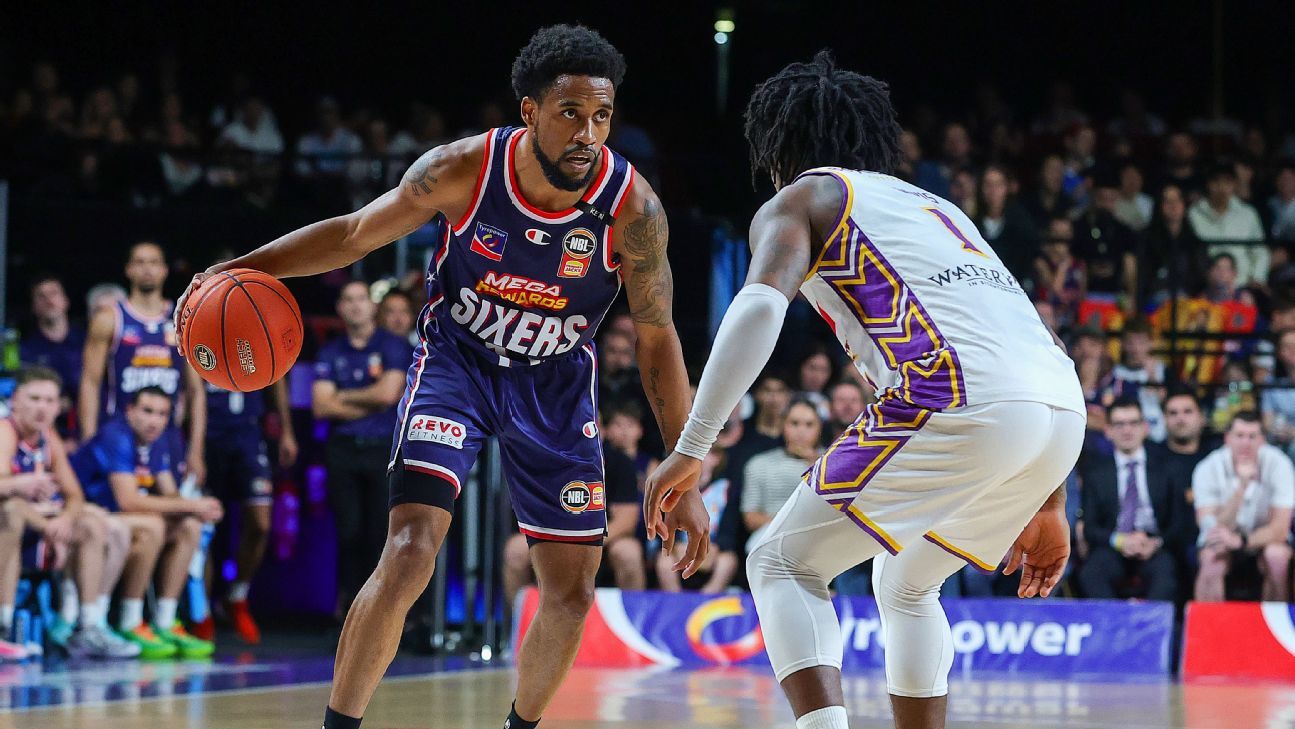
Bryce Cotton is learning how to attack Sydney’s elite defence
By now, what the Kings are doing to contain Cotton is clear, and leading the shots Brian Goorjian is generally okay living with.
When Matthew Dellavedova is the matchup, the four-time Olympian face guards Cotton all the way down the floor, top-locks, and doesn’t allow him to go left under any circumstances. We see that up-and-in defence in the half-court when it’s either Jaylin Galloway, Makuach Maluach, or Torrey Craig as the point of attack matchup, too, and the same intent to force Cotton right, but the six-time MVP does seem to have more confidence attacking those three in one-on-one situations.
STAY IN THE KNOW WITH ESPN
Stay across all the big sports news — sign up to our weekly newsletters here!
SUBSCRIBE
In Game 4 — and we saw it in Game 3, too — Cotton seemed to get the clearest picture yet of where his team’s advantages will come from, given the coverage on him. Countless times, Cotton would get a head of steam driving right – the Kings are overplaying his left hand – and get two feet in the paint in order to create for himself and his teammates. It’s why it shouldn’t be a surprise that Cotton finished with 12 assists, to go with his 19 points; and that came after he had a dozen dimes in Game 3. Cotton is breaking the paint — either driving right, or by back-cutting — and finding his bigs with drop-off passes, or kicking it to open shooters after the defence collapses on him.
We’ve also been seeing some more guard-to-guard screening actions with Cotton as the ball-carrier. The 36ers know the Kings will show two players to Cotton, so sending one of their shooters to set the on-ball and quickly slip out has led to some good quality looks. It seems Cotton is getting off the ball quicker than he did in the first two games of the series, allowing his teammate to make the most of the advantage.
This was one of the 36ers’ most rounded scoring efforts of the season, and it’s because of Cotton’s adjustment. Dejan Vasiljevic hit four three-pointers for 19 points, while Flynn Cameron had 11 points of his own. Everyone knows Cotton in Adelaide’s engine, and the Kings have done an expert job, for the most part, of taking away his elite skill, which is his scoring. Over time, the 36ers have figured out how to leverage that coverage into utilising Cotton’s high-level advantage creation in different ways.
The Kings’ defence is elite, but the 36ers have figured out how to get good quality looks on a consistent basis.
Things got sticky for the Kings again
Game 4 felt like a repeat of Game 2 for the Kings.
It’s something we’ve spoken about before; this is a Kings team full of veterans, and a talented point guard in Kendric Davis, all of whom are quick processors and have learned from every game this series. They can get a good look every time down the floor.
The 36ers’ coverage allows for mismatches, and the Kings have done a great job at using them to create advantages; and, in turn, good quality looks. It could be a big switching onto Davis, Dellavedova in the post, any of the Kings’ frontcourt players down low with a smaller player on their hip; the Kings force the 36ers to load up, and have moved the ball well to find the good-to-great look.
Look at Jaylin Galloway’s game as an example. He had 20 points, shooting 5-of-9 from beyond the three-point line, with the bulk of his looks created from impressive ball movement from the Kings. Galloway is emerging as an elite catch-and-shoot guy in his own right — he’s a scorching 15-of-25 from downtown in this series — but it’s, for the most part, been off the back of the Kings bending the defence and finding high-quality looks. Then, you have Davis, who’s an advantage creator just by nature of his talent; he finished with 22 points and 10 assists in the loss, and has largely been good at playing within the team’s process.
Jaylin Galloway of the Sydney Kings in action. Sarah Reed/Getty Images
In Game 4 — like Game 2 — the Kings seemingly stayed within that for three quarters, jumping out to a nine-point lead (it was a 14-point lead in the second game of the series ), then things got stagnant. The Kings should be able to score when they like, but that process escaped them down the stretch.
Once again, the spacing in the fourth quarter wasn’t terrific — a result of Davis, Dellavedova, and Xavier Cooks sharing the floor — and the ball seemed to stick in that middle cylinder. The 36ers have a role in that, too, in the way they made Davis see multiple bodies, but the stickiness of the offence has now come up twice for the Kings in this series, in both road games.
Davis made some tough shots in the fourth quarter, but, for the most part, the 36ers would’ve been happy with the looks they gave up in that final period.
Adelaide’s crowd impact a game more than any other
There have been some great playoff crowds in the NBL over the last few years. The fans in Wollongong are beautifully and hilariously rabid, the Tasmania crowd is unbelievably loud and have a unique togetherness in how they operate.
The fans in the Adelaide Entertainment Centre, though. They’re different.
“You guys are f–king incredible,” Vasiljevic said to the crowd after the Game 4 win.
We’re trying not to let recency bias creep in, and this isn’t a case of giving credit to a fanbase to get them on side. That isn’t important here. What’s clear, though, is that the fans in that building had a material impact on the game.
And not in the way we thought. Everyone assumed there’d be a wild overcorrection from the officials, but the Kings committed just 13 personal fouls (Adelaide’s 21). It’s more about how much their energy lifts the players; the volume on a made free throw is the same as if it’s a 30-foot three-pointer. A three-pointer to cut a nine-point lead to six feels oddly back-breaking, because the fans make it feel that way.
Even the way the 36ers were crashing the boards in the fourth quarter felt like it was catalysed by the crowd. Cotton went and had two offensive rebounds — both leading to scores — looking like an energiser bunny as he chased his own misses.
I’m not sure there’s a crowd in the NBL that has lifted a team — and perhaps stifled another — than what the 10,068 did in Adelaide on Wednesday evening.
Bryce Cotton of the 36ers and Kendric Davis of the Sydney Kings in action. Sarah Reed/Getty Images
Who does this Game 5 favour?
It all comes down to one game. The decider: Sunday afternoon in Sydney, in what’s a do-or-die for both teams.
The last time these two teams played at Qudos Bank Arena was Game 3, and the city of Sydney turned out for the largest crowd in NBL history. It seems there’s a good chance that record is broken once again on Easter Sunday.
“I think we’ve got the city behind us,” Kings head coach Brian Goorjian said. “I’m expecting a great crowd and great environment. I don’t think we did anything tonight that anyone back home would be disappointed with… I think, for everybody, the game of basketball, the NBL, the fight over the years for the game itself, the quality of this series… I think it’s been a high-level performance from the coaches, the players, the support and the communities, the passion behind the teams… everybody’s engaged in this. It’s exciting for basketball.”
During that Game 3, it was all Davis, with the electric point guard dropping 34 points and 15 assists — and, of course, zero turnovers — to guide his Kings to victory. Will we see another historic performance from him?
On the other hand, Cotton does get a considerable break between Wednesday’s Game 4 and Sunday’s Game 5, allowing him to rest for what’s expected to be another 40 minutes of physical defence on the reigning MVP. That rest isn’t trivial; we saw how Cotton tired as Game 3 ticked along, so the turnaround time between these two contests is something that’s absolutely advantageous to him and a 36ers team that has been going seven-deep in this Championship Series.