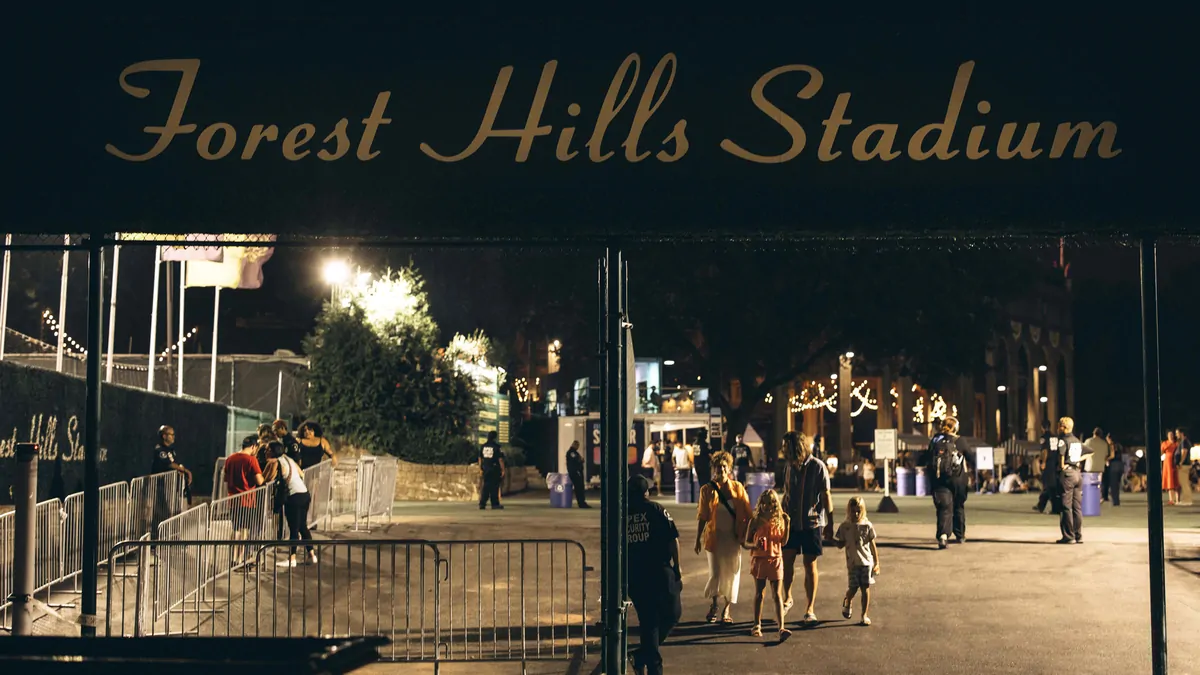
NEW YORK — A homeowners’ association in Queens has won a small victory in its long-running fight over loud local concerts, reaching a settlement with New York City over a complaint related to a stadium’s noise levels.
In a settlement reached March 17, the city agreed to pay $150,000 to the homeowners’ association, the Forest Hills Gardens Corp., and the captain of the Police Department’s 112th Precinct agreed to consult with the corporation on security plans for all events held at Forest Hills Stadium, which has hosted high-profile concerts since the 1960s.
But not everyone is happy about the settlement, which was earlier reported by local Queens news outlets.
Sign up to The Nightly’s newsletters.
Get the first look at the digital newspaper, curated daily stories and breaking headlines delivered to your inbox.
By continuing you agree to our Terms and Privacy Policy.
“This settlement does nothing to solve the real problems that have been affecting people in the neighbourhood for years now,” said Andy Court, the president of Concerned Citizens of Forest Hills, a nonprofit that represents residents affected by the stadium.
The Forest Hills Gardens Corp. has been engaged in litigation against the West Side Tennis Club and Tiebreaker Productions, which runs the club’s Forest Hills Stadium as a concert venue. Residents of Forest Hills have long said that the concerts are disruptive, attracting crowds of people from across the city’s five boroughs and producing hours of noise that shake their mainly Tudor-style homes.
Bruce Eaton, the president of the Gardens Corp., declined to comment, citing continuing lawsuits.
When lawsuits against the tennis club failed to gain traction or produce their desired results, the Gardens Corp. employed a novel strategy: informing the Police Department, which provides security for the concerts, that it could not operate on the private roads surrounding the stadium in 2025.
At first, the action against the Police Department appeared as though it might produce the outcome that residents had long sought — an end to summer concerts. The department’s legal bureau said in a letter that if the department could not ensure public safety at the venue, it would not issue the sound permits needed for the concerts to proceed.
But in April of that year, Donovan Richards, the Queens Borough president, announced that Tiebreaker, the West Side Tennis Club, the Forest Hills Garden Corp. and the Police Department had brokered an agreement in which Tiebreaker agreed to hire private security for the stadium grounds. Police granted a conditional sound amplification permit, and local officials announced that the concert series would go on as planned.
What we really need is the city government to step up and just make sure to impose some reasonable restrictions on these events.
Matthew Mandell, a former member of the Forest Hills Garden Corp. board, said recently that despite what the borough president had said, the corporation was not involved in the agreement, which was part of the reason they filed suit.
On Oct. 13, the corporation filed a complaint against the city in U.S. District Court in Brooklyn charging that the Police Department’s security measures at events “for which sound amplification permits are required” during the past three concert seasons, which run from May to October, were illegal.
“There was a long-standing dispute between the venue operators and the local homeowners over noise at the venue and private property,” the department said in a statement. “This was not about the NYPD, and the agency was caught in the middle of the preexisting fight between the two groups.”
For many Forest Hills residents, the settlement with the city is meaningless when it comes to the overall issues they face.
“What we really need is the city government to step up and just make sure to impose some reasonable restrictions on these events,” Court, of Concerned Citizens, said.
The noise emanating from Forest Hills stadium goes on for hours, Court noted, including sound checks that take place long before the start of the actual concert and lingering racket from revellers leaving events and wandering through the neighbourhood.
But during the concerts, the noise levels are the worst — inspectors from the city’s Department of Environmental Protection found that 12 of the 14 concerts they evaluated last year created noise levels inside of residents’ homes that violated municipal noise codes. The season before that, 11 of 13 concerts were in violation.
“It’s like 86 per cent of the time,” Court said. “Do you know of any other business in the city that gets to violate like that without anything being done?”
Jimi Hendrix, Bob Dylan, Diana Ross and the Beatles all played Forest Hills Stadium in the ’60s. It was initially designed as a tennis stadium, hosting the U.S. Open from 1924 until the tournament moved to the USTA Billie Jean King National Tennis Center in Flushing Meadows in 1978. Concerts continued after that, but slowed in the 1990s and were largely absent from 1999 until 2013, when shows resumed with a concert by Mumford and Sons.
After a shaky relaunch, the stadium’s concert season now usually runs from May to October. When there were about a handful of shows each year, neighbours did not often complain. But as the number of concerts has increased, so has the level of discontent.
The March settlement released the city from any liability in continuing disputes over security at Forest Hills Stadium. This summer’s concert series will open in June with performances by the indie rock band Bright Eyes and continue through the end of September, when Irish musician Dermot Kennedy is set to perform.
© 2026 The New York Times Company