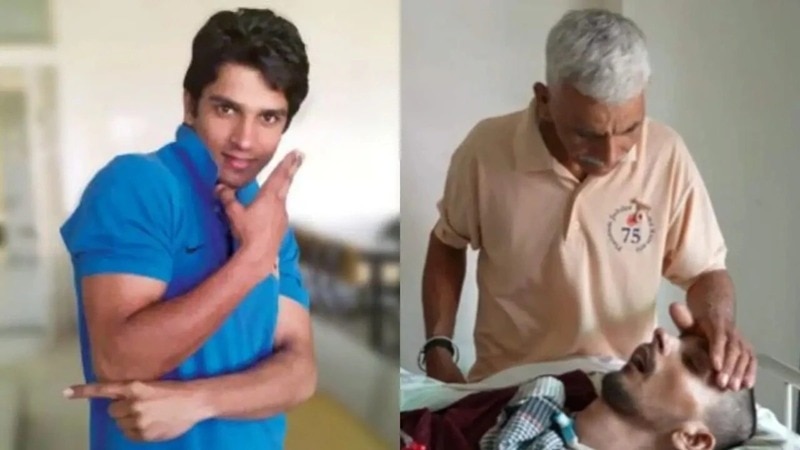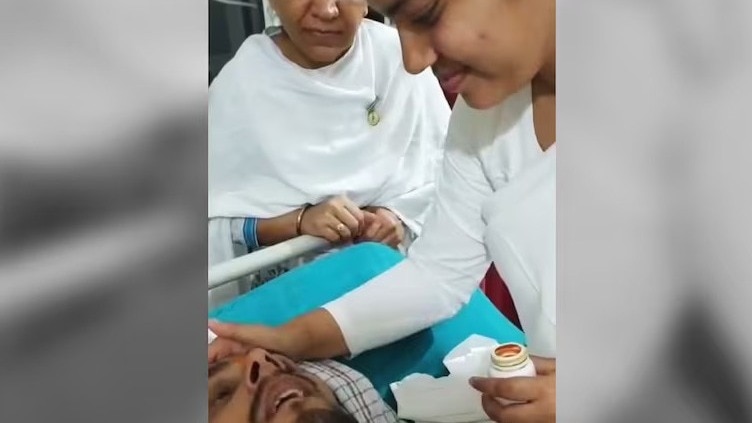
An emotional video of Harish Rana, the 32-year-old who will face a medically monitored death in the coming weeks, has gone viral, which shows his family bidding him farewell, before he was moved to a palliative care unit at Delhi’s All India Institute Of Medical Sciences.
Harish is seen blinking his eyes and gulping in the video, the only movements he has been able to perform for the last 13 years after a fall left him with severe, and irreversible, brain damage.
Read Full Story
The video also shows a Brahma Kumari sister caressing his forehead with a wistful smile while their stoic mother watches quietly from behind. “Sabko maaf karte hue, sabse maafi mangte hue, tum jao (Grant forgiveness, seek forgiveness, and leave),” says Brahma Kumari Lovely in the video.
Kumari Lovely is connected with ‘Prabhu Milan Bhavan’, a Brahma Kumari center in Ghaziabad. The Rana family has long been associated with the Brahma Kumari movement, a women-run spiritual organization founded in 1937 and headquartered in Mount Abu.
This moment comes days after the Supreme Court allowed Harish Rana to die with dignity – a historic first court-ordered case of passive euthanasia in India. The court acknowledged the medical opinion that Rana will never recover and that the tubes that feed him and keep him alive are only prolonging a pain that the 32-year-old is not even able to communicate.
Following the court’s order on March 11, Harish Rana was moved to a palliative care unit at Delhi’s All India Institute Of Medical Sciences where a medical board will formulate an end-of-life care plan.
While medical experts agreed his state was irreversible, the Supreme Court had to clarify that withdrawal of nutrition and medical tubes – beyond ventilator support – could legally constitute passive euthanasia.
A bench of Justices JB Pardiwala and KV Viswanathan delivered the historic verdict, enabling the family to end life support in a hospital setting, allowing Harish Rana to die with dignity. The case has sparked fresh debate in medical and legal circles about end-of-life rights in India.
Rana, an engineering student at Panjab University, suffered head injuries after falling from the fourth floor of his paying guest accommodation in 2013 and has been in a coma since.
Shortly after the ruling, Rana’s father said that the Supreme Court permitting the withdrawal of artificial life support to his son wouldn’t bring any personal benefit to the family. But he added that the decision could help others facing similar situations.
– Ends
Published By:
Aprameya Rao
Published On:
Mar 16, 2026 10:09 IST