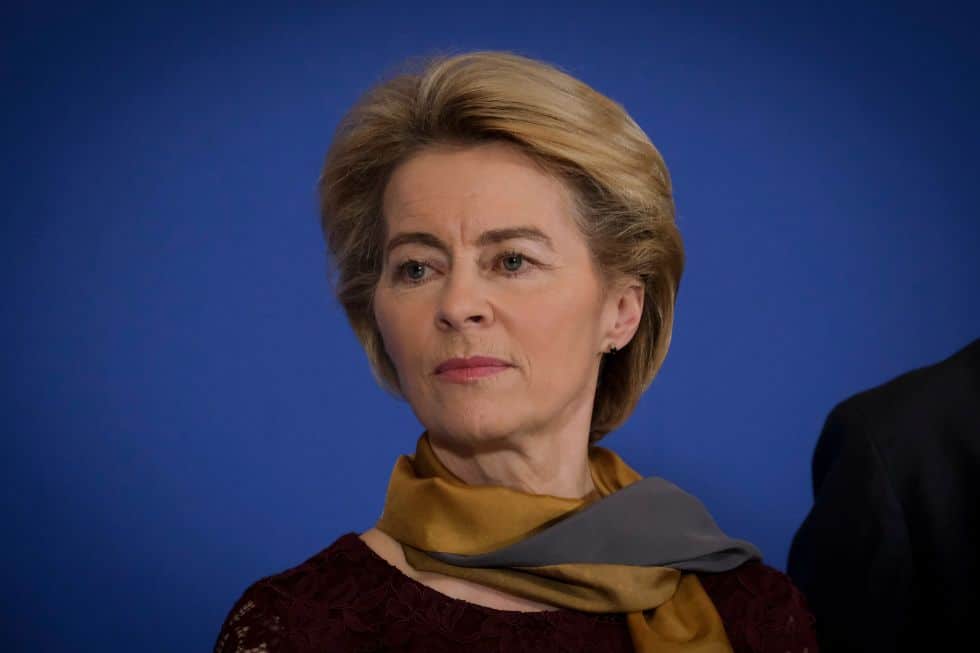
Elsinore, Denmark — In a ceremony at Kronborg Castle — a venue chosen, said one senior European Union official, because it “felt appropriately dramatic without requiring a new venue-hire budget line” — the president of the European Commission, Ursula von der Leyen, convened an emergency summit on Tuesday at which the assembled leaders of the European continent signed what they have formally titled the European Declaration of Independence from the United States of America.
The document was addressed personally to President Donald J. Trump of the United States, in keeping with what participants described as “standard diplomatic protocol for declarations of this nature,” though no officials could immediately confirm the precedent for that protocol when asked by reporters.
Among those present and signing were Chancellor Friedrich Merz of Germany, Prime Minister Keir Starmer of the United Kingdom, President Emmanuel Macron of France and Prime Minister Donald Tusk of Poland. Mr. Tusk, who arrived last and signed with what witnesses described as “a certain theatrical flourish,” was referred to throughout the proceedings by an unofficial honorific that spread quickly among the delegations: Polonius. Mr. Tusk was said to be aware of the nickname and to have taken it in good humor, though he declined to comment on whether he found it apt.
Viktor Orbán of Hungary was notably absent. His office issued a brief statement saying he had not been invited, which was confirmed by four officials with direct knowledge of the guest list, all of whom spoke on the condition of anonymity because they were not authorized to publicly confirm whom they had deliberately not invited.
“We wished to act with all appropriate urgency. This is why, having finalized the text in the final week of March, we waited until today to release it.”
The text of the declaration
The declaration, drafted over approximately four days by a working group of senior legal advisers, runs to slightly under two pages and opens with language that several historians of American constitutional documents described, when reached by telephone, as “familiar.” The full preamble reads as follows:
Excerpt — European Declaration of Independence, April 1, 2026
When in the course of European events it sometimes becomes necessary to think about who we are and how we live (without thinking about who we were in our colonial past) and to break the bonds that prevent us from being separate and equal powers trying to manage the global economy, a decent respect for our somewhat compromised dignity compels us to state the position on which we have hitherto remained silent.
To wit, we proclaim our equal and separate right to declare and wage our own wars in West Asia and elsewhere around the globe, as well as back the genocides of our choice, as befits any independent political entity. We regret any inconvenience this may cause to unfolding events, but we trust that your own precedent that took place 250 years ago will help you understand the urgency of this act.
Furthermore, we assert our sovereign prerogative to impose tariffs of our own devising, to conduct our own trade negotiations with parties of our choosing, and to organize our own security arrangements without prior consultation with or approval from Washington, Mar-a-Lago, or any other executive residence or golf property.
We hold these geopolitical truths to be negotiable, that all blocs are created with overlapping interests, that they are endowed by their treaties with certain inalienable prerogatives, that among these are the right to a unified agricultural subsidy regime, the unimpeded movement of professionals across member-state borders, and the pursuit of a competitive single market.
In testimony whereof, we have caused the seal of the European Union to be affixed to these presents, along with the signatures of such non-EU members as have been graciously permitted to append their names in a supplementary column to the right, formatted, it must be noted, in a slightly smaller font.
Reactions and context
The declaration was the culmination of a process, officials said, set in motion by the expanding scope of the United States-Israeli military campaign against Iran, which has reshaped strategic calculations across the continent. Several leaders, speaking to reporters after the signing, said the document had been in preparation since the final days of March — a timeline that, they were at pains to stress, reflected careful deliberation rather than impulsiveness.
“We did not wish to act in haste,” Ms. von der Leyen said at a brief press conference held in the castle’s Great Hall, beneath what is believed to be a reproduction of a sixteenth-century tapestry. “This is why, having finalized the text in the final week of March, we waited until today to release it.”
She did not elaborate on what had been gained by the intervening days. A spokeswoman later confirmed that the delay had allowed time for the document’s signatories page to be properly typeset.
Mr. Macron, who signed third and paused briefly to recap his pen before handing it to Mr. Starmer, said the choice of Elsinore had been intentional: “There is a question being asked here. It is not unlike another question famously associated with this place. We believe we have answered it.” He did not specify which answer Europe had chosen.
Mr. Merz said the declaration represented “the logical conclusion of a process that began some time ago and has been accelerating in ways that those responsible for accelerating it perhaps did not fully anticipate.” He added that Germany remained committed to dialogue, cooperation, and the rule of international law, and was simply choosing to pursue those commitments independently.
Mr. Starmer, for his part, noted that while the United Kingdom was not an EU member, the spirit of the declaration was one in which Britain could “wholeheartedly share, at least in this particular regard and subject to parliamentary review.” He signed in blue ink. All other signatories used black.
The White House had not responded to a request for comment by the time of publication. A spokesperson for the National Security Council said she was “not aware of any such document” and asked that it be sent over by secure fax.
Historical echoes and practical questions
Scholars of transatlantic relations were divided on the declaration’s legal standing, its diplomatic implications and, more fundamentally, its coherence as a framework for international action. “It’s a gesture,” said one professor of European constitutional law, who asked not to be named because his tenure review is pending. “A significant gesture, but primarily a gesture. The question is whether gestures, when signed at sufficient altitude in a sufficiently old castle, acquire the character of policy.”
Several signatories acknowledged that implementation would require further discussion. A joint working group was announced to address questions including, but not limited to: which wars Europe intended to wage, in what sequence, under whose command and whether a common European war would require a qualified majority in the Council or could proceed under enhanced cooperation. A subcommittee on genocide backing criteria was said to be meeting in Geneva next Thursday, with an indicative agenda circulated but not yet agreed.
Officials confirmed that Mr. Orbán had not been invited specifically because, as one diplomat put it, “the spirit of the declaration is that we are declaring independence, not that we are providing an opportunity to register objections to the concept of independence at length and then block the communiqué.”
“It is not unlike another question famously associated with this place. We believe we have answered it.”
The document ends with a provision — Article VII, Paragraph 3, footnote (b) — specifying that the declaration “shall enter into force upon ratification by the relevant national parliaments, a process estimated to take between eighteen months and the heat death of the current geopolitical order, whichever comes first.”
After the signing, participants repaired to a reception in an adjoining hall, where they were served smørrebrød and a locally produced sparkling wine. Mr. Tusk — Polonius — was seen in conversation with a senior Commission official near a window overlooking the Øresund strait. Asked later what they had discussed, he said: “The view. It is very fine. You can see Sweden from here.”
He paused. “We did not invite Sweden either, but for different reasons.”
The document was to be transmitted to the White House by courier, officials said, with a digital copy sent by encrypted email and a decorative framed version dispatched separately via registered post. It was unclear whether anyone was expected to respond.
Editor’s note: This article was published on April 1, 2026. Readers are encouraged to apply their customary standards of source verification. The Elsinore smørrebrød, however, was real.
The views expressed in this article are the author’s own and do not necessarily reflect Fair Observer’s editorial policy.