After the burst of hope when news broke of a proposed United States-Iran ceasefire, the grim reality soon emerged.
There were many areas still to be negotiated, upon which, on the surface at least, the sides remained far apart on Thursday.
These included access for shipping to the Strait of Hormuz; the fate of Iran’s uranium stockpile and enrichment program, and Israel’s war with the Iran-backed terror group Hezbollah in Lebanon. It seemed the ceasefire was hanging by a thread and the way forward was unclear.
Sign up to The Nightly’s newsletters.
Get the first look at the digital newspaper, curated daily stories and breaking headlines delivered to your inbox.
By continuing you agree to our Terms and Privacy Policy.
But what was becoming clear was that the war has done major damage to the US relationship with the North Atlantic Treaty Organization, and also put the US-Australian relationship under strain.
The 32-member NATO alliance is centred around collective defence — an armed attack against one member is considered an attack on them all. It has been the bedrock of European security since 1949. The US is its most powerful and crucial member.
In recent years US President Donald Trump has become increasingly agitated about what he sees as alliance members’ refusal to spend enough on defence, leaving the US to shoulder the burden.
The refusal of NATO countries to be more supportive of the US action against Iran has propelled Mr Trump’s agitation into fury.
The theme was reiterated by White House Press Secretary Karoline Leavitt: “It’s quite sad that NATO turned their backs on the American people over the last six weeks when it’s the American people who have been funding their defence.”
Mr Trump has regularly threatened to pull the US out of NATO and on Thursday a report emerged that his administration was considering a plan to punish members the President believed had been unhelpful — the US would move troops out of those countries and into countries that were more supportive.
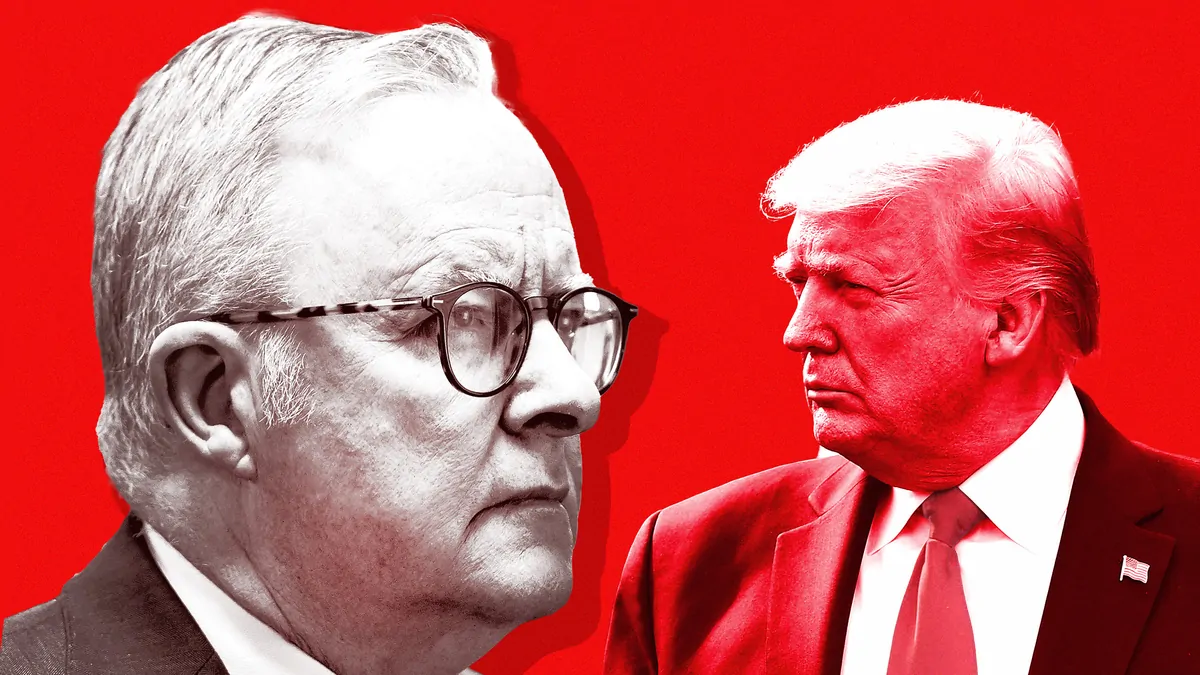
Mr Trump has also included Australia three times in his hit-list of countries he accuses of not doing enough. In a blast late last month he said “Australia was not great. I was a little surprised by Australia”.
This week he opened fire again. “It’s not just NATO,” he complained. “South Korea didn’t help us. You know who else didn’t help us? Australia didn’t help us. You know who else didn’t help us? Japan.”
Prime Minister Anthony Albanese has mostly played a straight bat to the Trump rhetoric. On Wednesday this changed when he said Mr Trump’s warning to Iran that a “whole civilisation will die” if the Strait of Hormuz was not reopened was inappropriate and an “extraordinary” statement. But he added the US was “our most important ally.”
“We are two great democracies, and that will continue into the future,” he said.
On Thursday Australia committed to keeping its E-7A Wedgetail surveillance plane in the Middle East a month after sending it to the region but Treasurer Jim Chalmers blamed Mr Trump for “unpredictability, uncertainty and volatility in the global economy”.
Mr Trump holds a grudge. For Australia, which relies completely on the US security blanket, the stakes could not go any higher.