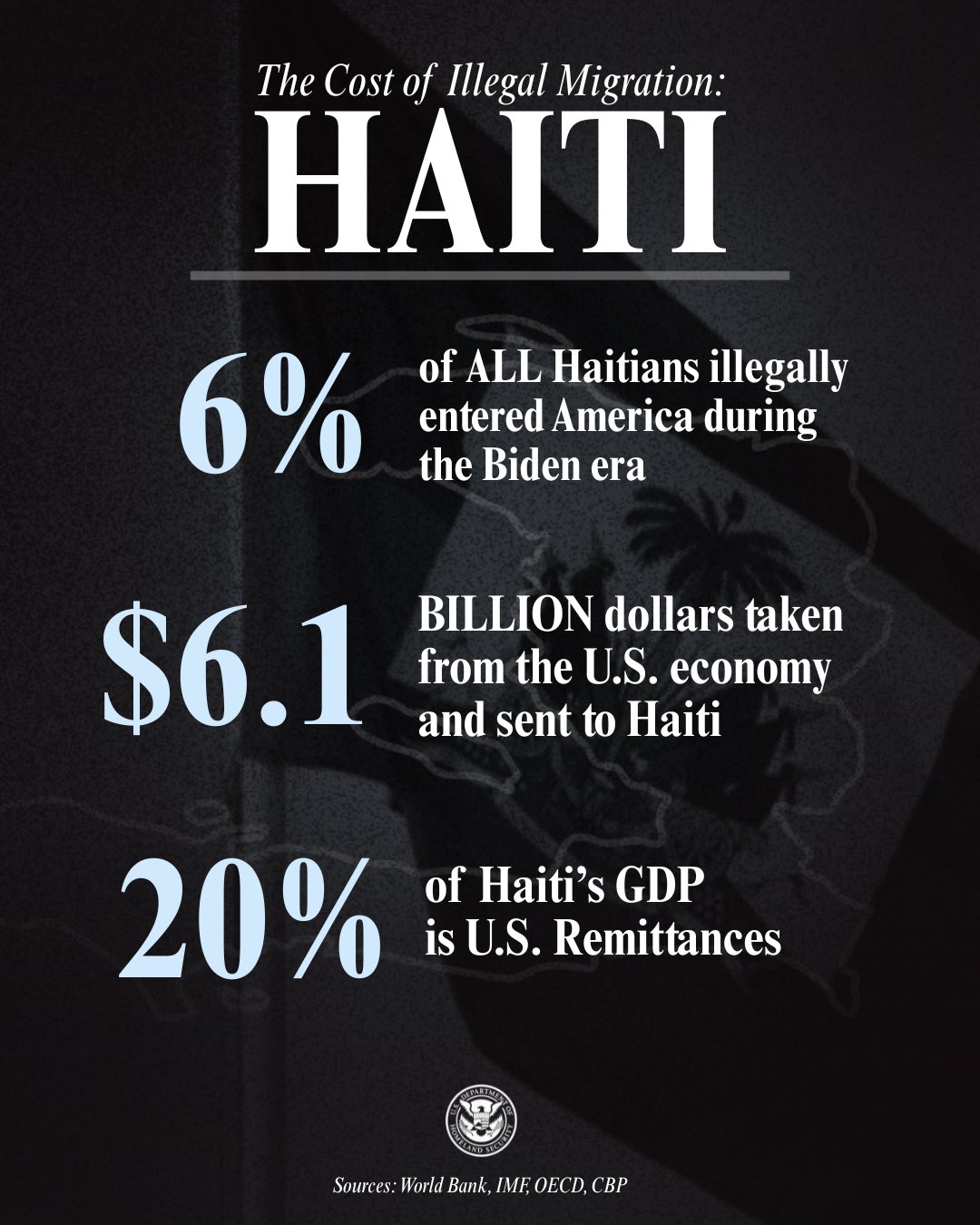
Official account claims “open borders” allowed 6% of Haitians to enter illegally and sent billions out of the economy – diaspora pushes back hard
Washington, D.C. – March 3, 2026 The U.S. Department of Homeland Security (DHS) ignited fierce controversy today with a strongly worded X post accusing the Biden administration’s immigration approach of enabling massive illegal Haitian entries and allowing billions in remittances to flow out of the American economy.
Posted this afternoon from the official @DHSgov account, the message reads:
“American dollars should NOT be used to subsidize foreign economies. Four years of open borders under the Biden Administration allowed 6% of ALL Haitians to enter our country ILLEGALLY. Many of these Haitians sent remittances back to their home country, making up 20% of Haiti’s ENTIRE ECONOMY and taking $6.1 BILLION from America. We will keep fighting to end this. Under @POTUS Trump and @Sec_Noem, our top priority is to put the safety and prosperity of the American people FIRST.”
The post quickly garnered thousands of views, reposts, and heated replies. It reflects the Trump administration’s intensified focus on immigration enforcement, including restrictions on programs that have benefited many Haitians — such as humanitarian parole (CHNV) and Temporary Protected Status (TPS) , amid ongoing legal battles over TPS terminations.
Sharp Divide in Reactions
Online responses have been sharply divided.
Supportive voices echoed the “America First” framing, praising the statement as a necessary call to prioritize U.S. resources and curb what they view as an outflow of American wealth.
Critical responses, particularly from Haitian diaspora accounts, immigrant advocates, and allies — pushed back forcefully. Many challenged the characterization of remittances as a “subsidy” or “drain,” emphasizing that these are private funds sent by hardworking individuals , often TPS holders, parole beneficiaries, or family-sponsored migrants , who pay taxes, contribute to U.S. industries (healthcare, construction, hospitality, etc.), and support families facing dire conditions in Haiti due to gang violence, displacement, and humanitarian crises.
Critics also highlighted perceived hypocrisy, pointing to U.S. foreign aid to other nations and noting that Haitian workers boost the American economy through labor and consumption. Remittances remain a lifeline for Haiti, providing essential support for food, education, healthcare, and survival in gang-controlled areas.
L’Union Suite will continue following this debate, including any official DHS clarifications, responses from Haitian-American leaders, and the broader implications for TPS holders, parole beneficiaries, and the diaspora.
Remittances are family love in motion, not a subsidy. Haiti endures. So does the fight for dignity.