

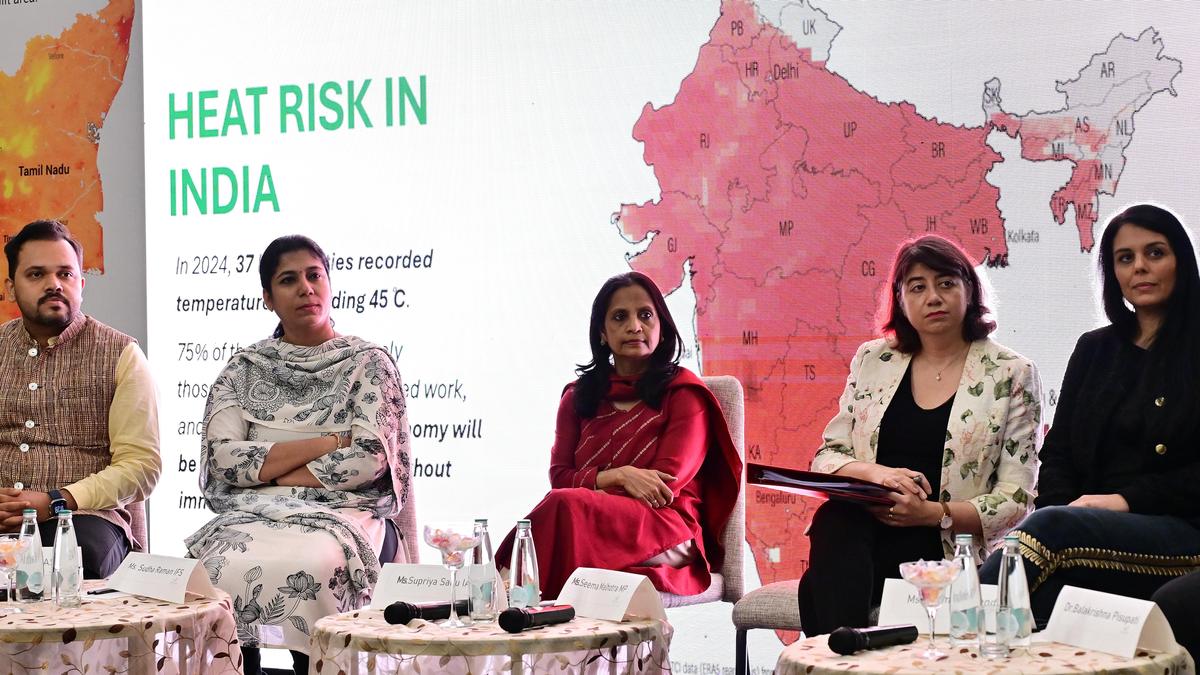
Supriya Sahu (centre), Additional Chief Secretary, Environment, Climate Change and Forests, Government of Tamil Nadu; Halima Holland, Deputy High Commissioner, Chennai; Seema Malhotra, U.K. Minister for the Indo-Pacific; and other dignitaries at an event on Friday.
| Photo Credit: B. VELANKANNI RAJ
Supriya Sahu, Additional Chief Secretary to the Department of Environment, Climate Change, and Forests, on Friday said the newly set up Centre for Heat Resilience in Tamil Nadu would have a broad roadmap, including high- resolution heat maps for all cities in Tamil Nadu.
The Centre for Heat Resilience in Tamil Nadu — set up within the Tamil Nadu Green Climate Company — is a landmark initiative under the U.K. Government’s Climate Action for a Resilient Asia Programme.
Heat maps
It marks yet another partnership between the U.K. and the Government of Tamil Nadu. “Heat maps will be the action that we will start with. Heat maps are crucial for targeted interventions. If you do not have the high-resolution heat maps, which are monitored over a period of time, you will not be able to design impactful interventions,” Ms. Sahu said at the event to mark the launch of Centre for Heat Resilience in Tamil Nadu. “Right now, it is very important that we have large-scale, real-time, city-based heat maps. So, we should look at preparing them at the Centre [for Heat Resilience),” she said.
“Do we have enough climate scientists? Do we have urban heat engineers? Do we have GIS (Geographic Information System) specialists, architects who are trained in cool city planning? Do we have health risk modellers? I don’t think we have them in adequate numbers. This is the second intervention that we would like to take up. We wish to strengthen the technical capacity of our government institutions and private institutions to manage heat risk scientifically. Thirdly, we must include heat risk zones in master plans. For this, we need to work closely with the Housing and Urban Development Department and designate areas now so that these strategies can be deployed from the very beginning, as soon as the master plans are getting ready,” Ms. Sahu said.
Ms. Sahu also highlighted the sponge cities and water cooling infrastructure, mangrove corridors, and biodiversity index for several cities that the Centre could consider. Bidding for the biodiversity park coming up in the outskirts of Chennai will be happening soon.
She sought measures to address challenges, including urban warming, heat stress in rural areas, gaps in data collection from rural and urban areas. She hinted at setting up a Centre for Circularity to design a sustainable framework for a circular economy.
U.K. Minister for the Indo-Pacific Seema Malhotra said extreme heat was one of the most urgent climate challenges we face today, and the Centre for Heat Resilience in Tamil Nadu marked the beginning of a collaborative effort — led by the Government of Tamil Nadu, the United Nations Environment Programme, and the World Resources Institute — to develop a shared framework for action on heat stress.
“Tamil Nadu has shown remarkable leadership on climate innovation. It is the first Indian State to establish a State Green Climate Fund and the Tamil Nadu Green Climate Company, and you’ve launched missions on climate change, greening, wetland restoration, and coastal resilience. Tamil Nadu is also a pioneer in recognising heat waves as a State-specific disaster,” she said.
Halima Holland, British Deputy High Commissioner in Chennai, Rahul Nadh, Managing Director, Tamil Nadu Green Climate Company, participated.
Published – November 22, 2025 04:54 am IST