Entertainment
The performance at Gwanghwamun Square launches a global tour spanning dozens of shows across the United States, Europe and Asia.
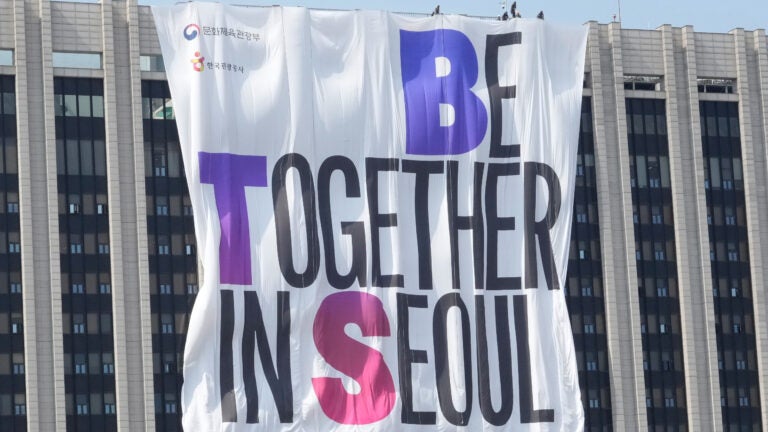
Workers adjust a banner promoting a comeback concert of K-pop boy group BTS on the government complex building near Gwanghwamun Square in Seoul, South Korea, Friday, March 20, 2026. (AP Photo/Ahn Young-joon) AP
March 21, 2026 | 9:05 AM
4 minutes to read
SEOUL, South Korea (AP) — After a four-year break, K-pop supergroup BTS returned Saturday with a massive, free comeback concert in Seoul, where thousands of police locked down a central boulevard for the Netflix-exclusive spectacle that drew tens of thousands of fans.
All seven members of the band — RM, Jin, Suga, J-Hope, Jimin, V and Jung Kook — recently completed South Korea’s mandatory military service, and hope to reclaim their status as one of the world’s biggest pop acts.
The performance at Gwanghwamun Square launches a global tour spanning dozens of shows across the United States, Europe and Asia, which analysts say could generate hundreds of millions of dollars in revenue per quarter.
The hourlong concert comes after the group on Friday released its fifth album, “ARIRANG,” which sold nearly 4 million copies in its first day, said the band’s management company, HYBE.
“Annyeonghaseyo! We’re back,” said RM, the band’s leader, using the Korean word for “hello,” as they opened the concert with the song “Body to Body.” HYBE said RM had injured his ankle during a rehearsal but he still performed with modified choreography.
Officials expected the BTS concert, which began at 8 p.m., to draw more than 200,000 people to the Gwanghwamun area, including 22,000 fans who secured free seats in the designated viewing zone and others watching on screens nearby. The show was streamed live on Netflix.
“It will be amazing because it’s been so long that BTS (was) not with us,” Dallila Di Tullio, a 32-year-old fan from Italy, said before the concert, calling it a once-in-a-century event.
BTS debuted in 2013 and has a legion of global supporters who call themselves the “Army.” It became the first K-pop act to top Billboard’s Hot 100 chart in 2020 with their first all-English song “Dynamite.”
Jung Dukhyun, a pop culture commentator, said that the impact of BTS’ return as a full-group would be tremendous at a time when global fandom for K-pop has grown much stronger, as shown by the success of Netflix’s animated sensation “KPop Demon Hunters.”
Stringent crowd controls
Police and city officials imposed stringent crowd-control measures, closing nearby streets, roads and museums, halting the area’s subway and bus services, and sealing off dozens of surrounding buildings, in what amounted to a full-day shutdown of the district.
Cars will be barred from the main road between Gwanghwamun and Seoul City Hall for more than 30 hours through Sunday morning. The government stepped up anti-terror monitoring, citing global tensions and large crowds of international fans, while police deployed surveillance vehicles and jamming equipment to block unauthorized drones. The restrictions have forced nearby shops to close and deliveries to pause.
Fans and curious onlookers streamed into streets around the square Saturday as thousands of police officers maintained a tight perimeter around the performance venue, channeling the crowds with a maze of fences and buses. Though the gates were not set to open until the afternoon, concertgoers began queuing by midday to secure spots along nearby roads, passing through security checks and metal detectors at designated entry points. The restrictions forced police to use their buses to shuttle wedding guests to a nearby venue.
“I was hoping to (see) if we can go through some holes or be around. Apparently we cannot because they will be asking people to move,” said Bernice Sanchez, a 52-year-old fan from Switzerland who was looking for a place to stay hours before the concert.
While South Korean officials have taken crowd safety more seriously since a 2022 Halloween surge that killed nearly 160 people, critics say the controls went too far and undermined the symbolism of performing in Gwanghwamun, seen as Seoul’s spiritual heart and most prominent gathering space.
Hundreds of thousands have gathered in Gwanghwamun in recent years to mourn, protest and celebrate as the country weathered tragedy and political upheaval. The BTS concert came about a year after waves of demonstrators filled the area, calling for the ouster of then-President Yoon Suk Yeol over his brief imposition of martial law in December 2024. Those monthslong rallies were marked by a festive atmosphere and a striking blend of politics and pop culture, with protesters singing and waving colorful K-pop light sticks, and ended without major safety accidents.
Drawing on culture and heritage
The new BTS album, “ARIRANG,” takes its name from a centuries-old folk song, regarded as an unofficial anthem in both Koreas, whose themes of separation, longing and quiet resilience have echoed across generations. Gwanghwamun and nearby Gyeongbok Palace provided a sweeping historic backdrop to Saturday’s show.
The 14-track record, with lead single “SWIM,” was recorded in Los Angeles as the group reconvened after years apart.
South Korean officials, including President Lee Jae Myung, expressed hope that the event would promote the country’s culture and growing soft power.
Group’s comeback coincides with K-pop’s global rise
The group’s comeback follows a nearly four-year hiatus driven by South Korea’s mandatory military service, which requires most able-bodied men to serve 18 to 21 months under a conscription system aimed at deterring aggression from North Korea. BTS members began serving in 2022, with Suga the last to complete his service in June 2025.
Some analysts say the group’s “ARIRANG” world tour is likely to become the biggest K-pop tour ever by scale and revenue, with 82 shows planned globally in stadiums of around 50,000 seats.
“They had a fairly long hiatus but still have a historically powerful fandom,” said Ha Jae-keun, a cultural critic. “I think they’ll likely have a second heyday.”
Associated Press video journalists Yong Jun Chang and Yong-ho Kim contributed to this report.