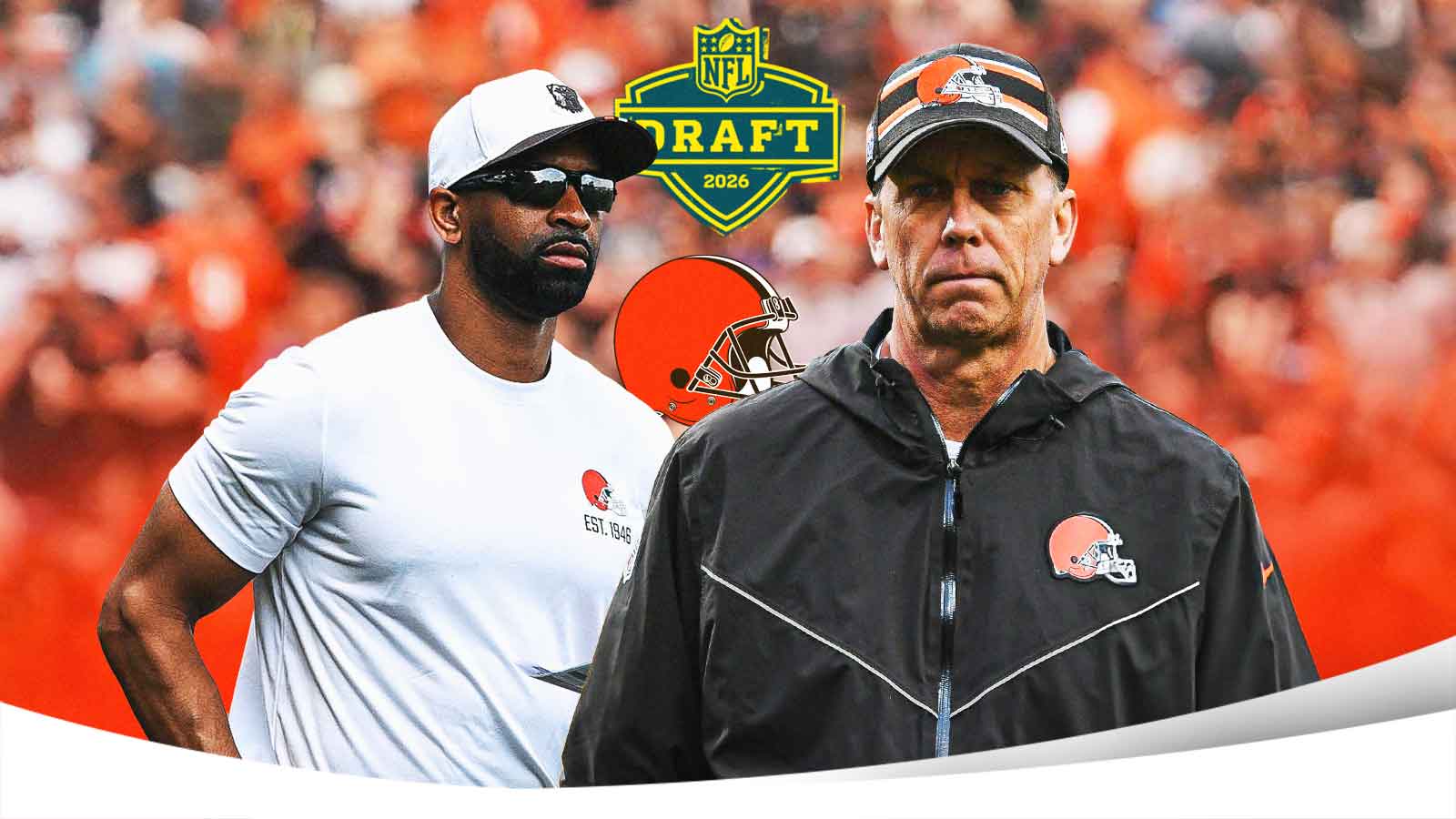
The Cleveland Browns enter the 2026 NFL Draft with a top-10 pick for the second consecutive season after going just 5-12 in 2025. After reloading in the offseason and replacing Kevin Stefanski with Todd Monken, Cleveland enters yet another new era.
The Monken era began in free agency, where the Browns overhauled their blocking unit by signing three veteran offensive linemen and a tight end. Cleveland will begin Week 1 with four new starters on its offensive line.
Despite the offensive focus in free agency, the Browns are expected to maintain that stance in the 2026 NFL Draft. They added several key defensive pieces in the 2025 offseason, with the focus now on building around second-year quarterback Shedeur Sanders.
Cleveland has nine draft picks in 2026 to address its clear roster holes, including a pair of first-rounders. They acquired the Jaguars’ No. 24 selection on 2025 draft night, when Jacksonville moved up to select Travis Hunter, along with their own No. 6 pick.
Let’s take a look at the Browns’ 2026 NFL Draft, according to the PFF mock draft simulator.
Round 1, Pick 6: OT Francis Mauigoa, Miami (FL)
Jerome Miron-Imagn Images
The Browns’ offensive line overhaul has them almost unanimously expected to target an offensive tackle at No. 6. Their decision will boil down to either Miami’s Francis Mauigoa or Utah’s Spencer Fano, and the PFF mock draft simulator expects them to end up with Mauigoa.
Mauigoa is not an immediate fix for the Browns’ new-look offensive line, but he is a massive step in the right direction. The Samoan only allowed a pressure on 3.5 percent of his pass-blocking snaps in his three years at Miami, providing a massive lift to an offense that allowed Shedeur Sanders to absorb 21 sacks in seven starts last season.
Mauigoa would immediately become the Browns’ starting right tackle, opposite Dawand Jones, the team’s only returning starting offensive lineman. Cleveland’s only other option is Tytus Howard, who allowed 21 pressures and committed eight penalties in 2025.
Round 1, Pick 24: OT Max Iheanachor, Arizona State
Despite selecting Francis Mauigoa at No. 6, the PFF mock draft simulator expects the Browns to add another tackle at No. 24. In this situation, Cleveland pairs Mauigoa with Arizona State’s Max Iheanachor.
Extenuating circumstances aside, Iheanachor is a stout offensive tackle prospect who has emerged as a late-first-round pick following a strong outing at the combine. Iheanachor never played football in high school, which resulted in some technical liabilities, but his athleticism is off the charts, and he impressed scouts at the Senior Bowl. Although he could be a project, Iheanachor is clearly someone many see with star potential.
Iheanachor would be a solid addition to the Browns at No. 24, but not after taking Mauigoa at No. 6. If it targets a tackle in the top 10, Cleveland would be better off adding a guard or a receiver with its second first-round pick.
Round 2, Pick 39: CB Colton Hood, Tennessee
Depending on how the Browns view Tyson Campbell, cornerback could be atop Andrew Berry’s Day Two priorities list. Campbell was Cleveland’s highest-rated cornerback on PFF in 2025, but also allowed a team-high 46 receptions and six touchdowns. The PFF mock draft simulator expects them to seek his replacement with Tennessee star Colton Hood.
After struggling to find his footing at Auburn and Colorado in his first two seasons, Hood broke out with Tennessee in 2025. A preseason injury to Jermod McCoy thrust him into an immediate starting role, and he responded with eight pass breakups, one interception and one forced fumble while allowing an elite 70.8 passer rating, per PFF.
Hood is trending toward becoming a first-round pick, but he could still be available when the Browns are back on the clock at No. 39. While he has the talent to elevate any defense, pass coverage was one area Cleveland did not struggle in last season. Getting hood in the second round is exceptional value, but they could benefit more by addressing other positions of need.
Round 3, Pick 70: WR Elijah Sarratt, Indiana
Aaron Doster-Imagn Images
The Browns cannot end the first two days of the 2026 NFL Draft without taking a receiver, and the PFF mock draft simulator has them waiting until the third round before taking Indiana’s Elijah Sarratt. The 22-year-old Sarratt enters the draft after posting an FBS-high 15 touchdowns in the Hoosiers’ national championship season.
Sarratt’s yard total decreased in each of his final three seasons, but he has always been the go-to receiver in every offense he has played in. Whether it was Fernando Mendoza, Kurtis Rourke or Jordan McCloud throwing him the ball, quarterbacks always looked for Sarratt when they were in trouble. Sarratt learned how to pair his sticky hands with his sturdy frame to become one of the most lethal red-zone targets in the country as a senior to further bolster his draft stock.
The Virginia native is not someone who beats defenses with speed, but he became one of the best contested-catchers in college football during his two years at Indiana. The Browns need to give Shedeur Sanders more weapons, and Sarratt is a fine Day Two target, especially in the third round.
Round 4, Pick 107: QB Carson Beck, Miami (FL)
The one position Berry needs to avoid in the 2026 NFL Draft is quarterback. Yet, despite DeShaun Watson returning to join Shedeur Sanders and Dillon Gabriel in 2026, the PFF mock draft simulator expects the Browns to select Carson Beck with its fourth-round pick.
The Browns already have more quarterbacks than they can handle for the second consecutive offseason. Adding a talented, experienced veteran like Beck would only turn a messy situation into an unwarranted headache for Todd Monken to deal with in his first offseason as an NFL head coach.
Beck ended his collegiate career on a high note, throwing for 3,812 passing yards and a career-high 30 touchdowns with Miami in 2025. He deserves a shot at winning a potential backup job in his rookie season. The Browns are not the team for him, and it makes even less sense for the most quarterback-troubled franchise in the league.
Round 5, Pick 146: DL Tim Keenan III, Alabama
Contrary to its offensive counterpart, the Browns’ defensive line is shaping up to be one of the team’s strengths in 2026. The PFF mock draft simulator still expects them to target former Alabama standout Tim Keenan III in the fifth round.
Keenan flew under the radar as a high school recruit before breaking out with the Crimson Tide as a sophomore, racking up 78 tackles, 3.5 sacks and two pass breakups from 2023 to 2024. Keenan was trending toward becoming a potential Day Two prospect before injuries limited him to just nine games in his senior season.
While the Browns have to be pleased with what they got out of Mason Graham and Maliek Collins in 2025, they lack depth with former second-round pick Mike Hall Jr. proving to be a massive bust. Keenan would be a high-upside depth piece, especially with Collins preparing for his 11th season.
Round 5, Pick 149: WR Cyrus Allen, Cincinnati
Rob Gray-Imagn Images
The Browns would be wise to add multiple receivers in the 2026 NFL Draft, which is precisely what the PFF mock draft simulator projects. Two rounds after selecting Elijah Sarratt, the simulator has Cleveland going with Cincinnati wideout Cyrus Allen.
Allen’s rocky four-year college football career includes two solid seasons at Louisiana Tech that made him one of the top transfers entering the 2024 season, only to bust at Texas A&M before ending it on a high note with Cincinnati. Despite being known as a small-statured speedster, Allen became a touchdown machine for the Bearcats, reaching the end zone a Big 12-leading 13 times.
Speed is the one element the Browns’ receiving corps lacks the most, making Allen an intriguing addition to the group. Shedeur Sanders has had success working with similar wideouts before, including LaJohntay Wester, Dre’lon Miller and Omarion Miller at Colorado.
Round 6, Pick 206: WR Zavion Thomas, LSU
The PFF mock draft simulator wants the Browns to add a third receiver in the sixth round with LSU’s Zavion Thomas. The 5-foot-10 wideout enters the draft after amassing 1,213 receiving yards and seven touchdowns during his four-year collegiate career at Mississippi State and LSU.
Thomas, a former four-star recruit, never developed into the dominant pass-catcher many expected him to be, but he brings a versatile skill set to the table. He carried the ball 19 times for 99 rushing yards and a touchdown in 2025 while creating more chunk plays on basic screen passes.
With Monken now working with significantly less talent than he had in Baltimore, a player like Thomas would help him open up the playbook. Thomas will need to improve his route-running technique and footwork to carve out a meaningful career.
Round 7, Pick 248: RB Robert Henry Jr., UTSA
The depth of the 2026 running back class leaves UTSA product Robert Henry Jr. in a precarious position entering the NFL Draft. In addition to the negative connotations that come with playing at a Group of Five school, scouts are concerned about Henry’s size. Regardless, the PFF mock draft simulator has the Browns taking him with their ninth and final pick.
The 5-foot-9 Henry was one of the most efficient running backs in the country in 2025, racking up 1,045 rushing yards and nine touchdowns on an elite 6.9 yards per carry. Henry did his damage despite splitting the backfield with Will Henderson III to spearhead one of the most explosive offenses in the country.
A slow 40-yard dash time and middling vertical jump hurt Henry’s draft stock, which was already on life support as a 24-year-old running back. Nonetheless, the Browns could stand to benefit from a late-round running back flier as Quinshon Judkins recovers from a gruesome broken leg injury sustained late in his rookie season.