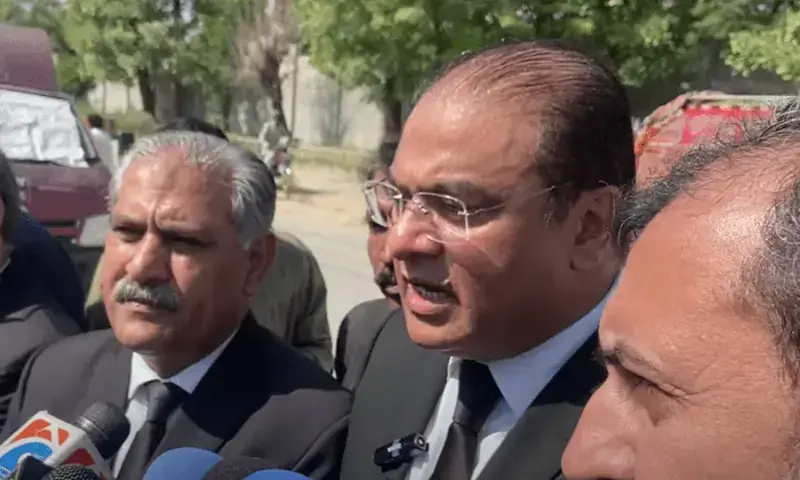
ISLAMABAD: Barrister Salman Safdar on Thursday met PTI founder Imran Khan at Adiala jail, a day after the Islamabad High Court (IHC) directed authorities to arrange the meeting.
However, the lawyer departed from the premises without sharing any details with the media.
Meanwhile, PTI information secretary Sheikh Waqas Akram said that Imran had directed the party to postpone its public meeting scheduled for Thursday (April 9) at Liaqat Bagh.
He said that a message had been given by Imran that the protest should be postponed due to the prevailing national and international situation.
“Imran Khan has said that he will himself inform about the new date of the protest,” he said.
Later, Safdar said in a series of posts on X that he had meet Imran at 3pm, but the ex-premier’s spouse, Bushra Bibi, “was not called from her cell to join the attorney-client meeting for crucial instructions” despite requests and court orders.
He said the meeting lasted for 60 minutes, during which Imran was comprehensively briefed on all legal matters including the Al Qadir Trust case.
“Overall found Khan sahib in good health, high spirits and exceptionally strong like before. Eye complication continues with major impairment and little improvement,” he claimed.
Imran’s eye ailment — right central retinal vein occlusion (CRVO) — came to light in late January. His first medical procedure, which was carried out on January 24, was confirmed by the government five days after reports surfaced about it in the media.
Subsequently, Imran’s lawyer, Salman Safdar, told the Supreme Court that the former premier had lost a significant amount of vision in his right eye while in custody.
A five-member team had initially examined Imran at Adiala jail on Feb 15. On Feb 24, Imran was brought to Pims for a follow-up. According to a Pims doctor, Imran was brought to the hospital for a second dose of anti-VEGF intravitreal injection. On March 23, he underwent a third eye procedure at Pims.
The government and the opposition have been engaged in a blame game, with the latter accusing the former of a lack of transparency on the matter, of not ensuring appropriate treatment for Imran, and of not allowing his personal physicians access to him. The government denies these allegations.
Safdar said Imran was to get further treatment in two week.
“Khan sahib gave very clear instructions for the Al Qadir case and emphasised on arguing bail applications and seeking decision on merits. Khan sahib and wife are being kept in torturous ‘solitary confinement’ for almost 24 hours with no access to books, TV, family or lawyers,” he claimed.
The IHC on Wednesday had allowed Safdar to discuss the proceedings of the Al Qadir case with Imran, in which he is representing the former premier.
It should be mentioned that this is the second time that Safdar has met Imran this year. The previous instance was also at the court’s direction when concerns were raised about Imran’s health.
TTAP meeting
Separately, a meeting of the opposition alliance Tehreek Tahafuz Ayeen-i-Pakistan (TTAP) was held in Islamabad at the residence of the Chairman and Leader of the Opposition in the National Assembly Mahmood Khan Achakzai.
The meeting was attended by prominent political leaders including Senator Allama Raja Nasir Abbas (Leader of the Opposition in the Senate), Salman Akram Raja (Secretary General PTI), Barrister Gohar Ali Khan (Chairman PTI), Firdous Shamim Naqvi, Sahibzada Hassan Raza (Head of Sunni Ittehad Council), Syed Zain Shah, Sajid Khan Tareen, Muhammad Zubair, Mustafa Nawaz Khokhar, Dr Ammar Ali Jan, Hussain Ahmed Yousafzai and Khalid Yousaf Chaudhry.
According to the declaration of the meeting, shared with the media, the meeting held detailed deliberations on the current political situation in the country, regional developments — particularly tensions involving Iran, Israel, and the United States — the evolving Middle East situation, the conditions in Balochistan, upcoming protest strategies, and the ongoing injustices faced by Imran.
Participants welcomed the two-week ceasefire between Iran and the United States and expressed hope that both sides would fully adhere to it, paving the way for lasting peace in the region. The meeting emphasised that sustainable peace in the Middle East required a just resolution of issues concerning not only Iran but also Lebanon, Syria, and Gaza. The movement reaffirmed its commitment to playing a constructive role in promoting global peace.
The participants also appreciated the Pakistan-Afghanistan dialogue held in China, stating that meaningful engagement and dialogue with neighbouring countries was the most effective path toward regional stability and development. The TTAP reiterated its stance that disputes must be resolved through dialogue rather than military confrontation, guided by principles of national security and regional peace.
The meeting urged the government of Pakistan to promote political dialogue, rule of law, and reconciliation, stressing that respect for public mandate was the foundation of national progress. It was emphasised that all political forces must unite and initiate serious negotiations to overcome internal crises.
Expressing grave concern over the situation in Balochistan, the participants called for the immediate release of the leadership and workers of the Baloch Yakjehti Committee. Furthermore, they demanded withdrawal of cases against Sardar Akhtar Mengal and an end to the exploitation of the province’s resources.
The meeting welcomed the IHC’s initiative regarding facilitating meetings with Imran and urged the Supreme Court and high court to conduct daily hearings on all cases, bail matters, and petitions related to meetings. It also demanded immediate restoration of meetings between the incarcerated PTI leader and his lawyers, family, and political associates, and called upon Adiala jail authorities to expedite completion of legal documentation required for Supreme Court proceedings.
The TTAP announced nationwide, district-level public gatherings on April 25 in support of constitutional supremacy, the release of political prisoners, including Imran, and the provision of economic relief to the public. The participants strongly condemned the treatment of detained leaders, including Sahibzada Hamid Raza, Iman Mazari, Hadi Ali Chattha, Ali Wazir and Samad Wazir, and demanded their immediate release.
On the occasion of May 1 (Labour Day), the movement announced that rallies will be organised nationwide in solidarity with workers, along with the presentation of an alternative economic agenda for national recovery. Expressing deep concern over the country’s economic situation, the meeting noted that inflation has severely impacted the poor, farmers, and labourers. It was decided to unite farmers and workers’ organisations for a joint struggle.