Members of the Telangana ASHA Workers Union gathered at Dharna Chowk, Indira Park, for the “Chalo Hyderabad” demonstration on Saturday (March 28, 2026)
| Photo Credit: RAMAKRISHNA G
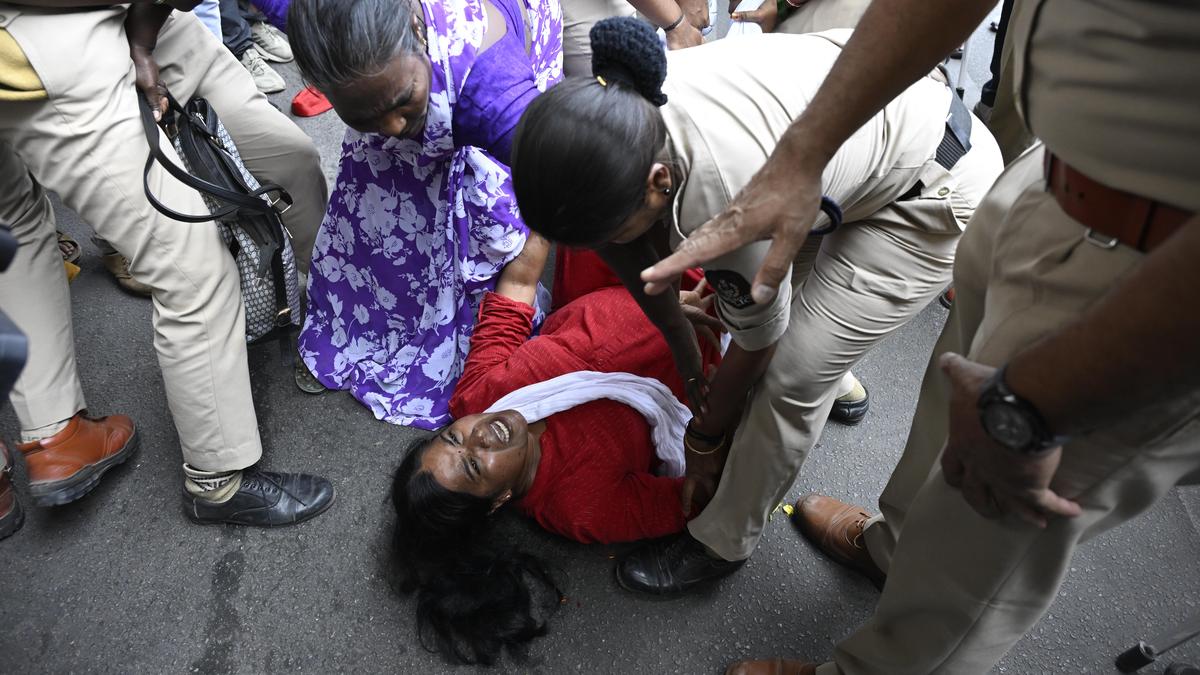
Over the past one month, Hyderabad and many other parts of Telangana have been witnessing protests by Accredited Social Health Activists (ASHA) workers, with the agitation intensifying into sit-ins, road blockades, and confrontations with the police. The protests are centred around long-standing demands which include a fixed monthly salary and formal recognition as workers within the public health system.
Who are ASHA workers and what do they do?
ASHAs form the backbone of India’s community healthcare system. In Telangana, there are over 28,000 ASHA workers. They are responsible for a wide range of services, including maternal and child health, immunisation, disease surveillance, health awareness campaigns, and linking communities to government health services.
What are they paid now?
At present, ASHA workers do not receive a fixed salary. Telangana ASHA Workers Association president P. Jayalakshmi said that workers earn around ₹9,900 per month, but this amount is not guaranteed. “It is incentive-based and not fixed. Depending on various factors, payments can fluctuate. At any time, depending on budget constraints or administrative issues, payments may be affected,” she said. This lack of predictability is one of the central issues driving the protests.
What is the main demand?
The primary demand is the implementation of a fixed monthly salary of ₹18,000. According to Ms. Jayalakshmi, this demand has been pending for years. “We have been fighting for our rights since the Congress government got elected to power here. Even with the earlier Bharat Rashtra Samithi (BRS) government, we demanded fixed wages. If not ₹18,000, at least minimum wages should be ₹15,000,” she said.
Members of the Telangana ASHA Workers Union gathered at Dharna Chowk, Indira Park, for the “Chalo Hyderabad” demonstration on Saturday (March 28, 2026)
| Photo Credit:
RAMAKRISHNA G
How did the protests unfold?
The current phase of protests began on February 23, when ASHA workers staged a demonstration near the office of the Commissioner of Health and Family Welfare in Koti, Hyderabad. Over the following weeks, the agitation escalated. Workers held continuous protests for over two weeks, including a 48-hour sit-in in front of collectorates across the State.
Why do ASHA workers say the system is unfair?
A key concern is the mismatch between workload and compensation. ASHAs are expected to be present at sub-centres from 9 a.m. to 4 p.m., while also carrying out extensive fieldwork that often extends beyond these hours. “We work day and night, but we are still treated as volunteers,” said R. Neela Devi, general secretary of the association. She added that their responsibilities have increased over time, including surveys, implementation of government programmes, and health data collection, but their earnings have not kept pace.
What are the other demands?
They are seeking a ₹1,500 monthly allowance to cover work-related expenses, along with clearance of pending dues, including six months of PF and ESI contributions from 2021 and all arrears from 2022 to 2025. They have demanded that ASHA workers be brought under formal labour protections and be recognised as part of the National Health Mission (NHM) workforce.
The association has also called for expansion of staffing, stating that for every 50,000 population, at least 50 ASHA workers should be appointed. Other demands include free medical treatment and insurance for workers and their families, parity with Auxiliary Nursing Midwives (ANMs) and Primary Health Centre (PHC) staff, a retirement benefit of ₹5 lakh along with pension, and provision of 20 days of casual leave.
Published – March 30, 2026 12:11 pm IST