Local News
State officials are urging water conservation amid persistent precipitation deficits despite heavy winter snowfall.
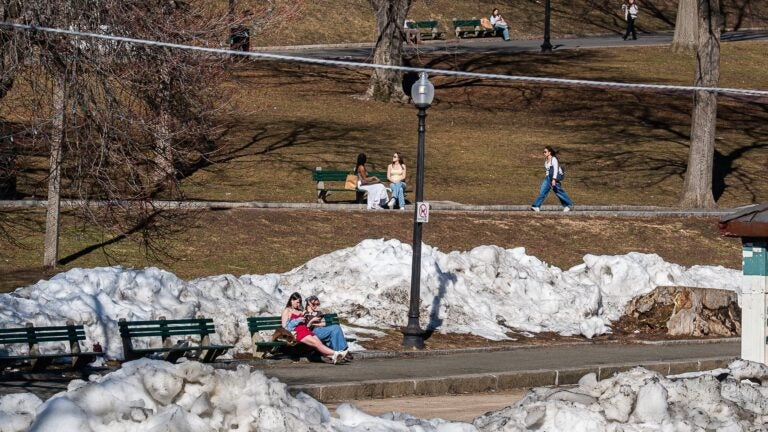
The warm weather is drastically melting any residual snow piles, like the ones seen Monday on the Boston Common. Finn Gomez for the Boston Globe
Despite February’s significant snowfall, drought conditions have intensified across several regions of Massachusetts, state officials announced this week.
Months of below-average precipitation and limited groundwater replenishment continue to strain water resources across the state, according to the state’s Drought Management Task Force.
In a press release, Energy and Environmental Affairs Secretary Rebecca Tepper said the Central and Northeast regions of Massachusetts have now been elevated to Level 3 — Critical Drought, the second-highest classification under the state’s drought management system. Meanwhile, the Connecticut River Valley has been placed in a Level 2 — Significant Drought, and the Western part of the state has moved to Level 1 — Mild Drought.
The worsening conditions follow a snowy February that brought up to three feet of snowfall to parts of New England. Officials say the snow has provided only limited relief because the cold temperatures have prevented significant melting that would refill the groundwater. When it does melt, the snow will likely yield only about 2.5 inches of water, according to the task force. That amount falls short of what is needed to replenish dry rivers, lakes, ponds, and aquifers.
“This drought has been building since 2024, and we’re still seeing the effects in low streamflow and lower water levels across the state,” Tepper said, urging Massachusetts residents to conserve water.
Officials recommend that residents check their water bills for sudden increases that may signal leaks and make immediate repairs. Residents should also run dishwashers only when they’re full, take shorter showers instead of baths, and turn off the faucet while brushing teeth or shaving. Replacing older fixtures and appliances with WaterSense-labeled models can also help improve water efficiency, officials said.
Residents can also utilize the state’s Home Water Use Calculator tool to track their household water use.
Despite the worsening drought in many regions, the Massachusetts Water Resources Authority’s system — which supplies water to much of the Greater Boston area — is not currently experiencing drought conditions.
Officials say upcoming spring rains may improve conditions, but sustained precipitation will be needed over several months to fully restore groundwater and surface water levels.
The task force said it will continue monitoring conditions statewide and is scheduled to meet again in early April to reassess the drought conditions.
Morgan Rousseau is a freelance writer for Boston.com, where she reports on a variety of local and regional news.
Sign up for the Today newsletter
Get everything you need to know to start your day, delivered right to your inbox every morning.