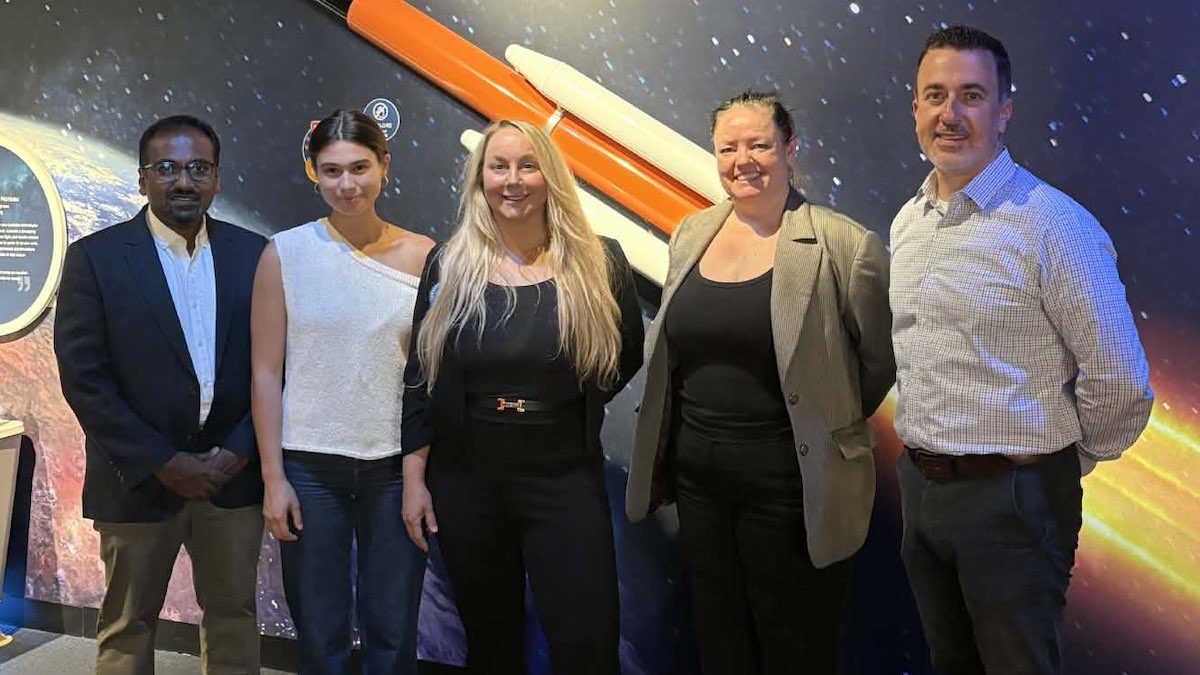
Pictured: The Adelaide University researchers involved in the space experiment.
In a world-first, Adelaide researchers are preparing an experiment which will see them send living cancer cells into space aboard a rocket, hoping the extreme conditions could unlock new insights into how the disease develops and resists treatment.
Led by Dr Nirmal Robinson from the Centre for Cancer Biology and SAHMRI, the project will study how cancer cells behave in microgravity, the near-weightless environment experienced in space.
The mission will see the cells launched on a suborbital rocket from Sweden, in partnership with Cambrian Defence & Space and Blue Dwarf Space, with support from the State Government. The flight will last just 10 to 12 minutes, but researchers say that’s more than enough time to gather valuable data.
On Earth, gravity plays a major role in how cells grow and behave. In lab settings, cells tend to settle into flat layers. But in microgravity, they float freely, forming three-dimensional structures that more closely resemble how tumours develop inside the human body.
“Cancer cells live under enormous stress,” said Dr Robinson. “In a tumour, cells are competing for nutrients and oxygen, and many die in that environment. Yet a small number of cells adapt and survive. Those are the cells that can become aggressive, spread through the body and resist treatment.”
By removing gravity from the equation, the scientists hope to get a clearer picture of how these resilient cells function, particularly those that can survive chemotherapy, spread through the body, or become more aggressive over time.
The focus will be on highly adaptable cancer cells that can divide indefinitely and shift behaviour quickly. These cells are often responsible for tumour growth and recurrence, making them a key target for future treatments.
Once the rocket returns to Earth, the samples will be rapidly frozen and sent back to Adelaide for detailed analysis. Researchers will examine changes in gene activity and protein expression to understand how the cells respond to their time in space.
“We want to see how the cells respond to microgravity – whether they multiply more readily,whether they experience different stress responses, or whether certain biological pathways are activated,” Dr Robinson said.
The project is also paving the way for more Australian-led experiments in space. It is a major step toward creating a reliable pathway for local researchers to use space as a laboratory. “This project is Australia’s first dedicated microgravity cancer research mission designed to establish a repeatable, sovereign access pathway for biomedical experiments in space,” added Dr Robinson.
“The grant team’s aim is not only to advance cancer research, but also to create opportunities for other scientists and industries to use space as a laboratory,” added grant partner, Cambrian CEO Tiffany Sharp.
With the launch expected later this year, the mission could open up a whole new frontier in cancer research, proving that the answers to some of Earth’s biggest health challenges might just lie beyond it.