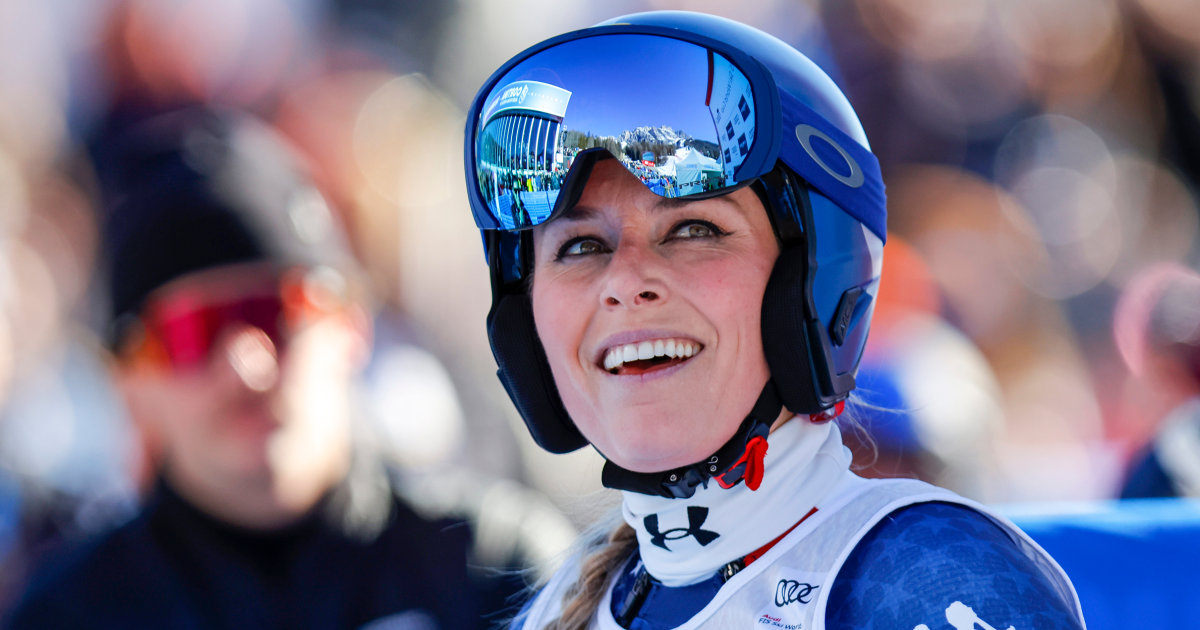
Once you have skied down mountains at speeds exceeding 80 mph, there are only so many ways to replace that feeling.
Since injuries led Lindsey Vonn to retire in 2018 after one of the most decorated and highest-profile careers in the history of American skiing, she tried investing. Vonn, the 2010 Olympic gold medalist, wrote a best-selling memoir and got into rodeo roping. Red Bull, one of her longtime sponsors, recruited her to drive for its Formula 1 team, she said.
Lewis Hamilton, her friend and a former Formula 1 champion, wasn’t sure whether such a transition from snow to racetrack was possible, “but he’s like, ‘If anyone could do it, it would be you,’” she said.
The speed intrigued her. Less intriguing was a three-year commitment she said the offer to drive required.
“There’s a lot of other things I’d like to do in my life,” she said.
Like pursuing, one last time, a rush replicable only on the slopes.
Lindsey Vonn in St. Moritz, Switzerland., on Wednesday.Alain Grosclaude / Agence Zoom / Getty Images
After nearly six years in retirement, Vonn returned to competitive skiing last year with the aim of qualifying for the upcoming Winter Olympics in Italy, which would be her fifth and final Winter Games. She will be 41 and hopes to compete in the downhill, the super-G and a team combined race when the events kick off in February. Her qualifying enters a critical stretch this weekend at a key Olympic precursor, when the season’s first women’s World Cup speed races begin in Switzerland.
Vonn, the only American woman ever to win an Olympic gold medal in downhill, retired because skiing with two knee braces, three fractures and no ligament in one of her knees had made her “a shell of a human being,” she said. Her desire for adrenaline and competition was unchanged. Undergoing partial knee-replacement surgery last year and subsequently feeling as pain-free as she had before her first major knee injury in 2013 freed her to contemplate a return to the activity that has animated her life since she was a 2-year-old in Burnsville, Minnesota — getting on skis and going as fast as possible.
“Being a downhiller, you have to have a certain mentality, and to be a really good downhiller takes something different, and maybe that’s why I’m a little bit crazy, but I’m accepting of that,” Vonn said in October. “I’m willing to risk everything. That’s why I’ve won as many times as I have in downhill.
“Board calls are nice, but they’re not really the same as downhill. And investing is great, but it’s also not the same. I built a great life outside of skiing, but there will never be anything like skiing, and I fully understand that, and I’m comfortable with that. But I’m definitely going to enjoy this last bit of adrenaline, because I won’t get it back.”
Though Vonn said Alpine skiing’s technology, courses and strategy had changed little since she retired — “downhill is downhill; you go as fast as you can,” she said — the Vonn competing now is far different from the version of her when she left the sport.
She cut out the pasta, wine and ice cream she permitted herself to eat during her prime and also dialed back the three-a-day workouts that were once a staple. She trains five hours six days a week.
“I can’t win a medal skiing the way I did with a nonfunctioning body,” she said. “I have to be strong, and I am strong, and that’s why I’m so excited, because I haven’t been in this position where I feel 100% healthy in so, so long.”
Skiing is still a young person’s game. The oldest woman to win Olympic gold in either downhill and Super-G was 32; only four competitors 30 or older have ever won the downhill or the Super G. But tell those odds to Vonn, whose smile curls as she rattles off, unprompted, numerous instances when she says she was doubted but won.
Along with renewed health and confidence, she believes her knowledge gives her an edge. Alpine skiing will be held in Cortina, on a course where Vonn has won 12 World Cup races. That experience factored heavily into her decision to come back.
What was not a consideration, she made it clear, was potentially damaging her legacy if she skis poorly.
“I don’t think anyone remembers Michael Jordan’s comeback. I don’t think that’s part of his legacy at all,” she said. “I’ve already succeeded. I’ve already won.”
Her 83 World Cup wins, third all-time, and past Olympic success have left her secure and “skiing freely with no exterior expectation or pressure,” she said. And yet, of Vonn’s eight medals at world championships, only one came after 2017. Of her three Olympic medals, only one came after 2010.
As her comeback got off the ground last year, getting back to medal contention got off to a bumpy start. Vonn made uncharacteristic mistakes on the slopes, realized she needed to add muscle in the weight room and worked out kinks with her equipment.
Signs began to emerge last season, however, that her trips down the slopes were not born out of a need to fulfill a nostalgic ride off into the sunset.
In March, she finished in the top three of a World Cup event — 2,565 days after her last World Cup podium — to become the oldest woman ever to place on the podium, at 40. A pathway to a medal could be improved by injuries that have already ruled Lauren Macuga of the U.S. and Federica Brignone of Italy out of Olympic contention. Another top contender, Switzerland’s Lara Gut-Behrami, also could be sidelined in Cortina, and reigning Olympic downhill champion Corinne Suter of Switzerland recently crashed in training, leaving her unable to ski until about a month before the Olympics start.
Meanwhile, Vonn, who missed the 2014 Olympics after she injured her right knee, says she feels at her physical best.
To improve her chances, Vonn hired Aksel Lund Svindal, a 42-year-old four-time Olympic medalist from Norway, as her coach. The two had grown friendly during concurrent careers, and that trust factored into his hiring. Vonn is deeply technical about her equipment, saying she once felt a millimeter’s difference between two skis, and Svindal has also raced for years using the same brand, Head, that Vonn uses.
As always, however, it comes down to speed.
“He knows the line that men ski, and that’s the type of edge that I need to be able to push the limits in a way that the other women are not willing to,” Vonn said.
Nothing Svindal tells Vonn will be more impactful than the advice she got when she was just a child, when her coach, Erich Sailer, told her she was fast just the way she was and not to change.
“I took that as not just in skiing,” she said. “In life, always be me.”
That instinct to trust herself has been taken, at times, to unusual lengths. Vonn used the same pair of ski boots for the last six years of her career until she retired; she does not make changes lightly. And what has never changed, through injury, retirement or her comeback, is the allure of going fast and placing high. Even at 41 — and especially at Cortina.
“There is that appreciation of the journey, but don’t get it twisted,” Vonn said. “I’m a results-based driven person. I’m looking to do well.”