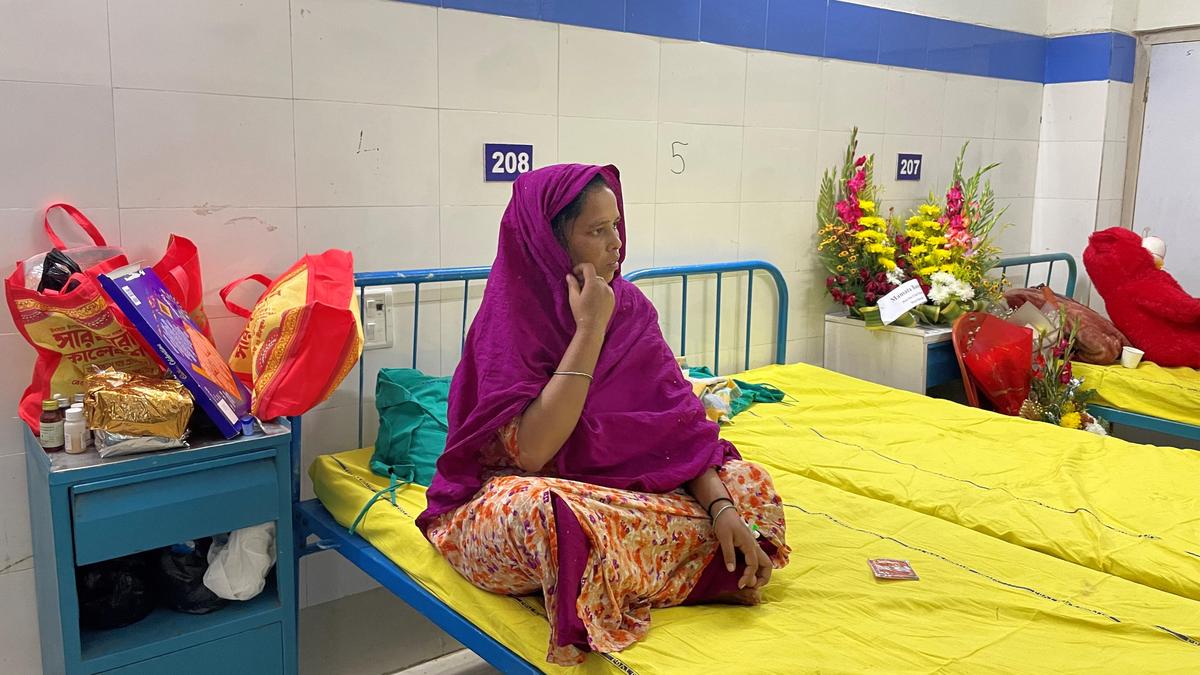
Behind a pair of green surgical curtains, 26-year-old Sunali Khatun struggles to sit cross-legged. It’s hard for her to tuck her swollen feet into the crooks of her knees while balancing her baby bump. Carefully shifting her balance, she sits next to her daughter while mixing some rice and piping hot chicken curry on a plate. As her daughter grows excited to be fed by her, Sunali’s swollen fingers sculpt a rice ball with chunks of chicken. Holding it before her daughter’s face, they both exchange a warm smile. It is an unspoken reassurance that they are now together after nearly six months.
Facing her daughter and son, aged eight and six, Sunali, who is nine months pregnant, struggles to string together words. “Kohun je din kete raat hoto ar ki bhabe je mash gulo kete gelo, ta mone nai (I don’t remember how days turned into night and how weeks turned into months),” she says in Bengali. “All I remember is being anxious about the child I am yet to give birth to and the one I had left behind in India,” she says while caressing her baby bump. For Sunali, being with a part of her family, close to her ancestral home in Birbhum’s Paikar village, is a huge relief.
Sources say in August 2024, the Ministry of Home Affairs had ordered a nationwide crackdown on Bangladeshi nationals staying illegally in India. Across May and June 2025, in a post-Pahalgam-attack India, this intensified; “national security” was cited as a reason.
In July, the advocacy group Human Rights Watch said in a report, “The Indian government has provided no official data on the number of people expelled, but Border Guard Bangladesh has reported that India expelled more than 1,500 Muslim men, women, and children to Bangladesh between May 7 and June 15, including about 100 Rohingya refugees from Myanmar.”
Surprise arrests
On June 18, when Danish Sheikh, Sunali’s husband, sat down to eat a meal in their rented house in Delhi’s Rohini, three police officers came to their shanty asking for Bengali-speaking migrants. Danish, a kabadiwala, who dealt with scrap; his neighbour Sweety Bibi; and her two sons, aged 17 and six, were taken to the K.N. Katju Marg police station in India’s Capital.
Also Read | Sunali Khatun was pushed to Bangladesh despite being Indian, says Mamata Banerjee
“I got a call to bring Danish’s documents to the police station, but without even checking anything they put me and my son behind bars too,” says Sunali, adding that she had carried her husband’s Aadhaar and voter ID cards. Her daughter was at a relative’s place that day.
In the following hours, Sunali alleges that Delhi Police coerced her into accepting that they were Bangladeshis. “We told them that we were from West Bengal’s Birbhum and had been working in Delhi, but nobody listened,” she adds. They were allegedly sent to a confinement centre on June 24.
She says the six of them were then allegedly flown from Delhi to Assam and on June 26 pushed over the Bangladesh border. “Throughout the journey, they did not give us food or water. When they pushed us into the jungles, they threatened to shoot us if we did not cross over,” says Sunali. “We walked through the jungles, crossed rivers, and when we first caught sight of a hut, we knocked on the door to ask for alms,” she says, her voice trembling.
Sunali Khatun’s native home in Paikar, in West Bengal’s Birbhum district.
| Photo Credit:
Alisha Dutta
The two families explained to the villager that they were not carrying any money and had no phones on them to reach anyone. She recalls how the person gave them some rice and curry to eat, and allowed them to rest.
While the six Bengali migrants were helped by the people of Kurigram, Bangladesh, locals suggested that they move away from the border villages and go to Dhaka in search of work in order to stay away from the Border Guard Bangladesh. “They told us to take up some work and then try to cross back after a few weeks. But we were soon arrested from Alinagar (near Dhaka) and put behind bars in Chapainawabganj (district),” says Sunali. No amount of pleading and explaining helped, she says.
Reacting to allegations made by those pushed into Bangladesh, DCP (Rohini) Rajeev Ranjan says they were handed over to the Foreigners Regional Registration Office after they failed to produce the required documents. “We have not forced anyone to accept that they are Bangladeshis. In any case, the matter is sub judice.”
Legal battles
For the next three months, the six were in prison for illegally entering Bangladesh. They were booked under the Control of Entry Act, 1952, which states, “No Indian citizen shall enter any part of Bangladesh unless he is in possession of a passport with a visa authorising the entry.”
It adds that whoever contravenes this will be punished with imprisonment up to a year, or with a fine up to 1,000 taka (Bangladeshi currency), or both.
Meanwhile, the pushing of these six migrants across the border, along with the detention and so-called deportation of many other Bengali-speaking migrants, especially from Bharatiya Janata Party-ruled States such as Haryana, Gujarat, and Odisha, stirred turmoil in India.
West Bengal Chief Minister Mamata Banerjee, her Ministers, and ruling Trinamool Congress workers took out rallies across the State mid-year to protest the assault, detentions, and what they said was linguistic profiling of Bengali migrants working in other States.
Three months after Sunali, Sweety, and their families were pushed into Bangladesh, the Calcutta High Court on September 26 quashed the Centre’s ‘deportation order’ and directed it to facilitate their return. The court heard writ petitions filed by Sunali’s father, Bhodu Sheikh, and Sweety’s brother, Amir Khan. Bhodu says his name featured in the West Bengal Special Intensive Revision of 2002.
In its order, the Division Bench, comprising Justices Tapabrata Chakraborty and Reetobroto Kumar Mitra, noted violations of the provisions of a memo of the Ministry of Home Affairs dated May 2, 2025. The memo stated that an inquiry must be taken up by the State or Union Territory government before the deportation of any alleged Bangladeshi or Myanmar nationals found living illegally on Indian soil.
The court observed that procedures laid down in the memo ought to have been followed by authorities and “acting in hot haste to deport them is a clear violation which renders the deportation order bad in law and liable to be set aside”. The Union government, however, subsequently moved the Supreme Court challenging the Calcutta High Court order. Finally on December 3, the Centre agreed to repatriate Sunali and her minor son on “humanitarian grounds” after the apex court’s intervention.
On December 1, when the Supreme Court first directed the Centre to consider bringing back Sunali and her son, Bhodu had very little faith. “I had promised myself not to be hopeful until I saw my daughter walk in through the doors of my house,” he says.
On December 6, when Sunali and her son were brought back to their village, her father recalls, “My daughter’s face looked dull and she seemed so frail, but I was happy.” Bhodu earlier expressed anxiety over the nationality of his grandchild had Sunali given birth in Bangladesh. “The doctors have checked Sunali and told us that she has certain medical complications and is weak, but fit enough for child birth,” he adds.
The delivery ward where Sunali Khatun has been admitted in Rampurhat Government Medical College and Hospital.
| Photo Credit:
Alisha Dutta
The West Bengal Chief Minister termed it the victory of her State and the Trinamool Congress against a “Bangla-birodhi (anti-Bengal)” Union government. “How are Indian citizens being labelled Bangladeshi? Was Sunali Khatun Bangladeshi? She was Indian. Despite her having Indian [documents], you pushed her to Bangladesh through the Border Security Force,” Banerjee roared on stage at a rally in Malda, targeting the BJP-led Central government hours after it decided to repatriate Sunali.
Rajya Sabha member from the Trinamool Congress and president of the West Bengal Migrant Workers Welfare Board Samirul Islam says his party did whatever was necessary – from providing legal resources to sending an emissary to Bangladesh – to help bring the six back.
Those left behind
Despite the bouquets and sweet boxes lining the shelves inside Sunali’s maternity ward, the migrant worker is far from being at ease.
“When I was taking my first bite of home-cooked food, I got a flashback of the days I went without food in Bangladesh and the inedible food served in jail,” she says.
Running her fingers through her son’s hair, she talks of how he often wakes up in the middle of the night terrified. “He has become very scared of darkness; he does not let any of us out of sight,” she adds.
Now only days away from giving birth, Sunali only thinks about her husband who continues to be in Bangladesh. “They brought us back, but I am worried what they will do to him. A father deserves to see his child being born, right?”
On the other side of the border, Danish has been anxious regarding his repatriation. Speaking over the telephone, he says he has lived and worked in Delhi for over a decade. “In our village in Birbhum, we can either get work as a raj mistri (mason) or make beedis, but that is not sufficient to run a family,” he says.
Worried about his future, he asks if it is a “crime to migrate for better work”. “They picked us up just because we spoke Bangla. Now, I am in a different country and might not be able to witness the birth of my child,” he says, sobbing.
Meanwhile, Sweety, who also awaits repatriation along with her two sons, is worried about surviving as a single mother in a land she says she does not know. About 100 km from Chapainawabganj, Bangladesh, in Fakirpara village in West Bengal’s Birbhum, Sweety’s mother Nazeena Bibi is worried about her daughter and grandsons. Sweety’s middle child, who now lives at Paikar with Nazeena, asks his grandmother every day about his mother’s return.
Sweety Bibi’s mother Nazeena Bibi sitting in the courtyard of their partially constructed two-storey house in Fakirpur at Paikar gram panchayat in West Bengal’s Birbhum district.
| Photo Credit:
MOYURIE SOM
“I have not been well since they took my child away. Back in June, when she was being pushed to Bangladesh, she could somehow make one phone call. That was the last time we spoke before they were put in prison in Bangladesh. All she could say to me was, ‘Ma please save us; Ma, they are sending us away’,” Nazeena says, seated in the courtyard of her one-storey house. A second storey is under construction.
Behind her, two women are rolling beedis. The sound of scissors snipping leaves into shape accompanies Nazeena’s words in an unrelenting rhythm. The women, Sweety’s relatives in a joint family, explain how in Paikar, men of most households have migrated for work while the women have stayed back. They roll beedis for a meagre income, not more than ₹1,000-₹1,200 a week. In certain instances, like that of Sweety, multiple families migrate together, sometimes leaving behind only the elderly.
Nazeena says how she cannot put a blanket on herself without worrying about how her daughter and grandsons are weathering the cold in Bangladesh. “Tin tinte jaan (Three lives are at stake),” she says. “It is getting colder now; I worry if they have enough to stay warm.” She wonders why speaking in Bangla led the police to believe they are Bangladeshis when the whole of West Bengal speaks that language.
alisha.d@thehindu.co.in
moyurie.som@thehindu.co.in
Edited by Sunalini Mathew