

Local News
A relatively new center on campus is trying to help Tufts and other universities “break out of ideological bubbles.” Not everyone is a fan of its work.
A group of Tufts University professors is sounding the alarm again about a center on campus aimed at promoting viewpoint diversity.
The Tufts University Chapter of the American Association of University Professors is continuing its calls for accountability and transparency from the Center for Expanding Viewpoints in Higher Education due to concerns the center is focused on promoting conservative views on campus.
CEVIHE, founded at Tufts by political science professor Eitan Hersh in September 2025, is intended to help “Tufts University and higher education broadly embrace difficult topics and challenging conversations to break out of ideological bubbles to drive research and teaching forward,” according to its website.
CEVIHE hosts speaker events, conferences, workshops, a monthly film series, and a weekly lunch series, called “Politics and Culture From All Sides,” all meant to foster conversation and debate among students.
In its first year, the center hosted speakers ranging across the political spectrum, from Boston College Law professor Aziz Rana to Haviv Rettig Gur, a Middle East analyst at The Free Press.
“[CEVIHE] was established to offer a positive, and collaborative, vision of the idea that expanding viewpoints on particular topics or issues within academia is taken seriously, especially in the classroom,” Kalimah Knight, the university’s senior deputy director of Media Relations, said in a statement.
But in an end-of-year report sent to University President Sunil Kumar on May 27, Tufts AAUP outlined concerns that CEVIHE’s actions aligned closely with the national viewpoint-diversity movement in higher education, which the chapter says is aimed at boosting conservative views, shifting the power of course content from faculty to administrators, and targeting faculty with progressive views.
“This is a center that is about platforming, foregrounding, cultivating, [and] boosting conservative voices,” Nathan Wolff, an associate professor of English and a member of Tufts AAUP, recently told Boston.com.
Hersh, CEVIHE’s director, said the center’s goal isn’t partisan; rather, it’s to expose students to a range of viewpoints across the political and cultural spectrum.
“I want Tufts to be a place where we’re just as comfortable engaging with conservative ideas as with liberal ideas, just as comfortable engaging with religious ideas as secular ideas,” he said. “That doesn’t mean conservative or religious at the expense of the other.”
In the report, Tufts AAUP made three recommendations: relocate CEVIHE from the president’s office, publish bylaws that delimit its power to use faculty syllabi without consent, and disclose the names of its donors and Community Advisory Board members.
Wolff said that since the chapter sent the report, it has not received an official response from the president or CEVIHE.
Curriculum project
Student interns at CEVIHE are participating in a curriculum project researching how certain topics, including immigration and women’s and gender studies, are being taught at higher education institutions across the country.
Hersh, who teaches a course on American conservatism, said before CEVIHE’s founding, professors would reach out to him asking for advice on how to expose students to conservative viewpoints in their curricula. Hersh said the project’s goal is to provide resources to professors who want to improve their syllabi.
Catie Samaan, a senior at Tufts studying political science and philosophy, reviewed women’s and gender studies syllabi for CEVIHE. Samaan said her work looked at how to incorporate more radical viewpoints in women’s and gender studies, including Andrew Tate and Richard Reeves.
“We are not trying to make ourselves the experts on how everyone should teach,” she said. “It’s just offering a different alternative, like how can these controversial issues be studied?”
Tufts AAUP expressed concern in its report that CEVIHE’s curriculum project is reviewing syllabi without consent, coercing participation in curricular review, and bypassing ordinary review processes.
Wolff said faculty members have reported being approached by CEVIHE with requests to review syllabi for a student’s “independent study.”
“When those departments give the syllabi, it gets used to basically construct a report that is diagnosing all of the bias and wokeness that characterizes the department in question,” Wolff said. “It feels like the center is getting materials from faculty under false pretenses.”
Tufts AAUP worries that syllabus reviews by a center, which it characterizes as conservative, could create a chilling effect on campus and align with the Trump administration’s national attacks on higher education institutions.
“What does not invite debate is a politicized climate in which people are losing their jobs if they put something on the syllabus that is perceived by the president of the United States as being outside of his political agenda,” Wolff said.
Tufts AAUP recommended CEVIHE publish bylaws to ensure that it’s not “coercing” faculty into participating in syllabus reviews or bypassing ordinary processes.
“If it’s true that you really want this to be a fully voluntary center that’s not like these coercive efforts, why not publish some bylaws that make it explicit that you are not allowed to do that?” Wolff said.
Hersh said bylaws are a “great idea” that he will consider as they move forward, adding that CEVIHE has no plans to control faculty’s course content.
“I think [Tufts AAUP] may have a fear that something like this could turn into some kind of mandatory syllabus review,” he said. “The whole idea is to provide resources to faculty who want to improve their curriculum, and that’s it.”
Kenneth Garden, a CEVIHE board member and former Tufts AAUP president, said CEVIHE’s curriculum project serves as a resource rather than a mandate.
“The center right now is putting these together as a national resource for people who want to look at these kinds of syllabi and think about, ‘If I want to try to discuss a controversial topic, how might I do it without taking sides?’” he said. “ … I don’t see that as a threat to academic freedom on campus.”
Position in the president’s office and funding
Tufts AAUP has also voiced concerns over CEVIHE’s location within the president’s office, which it says is out of “line with Tufts’s standard administrative protocol for Centers and Institutes.”
“The association of the Center with the president’s office risks sending a repressive message: CEVIHE speaks for Tufts, and those who disagree with its political agenda are non grata,” the report said.
In early September, Kumar announced the adoption of an official position of institutional pluralism, meaning Tufts leaders refrain from issuing official institutional statements on political or social matters. Wolff said CEVIHE’s location in the president’s office does not align with this position.
“It seems to me really strange and kind of alarming that his first initiative under the heading of pluralism is to lend his name and kind of support to a center whose focus is on boosting conservative thoughts,” Wolff said.
By allowing the center to operate out of the president’s office, Kumar is lending his “endorsement to the views being expressed by the center,” he said.
Hersh said the people involved with CEVIHE, including Kumar, are not endorsing any of the views expressed by guest speakers.
“We were set up this way to incubate the center, just to give it a start,” he said. “I don’t suspect it will stay in the president’s office forever.”
The university echoed Hersh’s sentiment, saying the center “might ultimately reside” elsewhere on campus, outside of the president’s office.
“Supporting the Center’s launch from the President’s Office advances Tufts’ stated goal of institutional pluralism by encouraging an open exchange of ideas across the university and the practical commitment to helping a new initiative take root,” Knight said in her statement.
Tufts AAUP also recommended CEVIHE disclose the names of its donors and Community Advisory Board members. Since the report was published, the Community Advisory Board members have been made public on CEVIHE’s website, and they include politicians, such as former Democratic Congressman Joe Kennedy III, journalists, and business leaders.
CEVIHE’s donors remain anonymous. Hersh said CEVIHE is following Tufts protocol on donations, which honors donors’ requests for anonymity and does not accept donations “that compromise the University’s commitment to academic freedom and independent pursuit of truth.”
“We just follow the same rules as the rest of the university,” he said.
Kamran Rastegar, a comparative literature professor and Tufts AAUP member, said the center’s sensitive role on campus means it should have increased transparency.
“They point to a certain policy to say that, ‘Oh, well the donors can request anonymity,’ but it seems to us that when you’re implementing a center that is so clearly going to be sensitive and so clearly going to be raising concerns on campus, the very least you should do is to be transparent about the funding,” Rastegar said.
Viewpoint diversity in the classroom
Hersh said he founded CEVIHE after noticing a need for a more diverse range of opinions on Tufts’s very “progressive-oriented” campus. Students experience social pressure to conform to the beliefs of their classmates and professors, he said.
“We’re just trying to have students and faculty encounter lots of cool ideas from different perspectives and feel completely comfortable being inquisitive,” Hersh said. “Asking what is this person saying? Why would we care about this perspective? Why do we want to learn about it?”
Rastegar said he finds it “insulting” how CEVIHE frames Tufts faculty as “so blinkered by [their] liberal tendencies” that they are unable to educate students properly.
The need has been met, Wolff said, as students are already exposed to a diverse range of views in the classroom.
“One of the reasons that many of us are frustrated with the framing of the viewpoint-diversity center is that myself and most of the faculty members that I know, it’s not like we go into the classroom and proselytize a political viewpoint,” he said.
Arik Burakovsky, CEVIHE’s associate director, said he believes a lack of viewpoint diversity is a problem in the undergraduate population in particular, where he’s noticed a “great deal of ideological homogeneity.”
While students at Tufts may agree on issues like LGBTQ rights, Rastegar said they deserve more credit for being multifaceted in their viewpoints.
“There are sometimes convergences on certain ideas, but you would be surprised at how complex [students’] attitudes are about a lot of things,” he said.
But Garden, the former Tufts AAUP president who stepped down due to his involvement with CEVIHE, said when it comes to contentious issues, he has noticed that students on campus fear speaking openly.
“Many of them would just rather not talk about issues where they think that the conversation could be contentious, or where their views might not be welcome, or they could be attacked for holding different positions,” he said.
CEVIHE aims to satisfy the “major appetite” students have for exposure to perspectives across the political spectrum, Burakovsky said.
At a liberal school like Tufts, Garden said viewpoint diversity may inevitably mean bringing more conservative perspectives to campus.
“If those are the viewpoints that are most commonly represented on campus, then trying to find greater balance will mean, you know, bringing in more conservative perspectives,” he said. “But I think a lot of people look at this and see it as a kind of a group of conservatives who want to see conservative perspectives prevail, and I don’t really think that that’s the case.”
What do students think?
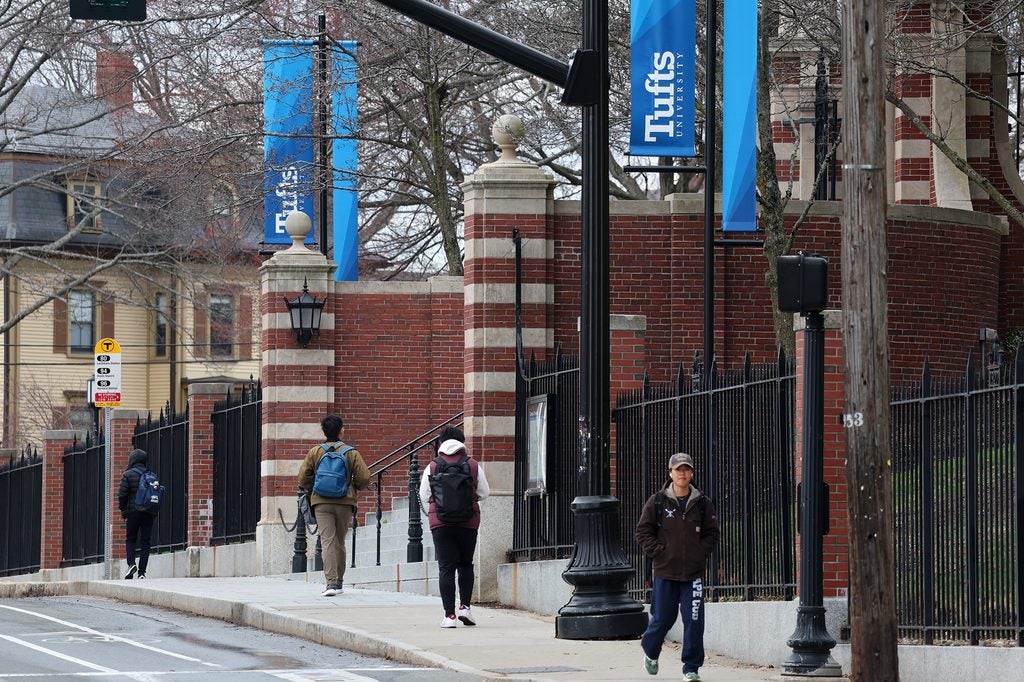
Gavin Federizo, a junior at Tufts studying philosophy, said he is exposed to different perspectives in the classroom, but not in other areas on campus.
“Certainly outside of academic classes, there is a sort of rigor to the virtue signaling that goes on in young America, especially in a liberal arts college,” he said. “It’s a little bit ostracizing to some, that’s personally not my experience … but I can understand that some feel pushed away from the discussion as a whole.”
Federizo said CEVIHE promotes conversation, but in ways that can be “inflammatory.” In its report, Tufts AAUP criticized the center for hosting Rettig Gur, who discussed the Israel-Hamas war, after he called protesters outside the event “pathetic losers who don’t matter.”
“The guest speakers that they bring on are known to be divisive and polarizing,” Federizo said. “A Tufts-sanctioned center platforming people who will be silencing Tufts voices is certainly not nice to see.”
Torcato Zina, a senior studying economics, said Tufts can be “somewhat of a bubble” in terms of liberal views and students generally try to “stay politically correct.”
“If you’re a student who doesn’t like high taxes or wants to spend more money in the military, I don’t think people are going to be too upset about that,” Zina said. “But I think on some of the touchier issues, especially LGBT rights or abortion, I think those are issues where people definitely are a bit more hesitant if they have those opposing viewpoints to speak out on it.”
Samaan, the senior who is working on the center’s curriculum project, said despite being a liberal school, she believes Tufts students are able to effectively engage with different viewpoints in and outside of the classroom.
Although she is “pretty aligned with the rest of Tufts” when it comes to her political beliefs, Samaan said she appreciates the opportunity the center provides to hear different perspectives.
“[Students want] to say, ‘Hey, I know that I live in a little bit of an echo chamber, so let’s challenge these beliefs, let’s see if we can learn from different people,’” she said. “I think it’s been very, very valuable to me to expose myself to different sorts of radical perspectives that I don’t necessarily know if I would have given a lot of uptake to and taken very seriously until my work here.”
Sign up for the Today newsletter
Get everything you need to know to start your day, delivered right to your inbox every morning.
