

Home Improvement
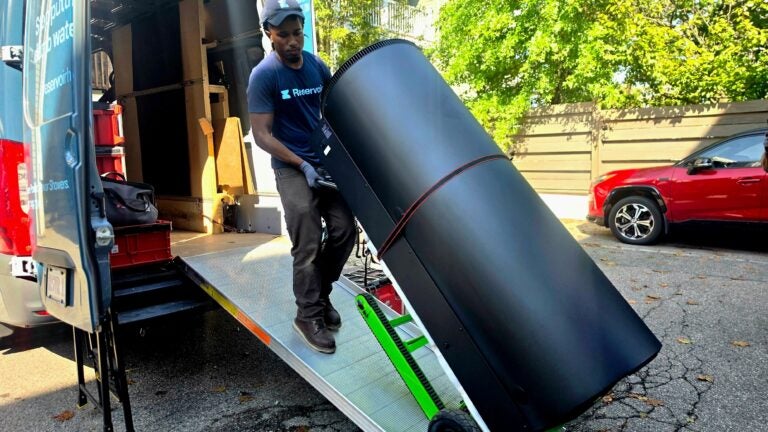
With $8 million in new funding, a Charlestown startup is trying to reinvent one of a home’s biggest energy guzzlers — and persuade skeptical homeowners to curb their emissions.
A few months ago while running our bath, I noticed that the water looked the color of rust.
That didn’t seem good.
I would have liked to ignore it, but my wife implored me to deal with it.
That led to me lugging a long hose from our community garden to drain our gas-fired water heater. Despite my hopes that it would solve the problem, after multiple tries, the water remained copper-colored.
Reluctantly, we decided to replace our 50-gallon A.O. Smith Signature tank, which seemed to fail just after its six-year warranty expired.
The last time we were in the market for a water heater — which accounts for about 18 percent of a typical home’s energy use — I had looked into options for buying an ultra-efficient hybrid water heater, which relies on surrounding air and electricity to heat water. As a reporter who covers the environment, I wanted the more climate-friendly option, but the upfront costs were substantially higher.
So when we had to revisit the issue this summer, I began looking at heat pump water heaters again and found — with utility rebates through Mass Save — they now weren’t much more expensive than those that operate on fossil fuels. After searching the web and seeking quotes, we decided to buy a 65-gallon Rheem ProTerra hybrid heat pump water heater via Mass Save, which promised it would use 70 percent less energy than a standard electric water heater, cut our carbon emissions by more than 2,000 pounds per year, and save us hundreds of dollars annually.
With the $750 rebate — and a well-timed purchase over the state’s sales-tax holiday weekend — the tank cost us $1,279.
But there were other expenses. It was taller than the one we had, which sat on a wooden platform next to our neighbors’ water heaters in our triple-decker’s basement in Jamaica Plain. That meant we needed to hire a carpenter to cut up the platform. The new water heater also required an electrician to run a 240-volt line and circuit breaker from our electrical panel.
Finding contractors took time and effort. Quotes ranged from $1,200 to more than $4,000, and for some of the lower bids, it wasn’t clear they were licensed or would pull the required city permits.
A few days later, while still weighing our installation options, I read about a Boston-based startup called Reservoir that had just raised $8 million to help the company expand sales of a new kind of heat pump water heater. They claimed their water heaters were significantly more efficient in practice than the one I had just bought, with proprietary software that tracks hot water use and predicts when it’s needed. The software is designed to anticipate hot-water demand and reduce unnecessary heating.
There were other advantages, such as an app that allows users to adjust settings remotely; special sensors that monitor water pipes for small leaks or a dripping faucet; and a built-in mixing valve that blends hot and cold water, which company officials say effectively doubles the tank’s capacity to provide hot water. And because their water heaters are connected to the internet, the company is constantly monitoring whether they’re functioning properly.
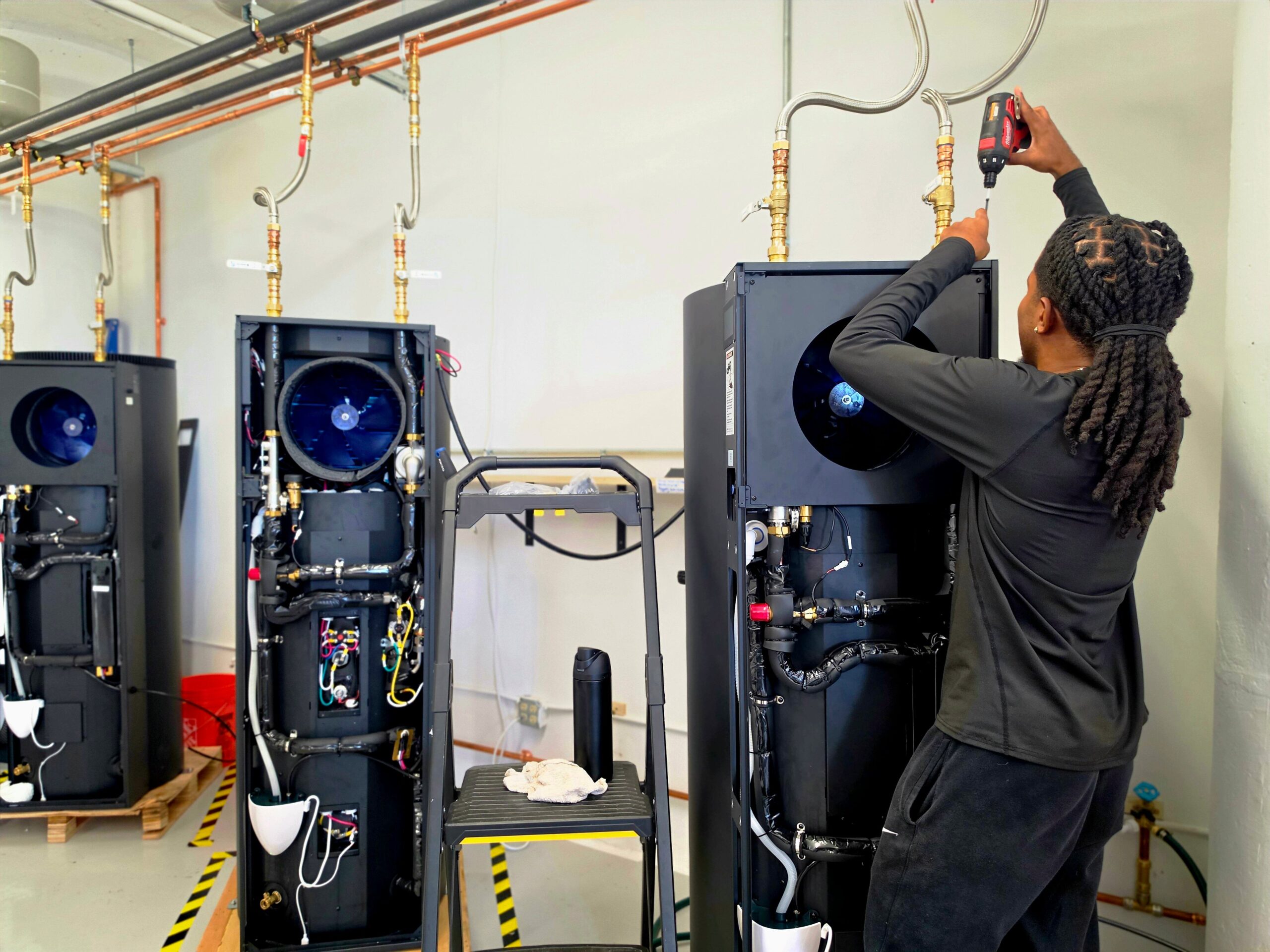
Most compellingly, Reservoir promised to do all the installation and electrical work for one price: $4,450 for their “core” version, or $1,000 more for their “max” version, which promises more hot water for when more people are showering. That price included the Mass Save rebate.
Intrigued, I wrote to the company to ask for an assessment of whether the relatively small utility room where we keep our water heater was large enough. To warm water, heat pumps require sufficient space to extract ambient heat from the surrounding air.
I received a response a half-hour later asking me to share a few photos of our water heater, electrical panel, and utility room. That was enough to provide the go-ahead.
But I had more questions, such as: Did it make sense to choose a startup with little track record for such a critical home appliance, given that so many startups fail after a few years? Would their 10-year warranty have any value if they went out of business? And would their 50-gallon tanks and predictive tech be sufficient to ensure my wife and two kids didn’t hate me if they ran out of hot water?
By the end of the day, I was on the phone with the company’s CEO and cofounder, Luke Winston-Almanzar, who has three degrees from Harvard.
He acknowledged that there was no guarantee the company would be in business long enough to honor its 10-year warranty. But he said they’re growing quickly and have already installed about 100 water heaters since December, most in the Boston area. With their new infusion of cash, and a new office in Potland, Maine, he said Reservoir intends to sell 1,000 water heaters by the end of next year.
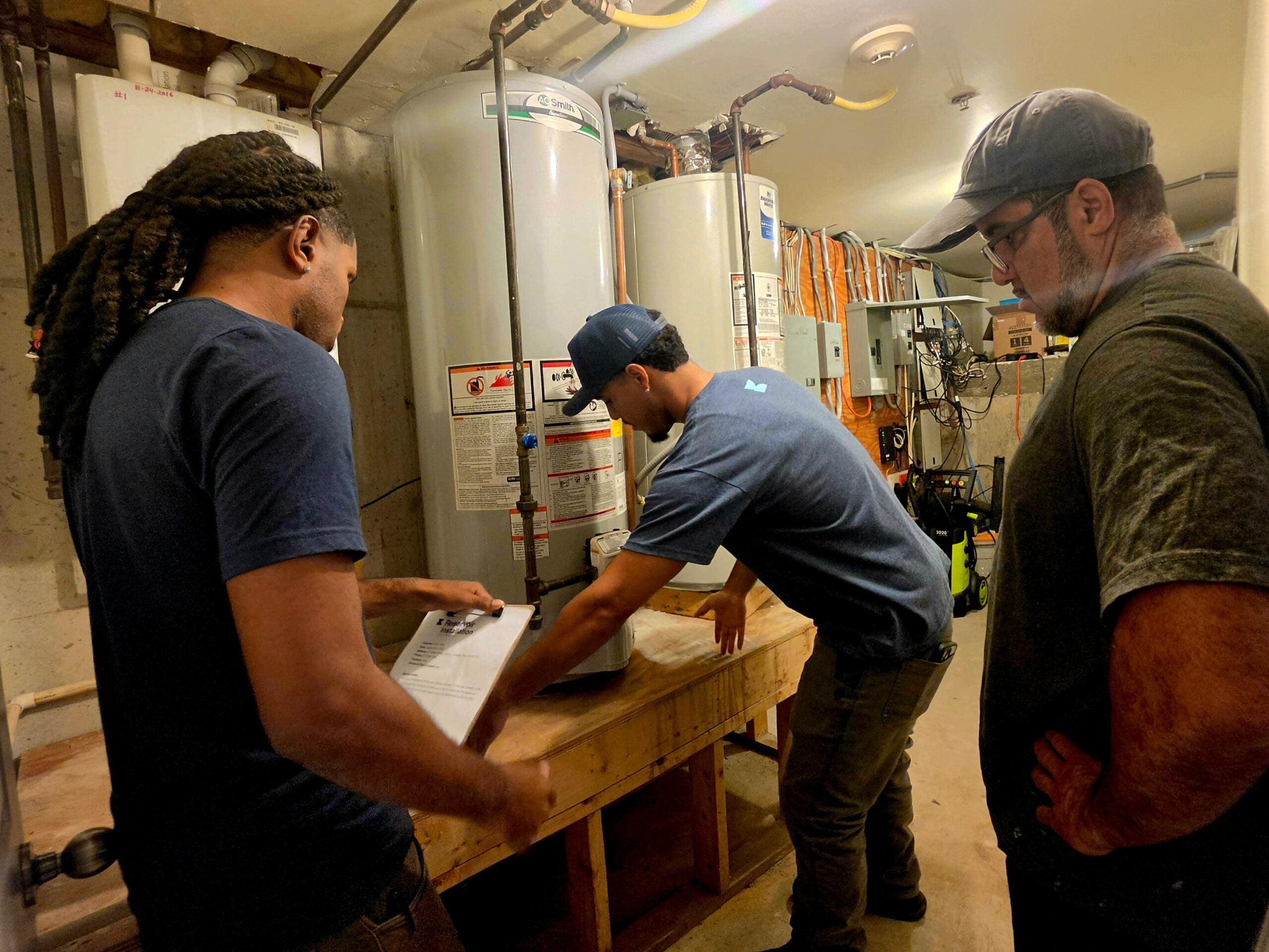
Most of the tank’s components, he added, were standard and could be serviced by any plumber. “That’s not going to guarantee we’re not going to go out of business, but the machine can perform, regardless of if we exist,” he told me.
He added that many other water heaters — such as the A.O. Smith I was replacing — don’t typically last that long. “At the end of the day, if Reservoir fails, and the product fails, you can go get a new water heater,” he said.
To me, those were actually reasonable, if somewhat unsatisfying, responses.
Later, during a tour of their spare offices on the fourth floor of an old brick warehouse in Charlestown, some of Reservoir’s 15 employees were preparing new water heaters for delivery, Winston-Almanzar showed me how their technology has evolved over the past two years.
Eventually, he said he hopes the company will work with utility companies to use their water heaters as thermal batteries, storing energy that can be used on the grid to offset peak demand.
“We’d have to get homeowners’ consent, but we have the capacity to be a virtual power plant,” he said.
Outside experts said that potential is real.
“Smart appliances like Reservoir can make use of real-time information about when electricity is plentiful and being generated by renewables,” said Mike Phillips, CEO of Sense, a Cambridge-based maker of smart home energy monitors and grid-management software.
Michael Rigney, CEO of Cala Systems, a competitor in Wilmington, called heat pump water heaters “the only cost-effective way to electrify water heating.”
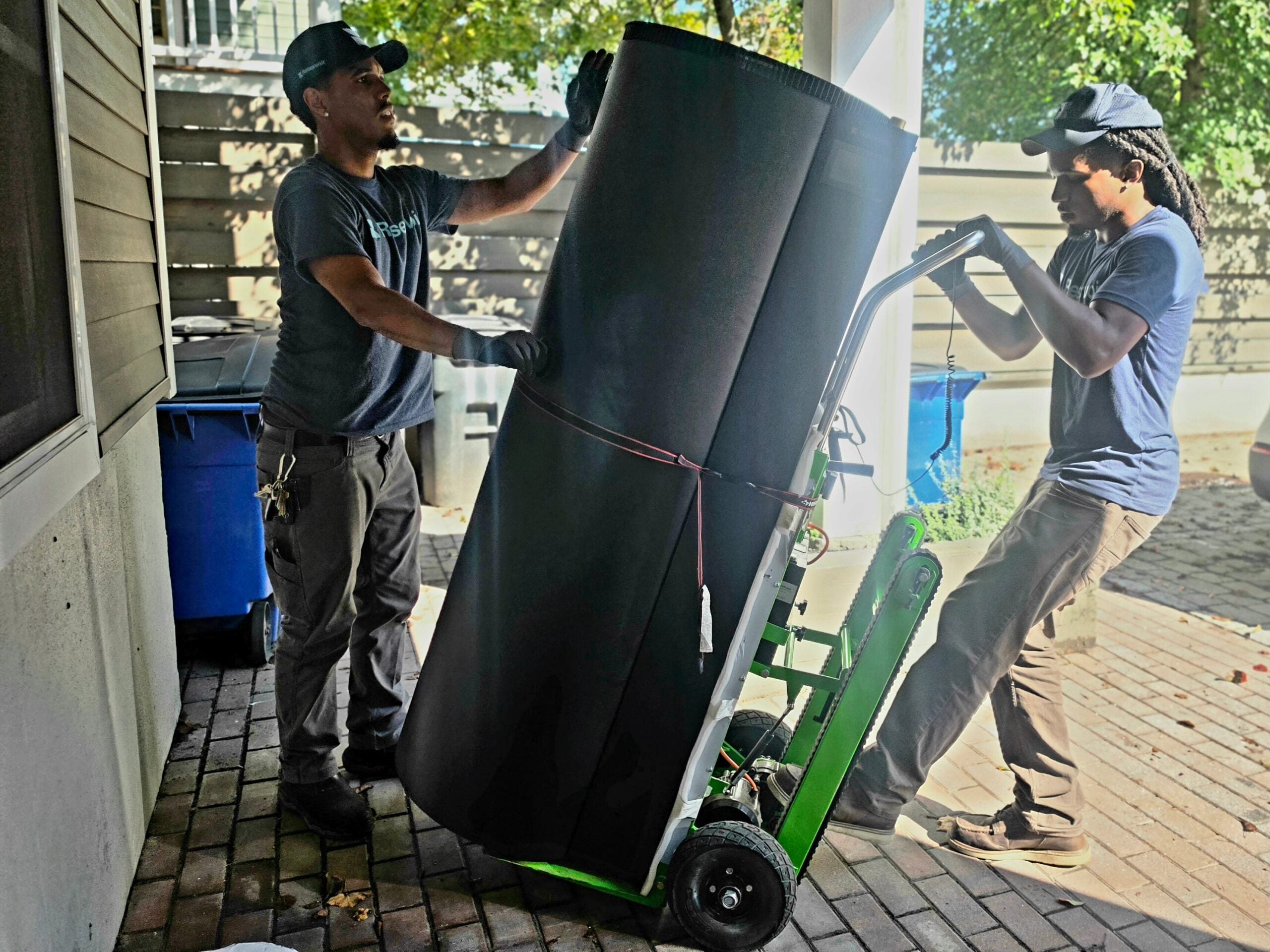
After some negotiating and getting a refund for the Rheem water heater we bought, I signed the agreement, understanding we were taking a risk. Within a few days, Reservoir’s blue van had arrived in our parking lot.
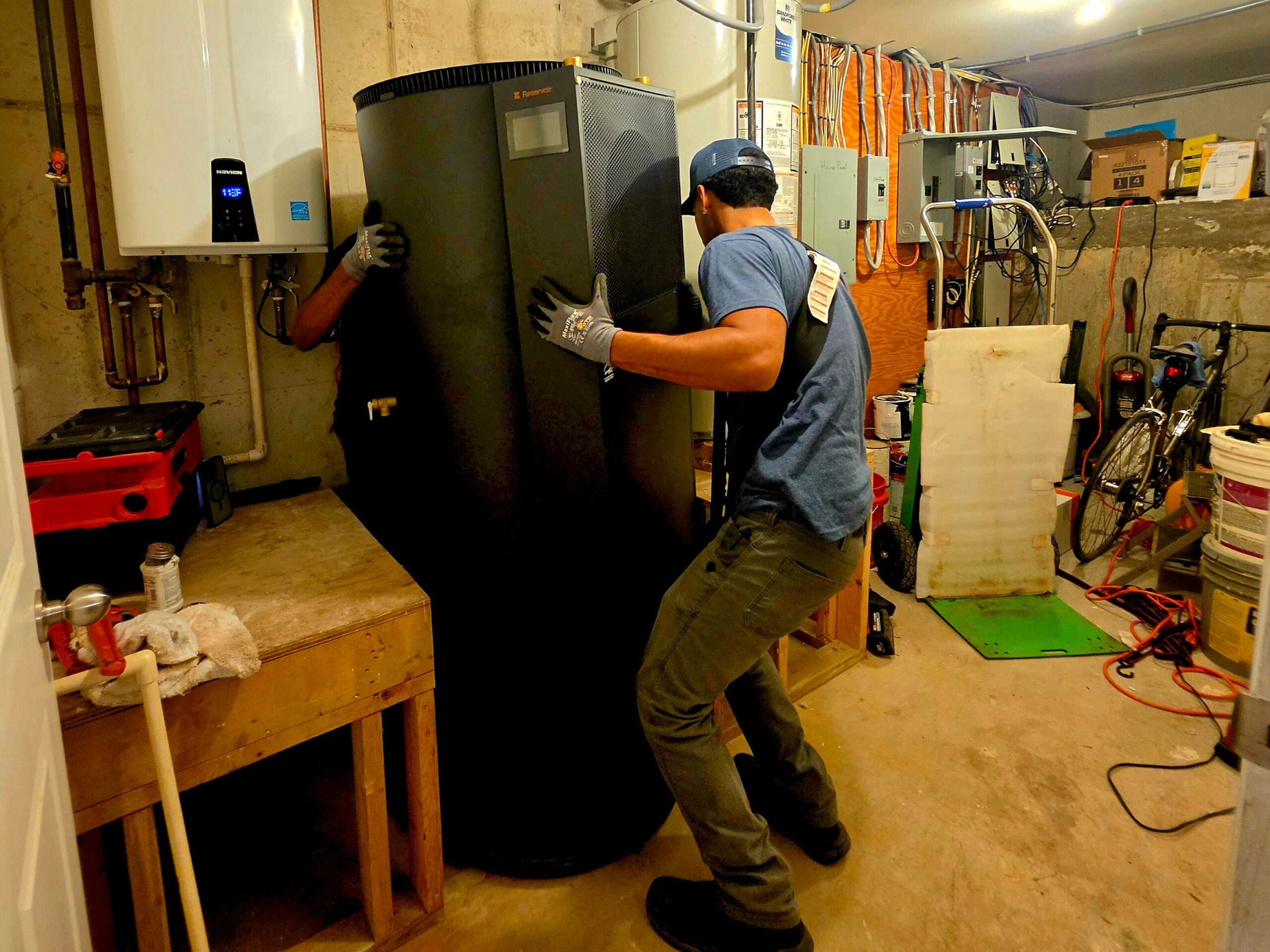
After the electrician installed the circuit breaker and the carpenter trimmed the wooden platform, the plumbers hauled out our old tank and wheeled in Reservoir’s sleek black unit, which at more than 65 inches tall looked to me like the Monolith in the movie “2001: A Space Odyssey.”
A few hours later, their work done, the plumbers showed me how to maintain the water heater, use the app, and play a game on the small screen at the top of the tank. They also provided a Wi-Fi repeater to ensure the internet in our second-floor condo reaches the basement, a critical part of Reservoir’s ability to monitor our water heater’s performance.
Before the crew left, they gave us a gift box, which included a bottle of wine, lavender soap, a rubber duck, and a small insulated black water bottle resembling their water heaters.
Since the installation in late August, the water has run clear, the hot water has held up, and the monitoring system alerted me when the tank briefly went offline. (Reservoir quickly emailed directions how to reconnect it and update the software.) The heat pump has also made our often-muggy basement noticeably cooler.
So has the switch saved us money? Because New England’s electricity rates are among the highest in the country — our Eversource rate is about 34 cents per kilowatt-hour — moving from natural gas to a heat pump hasn’t been a financial windfall.
In our first full billing cycle after disconnecting the old tank, our National Grid gas bill plunged 92 percent compared to the previous October, falling from $45.31 to just $3.70. Meanwhile, our Eversource bill rose to $256 — nearly triple the $86 we paid during the same billing cycle a year ago — driven by a combination of the new water heater and charging our electric cars.
Isolating the water heater’s share of the electricity bill, we’re roughly breaking even now and on track to save perhaps $50 to $150 a year when winter gas rates spike, according to an analysis of our gas and electricity bills by Google’s Gemini. That’s shy of the $200 annual savings Winston-Almanzar had estimated when we first spoke, but it suggests we’re likely to cut our home’s carbon emissions without paying a financial penalty.
Better yet, no one in my family so far has complained about running out of hot water — even when both showers are going or my 10-year-old son lingers in the shower.
For now, I’m just hoping we can forget about water heaters for another decade or so.
David Abel spent years covering the environment for the Globe. He’s now a journalism professor at BU.
Address Newsletter
Our weekly digest on buying, selling, and design, with expert advice and insider neighborhood knowledge.
