

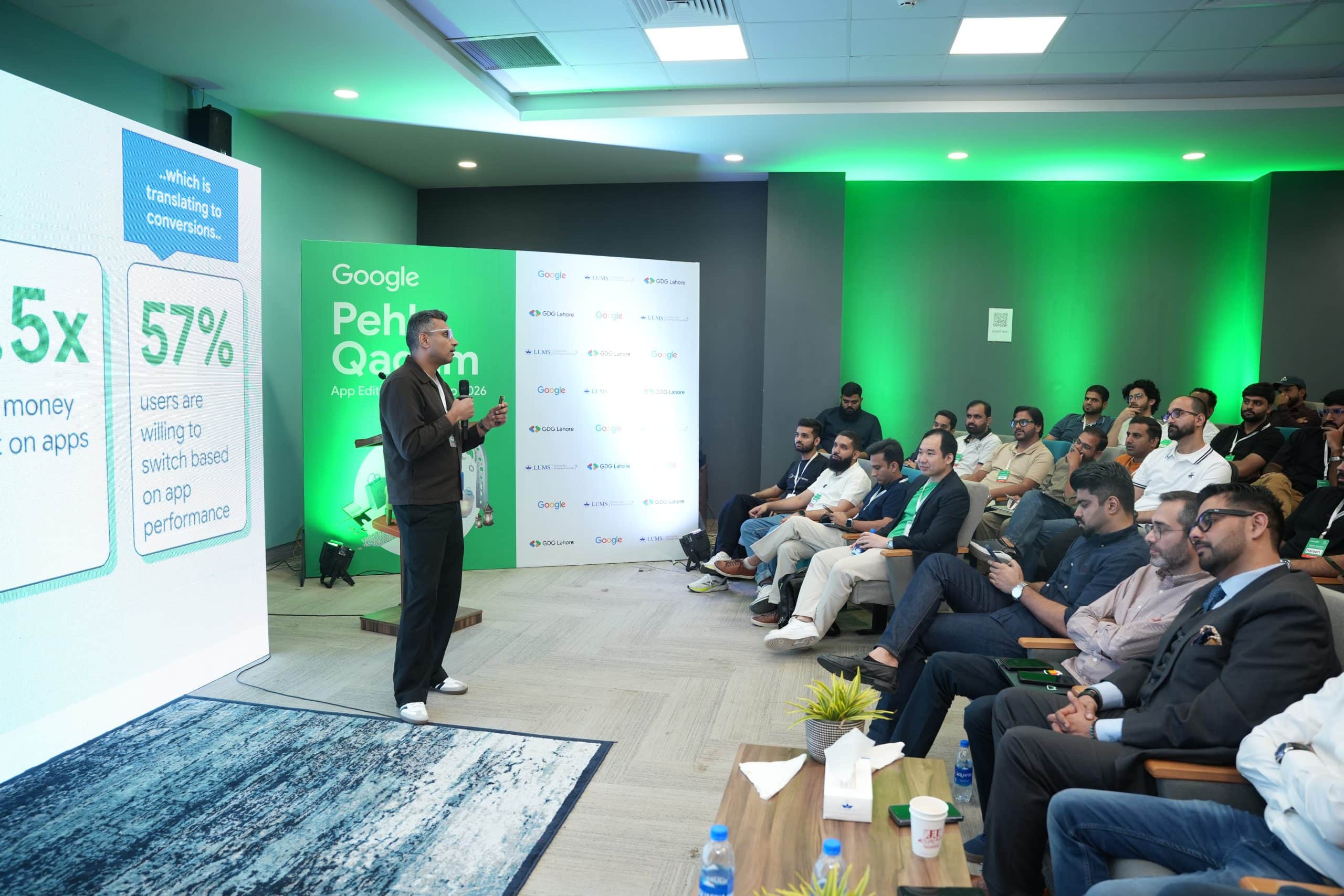
LAHORE – Pakistan’s growing reputation as emerging Tech powerhouse gets boost as Google brought its industry experts to Lahore University of Management Sciences (LUMS) amid the country’s potential to develop globally successful mobile applications and compete in multibillion-dollar digital economy.
Organised by Google Developers Group (GDG) Lahore at the LUMS Centre for Entrepreneurship (LCE), Pehla Qadam brought together Google’s industry specialists, university students, emerging developers and technology enthusiasts to explore how Pakistan can transform local innovation into internationally successful digital businesses.
The initiative comes amid growing engagement between Google and Pakistan’s technology ecosystem, following the opening of the company’s first office in Karachi.
LUMS Provost Dr. Tariq Jadoon welcomed the Google delegation and congratulated the technology company on establishing its first office in Pakistan, describing an important development in the country’s expanding relationship with the global technology industry. Former Google Country Consultant and LUMS faculty member Badar Khushnood facilitated GDG Lahore’s efforts to bring the event to the university.
The visiting delegation was led by Emre Dogan, Farhan Qureshi and Fasieh Mehta, alongside specialists who shared practical insights into application development, digital advertising, monetisation, artificial intelligence and international market expansion. The discussions reinforced a powerful message: Pakistan has the talent to create digital products capable of reaching millions of users worldwide.
The enormous scale of the global app industry was among the biggest highlights of the event. According to Sensor Tower statistics presented during the bootcamp, worldwide consumer spending on in-app purchases reached an impressive $167 billion in 2025, reflecting annual growth of 10.6 percent. Meanwhile, approximately 149 billion applications were downloaded globally, with users spending a staggering 5.3 trillion hours on mobile apps.
These figures show tremendous commercial opportunities available to Pakistani developers, startups and technology companies seeking to establish a stronger presence in international markets. With the right combination of innovation, technical expertise and business strategies, Pakistani developers could capture a greater share of this expanding digital economy.
One of the most encouraging examples presented at the bootcamp was the international success of Pakistani game development company Game District. Its mobile title, My Supermarket Simulator, recorded more than 60 million year-to-date downloads, demonstrating that applications developed in Pakistan can attract massive audiences beyond national borders.
The success story highlighted the country’s ability to produce competitive digital products while showcasing the commercial potential of its gaming and software development industries.
Other Pakistani studios were also recognised for reaching international audiences, reflecting the growing global footprint of the country’s technology sector.
Rather than focusing exclusively on technical development, the bootcamp provided participants with a broader understanding of what it takes to build a successful digital enterprise. Google experts delivered sessions on identifying market demand, attracting users, generating advertising revenue, improving customer retention and distributing applications through Google Play.
The discussions encouraged young developers to look beyond conventional career paths and explore entrepreneurship, product development and international business opportunities.
For students preparing to enter the professional world, the event offered a practical perspective on how a university project or startup idea could evolve into a profitable global application.
The event also sheds light at transformative potential of artificial intelligence in software development. During a dedicated session on Google Antigravity, participants explored how AI-powered tools can simplify coding workflows, accelerate application development and improve software testing.
The technology could be particularly valuable for young Pakistani entrepreneurs and smaller development teams seeking to build competitive products with limited resources. By adopting advanced AI tools, emerging developers could potentially reduce development time, improve efficiency and bring innovative products to international markets more quickly.
LUMS event is part of a wider series of technology-focused engagements planned by Google’s visiting delegation across Pakistan. The upcoming activities include Think Apps, Google’s flagship event dedicated to the mobile app ecosystem, bringing further attention to the opportunities available in software development and digital entrepreneurship.
The company is also preparing for Pakistan’s first-ever YouTube Festival, which will celebrate the country’s expanding content creation industry and the growing influence of Pakistani digital creators. These initiatives show increasing opportunities for collaboration between Pakistan’s technology community and international industry leaders.
With global digital platforms, increasingly accessible AI tools and a growing pool of skilled developers, Pakistani entrepreneurs have new opportunities to transform creative ideas into products serving international audiences.
Google-Pakistan Deal brings Free AI Access, Big Career Certificates for Youth
