

World News
“It’s a great result for Canada that Albertans have chosen unity,” Prime Minister Mark Carney told reporters Tuesday before a Cabinet meeting in Ottawa.
EDMONTON, Alberta (AP) — Voters in Canada’s oil-rich Alberta province overwhelmingly backed remaining in the country, referendum results showed Tuesday, delivering a boost to Prime Minister Mark Carney’s push for national unity as U.S. President Donald Trump’s trade war and annexation threats rally Canadians around their country.
With more than 1.9 million votes counted and results reported from 90% of voting areas and locations, 75% of voters supported remaining in Canada, while 25% backed beginning a process toward separation, according to unofficial results from Elections Alberta.
The referendum was not a direct vote on independence. Approval would have set Alberta on a path toward a future vote on separation from Canada.
“It’s a great result for Canada that Albertans have chosen unity,” Carney told reporters Tuesday before a Cabinet meeting in Ottawa.
Carney said the roughly one-quarter of voters who backed beginning the separation process did not necessarily want independence, suggesting only a smaller “hard core” favored leaving Canada. Some voters said they wanted to send Ottawa a message rather than separate.
Separatists confront defeat, Smith rules out another vote
Alberta separatist organizer David Parker acknowledged the scale of the defeat.
“Independence feels far away and we should not pretend this was not a defeat,” he wrote on social media.
In a televised address Tuesday night, Alberta Premier Danielle Smith welcomed the result and pledged not to hold another referendum on separation while she remains in office.
“Yesterday, Albertans voted overwhelmingly in favor of remaining a province of Canada,” Smith said. “The voter turnout was historic and a powerful testimony of the passion Albertans feel for our country and our province.”
Smith said Alberta would continue pressing Ottawa for greater provincial autonomy, but disputes would be settled within Canada’s political and legal institutions rather than through separation.
Carney said he spoke with Smith on Tuesday morning about the results and greater federal-provincial cooperation, including immigration.
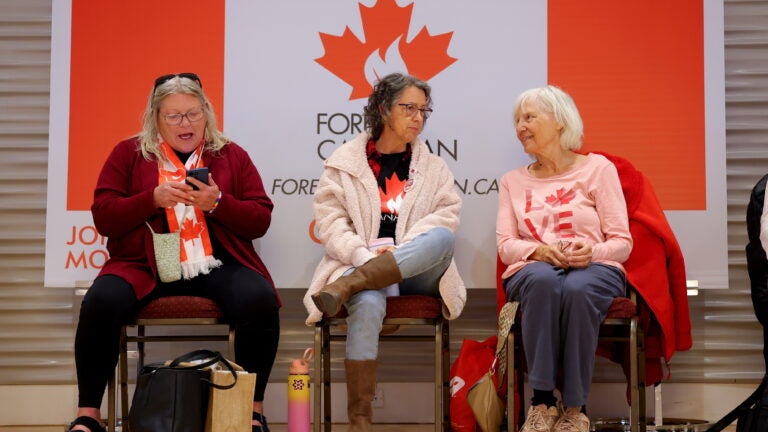
“Don’t mess with Canada. President Trump is watching this,” Thomas Lukaszuk, a former Alberta deputy premier who led the Forever Canadian campaign against separation, told supporters.
A fringe cause has become a movement that won’t disappear
Alberta, home to the world’s fourth-largest proven oil reserves, is cowboy country and a conservative stronghold whose political culture has long had more in common with the American West than much of Canada. Resentment toward Canada’s federal government in Ottawa runs deep, but hasn’t traditionally translated into widespread support for independence.
Despite the overwhelming rejection, separatist leaders vowed to continue pressing for independence.
Separatist parties traditionally attracted only 1% or 2% of the vote, former Premier Jason Kenney said. Anger over COVID-19 restrictions helped mobilize activists who later embraced the separatist movement, he said.
Trump’s trade war and threats to make Canada the 51st U.S. state have helped Carney rally support in Alberta, where Liberal prime ministers have historically been unpopular.
At a separatist referendum night gathering at an Edmonton restaurant, the crowd fell quiet as results rolled in.
“We’re not going anywhere,” said Jeff Rath of the Alberta Prosperity Project. “We’ve dominated the conversation in the last year. We’ve been educating Albertans on the benefits of independence, and we’re going to continue moving forward.”
Rath said before the vote that he would be thrilled with 30% support. He also said he wanted Smith ousted as UCP leader and believed the party could splinter, potentially creating a new pro-independence party.
Ian Brodie, a University of Calgary political scientist and former chief of staff to Conservative Prime Minister Stephen Harper, dismissed Rath and fellow separatist organizer Mitch Sylvestre as “nobodies,” saying they failed to gain traction even in a district that elected a separatist to Alberta’s legislature in 1982.
“Even on a very soft question — whether to hold a referendum on separation — they couldn’t gain real traction,” Brodie said.
A referendum on a referendum
Edmonton voter Shawn Campbell said he voted to begin the separation process even though he doesn’t want Alberta to leave Canada.
“It sends a message to Ottawa that Albertans are not happy,” he said.
Dave Malka, 59, of Edmonton, criticized spending money on a “referendum on a referendum” rather than healthcare.
With Trump threatening Canada, Malka said, “It seems to be happening at the absolute worst time when we should be united. Instead we’re fighting among ourselves.”
Edmonton resident Ali Khowaja, who immigrated to Canada six years ago, welcomed the result, saying he was glad Alberta had chosen unity rather than experiencing a Brexit-style rupture.
“Over the years, you’ve seen the consequences and what that meant,” he said. “I was concerned, especially as someone who is an immigrant to Canada.”
Ty ONeil contributed to this report from Wainwright, Alberta.
Sign up for the Today newsletter
Get everything you need to know to start your day, delivered right to your inbox every morning.
