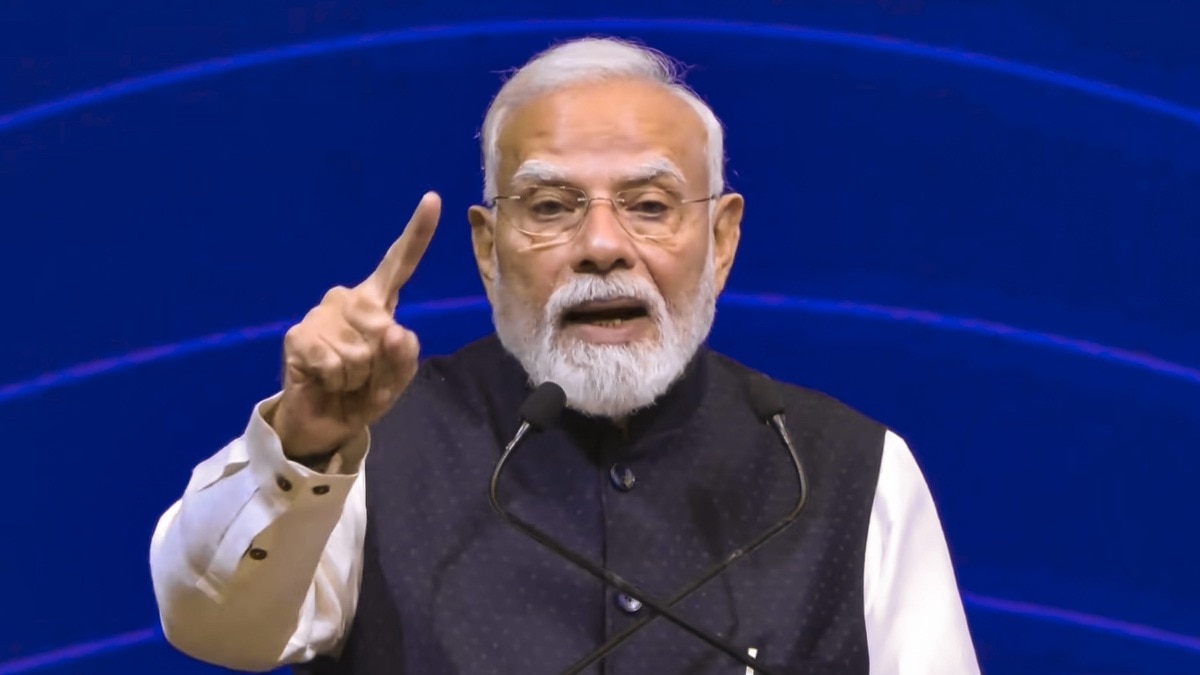
Prime Minister Narendra Modi on Thursday hailed freedom fighter Subhas Chandra Bose for writing his civil services exam in Sanskrit in 1920, when the British were in power.
Modi was attending the centenary celebrations of the Union Public Service Commission (UPSC) here at Bharat Mandapam.
In his address, the prime minister called the event a celebration of aspirations of millions of young people.
“It is a celebration of the trust that every Indian places in this institution. During this century-long journey, generations changed, governments changed, technology changed, and syllabi changed, yet the trust in the UPSC remains just as unwavering today, and that is one of your greatest assets,” Modi said.
He also asked everyone to go through the gallery set up at the venue.
“While viewing the gallery, I saw the details regarding the time – back in 1920 – when Subhas Chandra Bose also went through this very process. It struck me that although the British were in power at the time, there used to be a Sanskrit paper, and Subhas Babu wrote his exam in Sanskrit,” the prime minister said.
Contrasting the institution’s British Raj origins with its post-Independence evolution, he said that the system successfully shifted its focus to fulfil the dreams of a free nation.
Modi said that while the UPSC discharged its historical duties, the focus must now pivot toward the next 25 years.
The prime minister paid his homage to Sardar Vallabhbhai Patel (the first home minister of Independent India) for giving the newly formed nation a solid structure for governance.
He praised Sardar Patel for transforming and empowering the institution into a premier pillar of Independent India.
“The steel frame that was needed for the reconstruction of the nation was provided by Sardar Patel,” Modi said.
April 21 is celebrated as Civil Services Day every year.
The day commemorates Patel’s 1947 address at Metcalf House, Delhi, to civil services officers on probation, whom he called the “steel frame of India.”
Civil Servants for the East India Company used to be nominated by company directors and trained at Haileybury College in London before they would be sent to India, according to the UPSC documents.
Following Lord Macaulay’s report of the Select Committee of the British Parliament, the concept of a merit-based modern civil service in India was introduced in 1854. For this purpose, a Civil Service Commission was set up in 1854 in London, and competitive examinations were started in 1855.
UPSC’s institutional journey began with the formation of India’s first Public Service Commission on October 1, 1926. It became the Federal Public Service Commission on April 1, 1937.
After the Constitution of India came into effect on January 26, 1950, the Federal Public Service Commission became the Union Public Service Commission.
– Ends