

Local News
Attorney General Andrea Campbell is calling for an end to statute of limitations for civil child sex abuse claims.
A new report found 944 children suffered sexual abuse at the hands of 275 Catholic clergy within the Worcester, Springfield, and Fall River dioceses, Attorney General Andrea Campbell announced Wednesday.
The investigation is the commonwealth’s first look into the dark, and often hidden, history of the three dioceses. The AG’s office previously released a report into the Archdiocese of Boston — the only other diocese in Massachusetts — in July 2003.
The new 203-page report details the three dioceses’ repeated failure to respond to allegations of abuse, a culture of cover-ups, and the impact on survivors across more than 70 years.
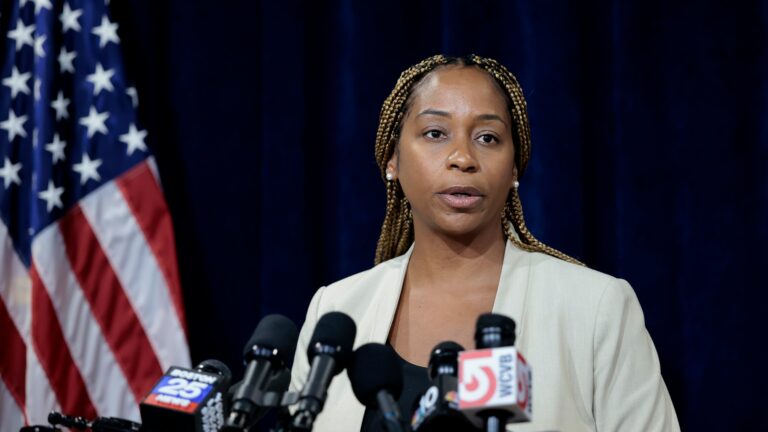
“Behind every one of those numbers is a child whose safety was violated, a family that was changed forever, and a survivor who carried the trauma of that abuse for years and, in many cases, decades,” Campbell said at a press conference Wednesday. “They continue to carry this trauma even today.”
The report shared stories of a priest taking semi-nude photographs of a boy in a pool locker room; a boy confiding abuse to a separate priest in a confessional, only for that priest to start abusing him; and a priest simply closing the door after walking in on another priest raping a child.
Several survivors shared statements in the report about the physical and mental impact the abuse had on their lives, from a lack of trust and anger issues to addiction and suicidal ideation.
“[The priest] destroyed my understanding of and trust in a God who loved and protected me. I was plunged into a darkness I could never have imagined,” one survivor shared.
“You call yourselves representatives of God – God has no place in anything you stand for,” another wrote.
The majority of the known abuse and misconduct predates 2002, when the Boston Globe’s Spotlight reporting on child sex abuse led to reforms in the Legislature and the Catholic Church, the report says.
Response from the dioceses
Each diocese in the report had around 90 clergy members accused of child sex abuse, according to data in the report. However, there is a large discrepancy in the number of survivors at each diocese.
The report found 216 survivors in the Diocese of Worcester and 259 survivors in the Diocese of Springfield. The Diocese of Fall River had the largest number of survivors with 469, according to the report.
But, the number of survivors and perpetrators may be even greater, Campbell said, citing missing records and survivors who may not feel comfortable coming forward.
Bishop Edgar M. da Cunha of the Diocese of Fall River wrote in a statement that he was “filled with sorrow” at the historical accounts of abuse in the report.
“To all survivors of child sexual abuse, I am deeply sorry. We as a Church failed you when you were most vulnerable,” da Cunha wrote in the statement. “As a Diocese we are firmly resolved to continue to do all we can to help you heal, to make certain we are accountable, and to protect our children so that no other child suffers as you have.”
Bishop William D. Byrne, of the Diocese of Springfield, wrote in a statement that the report is a “humbling reminder” of the diocese’s need for continued vigilance to protect children.
Byrne added the diocese has taken strides, but he welcomes the suggestions Campbell made in the report.
“As a bishop and as an uncle, it is heartbreaking and reprehensible to think that any child would ever be harmed by someone who is supposed to protect them,” Byrne wrote. “Our commitment to transparency, healing and the protection of children must remain the top priority.”
Campbell singled out the Diocese of Worcester for failing to publicize a list of credibly accused clergy — a feature of the dioceses in Springfield, Fall River, and Boston.
Diocese of Worcester spokesperson Ray Delisle responded to Campbell’s call by pointing to previous diocese statements that there is “no other precedent for the publishing of lists of the accused in society.”
“Such lists can be a cause for deep division among many members of our Church who see this as publicly branding as guilty those who never have been charged by law enforcement or had a chance to defend themselves in a court of law, given the fact that many decades have passed between the alleged abuse and the reporting of that abuse, or because they were already deceased when the allegation was first received,” according to a March report from the diocese.
The Diocese of Worcester published its own investigation into child sex abuse in 2004 and 2002, with an update in 2026. Delisle said the diocese welcomes the AG’s report.
“We will study the AG’s report to identify any additional improvements that can be made to respond to victims of past abuse and to continue to strengthen efforts to keep children safe,” Delisle wrote to Boston.com.
Calls for change
The commonwealth’s dive into the three dioceses began as a criminal investigation when then-Attorney General Maura Healey launched it in 2019. However, Campbell announced, no new indictments arose from the investigation.
Three cases were referred to the local district attorneys in Worcester, Hampden, and Bristol counties. Only the case in Worcester County resulted in charges, as the other two offices declined to pursue the cases, Campbell said.
Some of the conduct uncovered in the investigation was not a crime in Mass. when it occurred, Campbell said. In other cases, the statute of limitations ran out or the survivors have since died.
Campbell called on the Legislature to eliminate the statute of limitations for civil child sex abuse cases.
A survivor of sex abuse as a minor can sue within 35 of years of the abuse, or within seven years of when the victim knew the abuse caused harm, according to Massachusetts statutes. The time limit for filing the suit begins when the survivor turns 18, meaning the limit is age 53.
Bills ending this statute of limitations that have been introduced on Beacon Hill have stalled. Rep. John J. Lawn, Jr. most recently introduced another such bill in the House.
More than a dozen states have no statute of limitations on child sexual abuse, including neighboring Maine, New Hampshire, and Vermont, according to Sokolove Law.
Attorney Mitchell Garabedian, who often represents survivors of clerical child sex abuse, wrote in a statement that the time to amend this law is “here and now.”
“In doing so, many survivors will have the opportunity to seek justice, have a voice, and obtain validation,” Garabedian wrote.
Campbell also called on the legislature to eliminate the $20,000 liability cap for charitable organizations. Bills addressing this, too, have stalled.
Campbell, who disclosed that she herself is a survivor of child sex abuse, said the way the commonwealth responds is an opportunity to lead “in such a way that no child will ever be abused ever again.”
“If we care about the report, the findings, and the survivors, it is our responsibility as leaders who hold the power,” Campbell said at the press conference.

Sign up for the Today newsletter
Get everything you need to know to start your day, delivered right to your inbox every morning.
