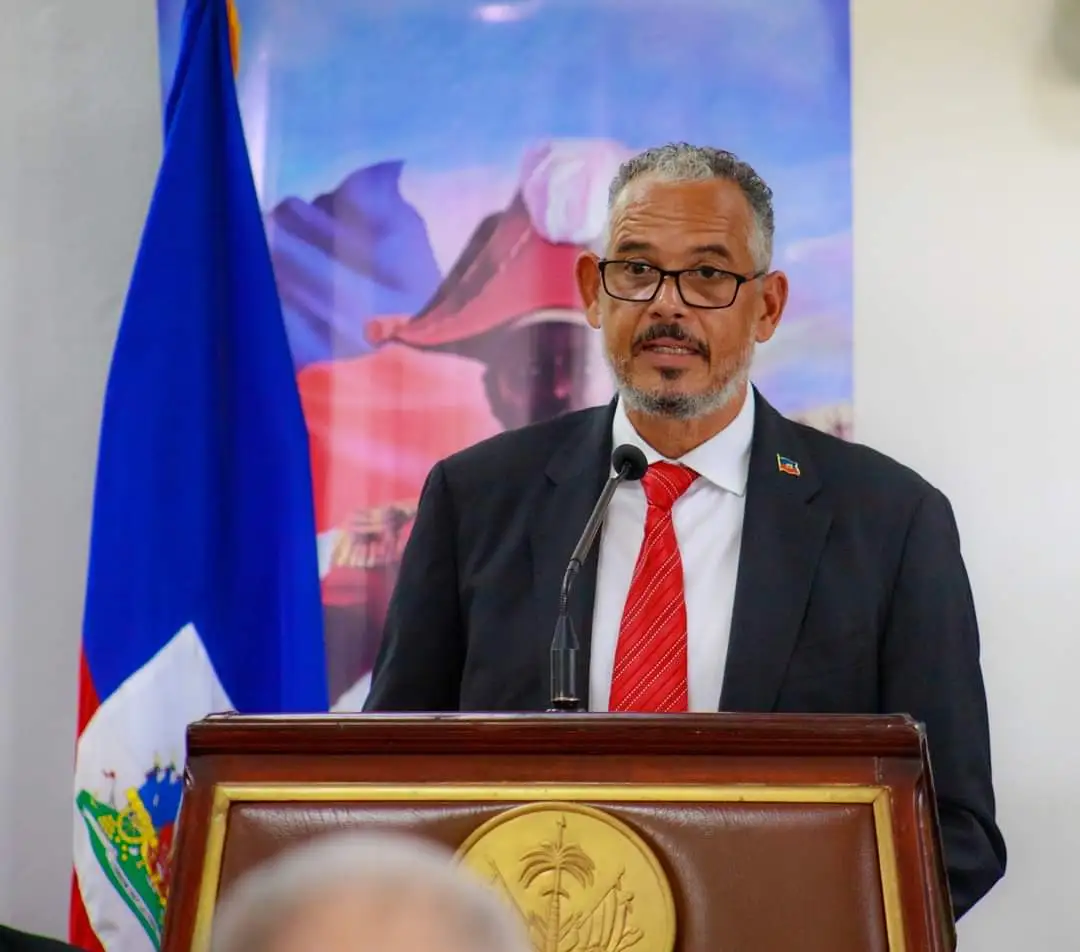
Haiti’s Prime Minister Alix Didier Fils-Aimé brought the country’s security crisis, elections and future before world leaders at the United Nations, declaring that Haiti is at a “watershed moment” and needs stronger international support while rebuilding its own institutions.
Fils-Aimé delivered the address on Friday, September 25, during the 81st session of the United Nations General Assembly in New York. His speech focused heavily on security, the return to elected government and Haiti’s need to move away from long-term dependence on international aid.
“Haiti will resist. Haiti is standing tall,” Fils-Aimé told the General Assembly. He said Haiti is not asking the international community to determine its future, but needs partners to stand alongside the country as it works to regain control of its security and institutions.
Security Remains at the Center of Haiti’s Crisis
Armed groups continue to control large parts of Port-au-Prince and important transportation routes. Nearly 1.5 million people have been displaced, while about 6.4 million Haitians require humanitarian assistance, according to the United Nations.
Fils-Aimé said Haiti is working to strengthen its own security forces. According to his address, more than 2,000 police officers have already been trained through the P4000 program, with another class expected to graduate from the police academy in November. He also said more than 1,500 new soldiers have been trained and that the government is developing a program to train 15,000 additional soldiers over the next three years.
But he said Haiti still needs international security assistance while those national forces are strengthened.
The prime minister called for the full deployment of the international Gang Suppression Force, saying the mission has not yet reached its planned strength of 5,500 personnel.
“A mandate is not enough,” Fils-Aimé said, arguing that the mission also needs personnel, equipment and resources to carry out its work.
Fils-Aimé Says Haiti’s Transition Must End Through Elections
The prime minister also addressed Haiti’s long-delayed return to elected government.
He told world leaders that improving security must go hand in hand with holding “free, credible, inclusive and honest elections.” He said voter enrollment centers are open, political parties and groups have been accredited, and potential candidates are completing the required formalities.
Haiti has been without nationally elected leadership for years, making the upcoming electoral process an important part of the country’s effort to restore functioning democratic institutions.
Fils-Aimé has also said Haitians are waiting to regain enough security to return to their homes, work, send their children to school and once again choose their leaders.
Haiti Calls for Action Against Illegal Weapons
Another major part of Fils-Aimé’s speech focused on the flow of illegal weapons and ammunition into Haiti.
He told the General Assembly that the weapons being used to terrorize Haitian communities are not manufactured in Haiti but are arriving through transnational criminal networks.
Fils-Aimé argued that addressing weapons trafficking must be part of the international response because those networks continue to strengthen armed groups and contribute to instability in Haiti and the wider region.
From International Aid to Investment
Beyond security, Fils-Aimé called for a different economic relationship between Haiti and its international partners.
“We need to move from aid to investment, from assistance to production, from dependency to partnership,” he said.
The prime minister argued that creating jobs and expanding economic opportunities, particularly for young people and women, will also be necessary if Haiti is to achieve lasting stability.
‘The Challenges Are Colossal’
Fils-Aimé ended his address by connecting Haiti’s present crisis to the country’s history and its struggle for freedom.
Referring to Toussaint Louverture and the “tree of liberty,” the prime minister said Haiti’s current generation now carries the responsibility of turning that freedom into lasting peace.
“The challenges are colossal, but our willpower is even greater,” he told the General Assembly.
His overall message was that Haiti continues to need international support as it confronts armed groups and prepares for elections, but that the country’s long-term security, government and economic future must ultimately rest on stronger Haitian institutions.